#Recycling / Circular Economy
New skills for a circular textile economy
From extended producer responsibility to textile recycling
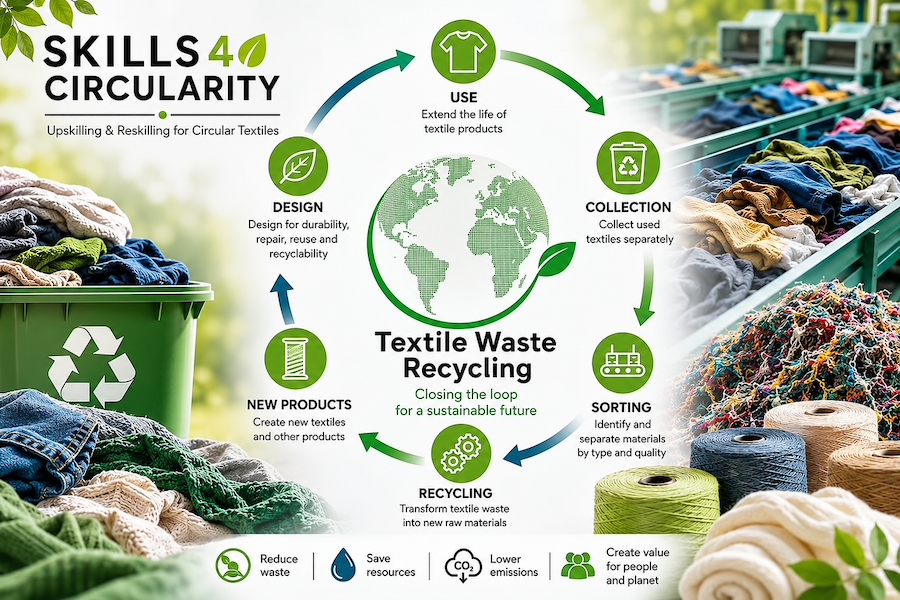
Growing volumes of textile waste, limited natural resources and new regulatory requirements are accelerating the transition towards a circular economy. Regulatory frameworks, collection and sorting systems, and advanced recycling technologies are closely interconnected and form the foundation of future circular textile systems.
The European Green Deal and the Circular Economy Action Plan provide the policy framework. Their objective is to keep products and resources in circulation for as long as possible while reducing the consumption of virgin raw materials.
The European Waste Framework Directive and Extended Producer Responsibility
The European Waste Framework Directive plays a central role by establishing the legal framework for waste prevention, recycling and resource conservation. Its current revision introduces binding requirements for clothing, textiles and footwear while strengthening the European strategy for sustainable and circular textiles.
A key element of the new legislation is Extended Producer Responsibility (EPR). In the future, manufacturers will also assume responsibility for their products after the end of their useful life. Producer Responsibility Organisations (PROs)support companies in meeting these obligations. EPR fees finance collection, sorting, reuse and recycling and are intended to become increasingly harmonised across Europe.
These regulatory measures respond to continuously growing material flows. According to Textile Exchange's Materials Market Report 2025, global fibre production could increase to around 169 million tonnes by 2030 if current trends continue. At the same time, approximately 92 million tonnes of textile waste are generated every year. This highlights the need to return end-of-life textiles to the textile value chain at the highest possible value.
Collection and sorting as the key to recycling
Successful collection depends not only on consumer participation but also on the accessibility and attractiveness of collection systems. Collected textiles must first be identified, classified and prepared for recycling. This includes removing non-textile components, separating damaged materials, dismantling individual components, cleaning and contamination control. Many of these processes are still only partially automated.
Sorting is the decisive factor in selecting the appropriate recycling pathway. Alongside manual sorting, automated technologies supported by RFID, sensor-based systems and artificial intelligence are becoming increasingly important. These technologies improve material identification and enable textiles to be assigned more accurately to the most suitable recycling process. Nevertheless, experienced personnel remain indispensable, particularly when handling complex fibre blends.
Selecting the appropriate recycling technology
Depending on fibre composition and origin, mechanical, chemical or thermal recycling technologies are applied. Production waste is generally more homogeneous and therefore easier to recycle than post-consumer textiles, which often consist of complex fibre blends and various contaminants.
The properties of recycled fibres vary according to the recycling process. Mechanical recycling generally shortens fibre length, whereas chemical recycling can produce fibres with properties comparable to virgin fibres. Spinning and downstream processing therefore need to be adapted to the specific characteristics of the recycled material.
Conclusion
The initial content developed for the Recycling Technologies module within the Skills4Circularity project demonstrates that textile recycling extends far beyond the recovery of fibres alone. High-quality circular textile systems can only be achieved through the interaction of European legislation, Extended Producer Responsibility, efficient collection and sorting systems, and recycling technologies tailored to specific material streams.
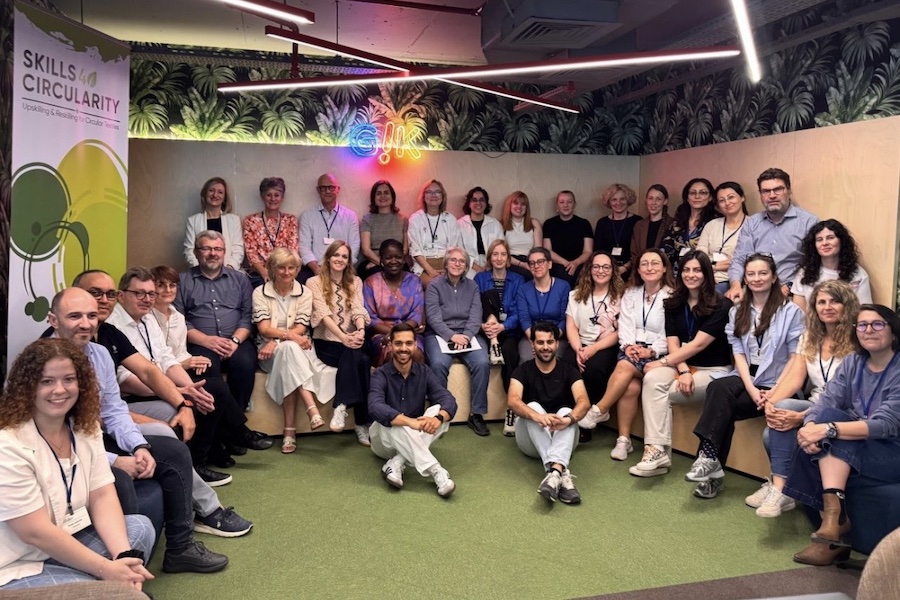
The module content was developed by the project partners Gheorghe Asachi Technical University of Iași (Romania), the Faculty of Textile Engineering at the Technical University of Liberec (Czech Republic), the University of Borås(Sweden) and INTEXTER at the Universitat Politècnica de Catalunya (Spain). It provides a systematic understanding of the relationships across the textile circular economy.
The transformation of the textile industry is therefore as much about policy and organisation as it is about technology.
www.ivgt.de | www.skills4circularity.com
https://www.unep.org/news-and-stories/press-release/unsustainable-fashion-and-textiles-focus-international-day-zero
https://textileexchange.org/knowledge-center/reports/materials-market-report-2025/