[pageLogInLogOut]

#Raw Materials

Partnership for sustainable textiles recognizes U.S. Cotton Trust protocol as a standard for sustainable cotton

The U.S. Cotton Trust Protocol has been approved as a standard for sustainable cotton by Siegelklarheit, an initiative of the German Federal Government. By helping consumers to better understand environmental and social labels, Siegelklarheit wants to contribute to more sustainable purchasing decisions. U.S. Cotton Trust Protocol successfully passed Siegelklarheit´s assessment system. As a result, members of the Partnership for Sustainable Textiles (PST) can use the Trust Protocol as another standard to calculate their share of sustainable cotton.

The Partnership for Sustainable Textiles was founded in October 2014, with the mission to improve social and ecological conditions within global textile supply chains. The Textiles Partnership orientates its work on the OECD Due Diligence Guidance and on international agreements and guidelines that define the principles of social, environmental, and economic sustainability and the framework for corporate responsibility.
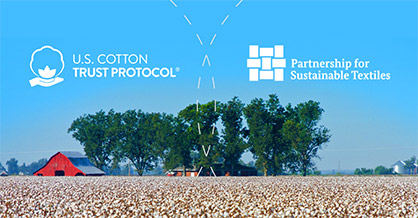
U.S. Cotton Trust Protocol (Photo: Business Wire)


“Members of the Partnership for Sustainable Textiles work together to achieve substantial social and ecological improvements in their global supply chains,” said Jürgen Janssen, head of the PST secretariat. “This also includes the production of raw materials and thus the cultivation and processing of cotton. In the Textiles Partnership, we advocate for transparent and traceable criteria in the certification of sustainable cotton. We are pleased that the Trust Protocol has successfully passed the audit by Siegelklarheit.”

The PST has developed an implementation framework and reporting format for corporate due diligence. In the context of this format PST member companies also indicate how much cotton they source and how much of it is sustainable or organic cotton, certified by recognized standards. Besides U.S. Cotton Trust Protocol, these include Better Cotton standard, the Australian myBMP standard, Cotton made in Africa, Fairtrade Cotton and CottonConnect. The following standards apply to purchasing of organic cotton: the Global Organic Textile Standard (GOTS), the International Association of Natural Textile Industry (NATURTEXTIL IVN) standard, the Textile Exchange Organic Content Standard (OCS), the bioRe Social & Environmental Standard, and all the organic standards forming part of the IFOAM Family of Standards.


The Trust Protocol is the only system that provides quantifiable, verifiable goals and measurement and drives continuous improvement in six key sustainability metrics - land use, soil carbon, water management, soil loss, greenhouse gas emissions, and energy efficiency. It is also the world’s first sustainable cotton fiber to offer its members article-level supply chain transparency through the Protocol Consumption Management Solution.

“We are thrilled to have received this recognition of being a sustainable cotton standard by the Partnership for Sustainable Textiles and proud to have passed Siegelklarheit’s rigorous assessment,” said Dr. Gary Adams, president of the U.S. Cotton Trust Protocol. “The Trust Protocol’s vision is to set a new standard in sustainable cotton production where full transparency is a reality and continuous improvement to reduce our environmental footprint is the central goal. We commit to ensuring the protection and preservation of the planet, using the most sustainable and responsible techniques.”

The U.S. Cotton Trust Protocol is aligned with the UN Sustainable Development Goals, recognized by Textile Exchange and Forum for the Future, and part of the Sustainable Apparel Coalition, Cotton 2025 Sustainable Cotton Challenge, Cotton 2040 and Cotton Up initiatives. It has also been recognized and published in the ITC Standards Map.




More News from TEXDATA International

#Recycling / Circular Economy

textile.4U publishes special edition “Top 100 Textile Recycling Companies 2025”

With a comprehensive 176-page special edition, textile.4U is dedicating its latest issue entirely to one of the most dynamic and influential topics in today’s textile industry: textile recycling. The new issue, published exclusively in high-quality print, presents the Top 100 textile recycling companies researched and selected by TexData – organizations that already play a key role in the transition to circular textiles or are expected to have a significant impact in the near future.

#Recycling / Circular Economy

Responsible Textile Recovery Act of 2024 signed by Governor

Senator Josh Newman (D-Fullerton) is proud to announce that Senate Bill 707 (SB 707), the Responsible Textile Recovery Act of 2024, has been signed into law by the Governor of California, Gavin Newsom. This groundbreaking legislation establishes the country’s first Extended Producer Responsibility (EPR) textile recycling program, marking a significant step forward in the state’s efforts to combat waste and promote sustainability.

#Textiles & Apparel / Garment

Modtissimo promotes sustainability with 28 coordinates in the Green Circle

Modtissimo is proving more and more to be a textile and clothing show that delivers the latest innovations in the area of sustainability, with the iTechStyle Green Circle being the main showcase for companies' creations. In this 60+4 edition, taking place on 12 and 13 September, 28 coordinates will be exhibited in a section organised by CITEVE and curated by Paulo Gomes.

#Europe

The EU and Egypt team up to mobilise private sector investments at Investment Conference and sign a Memorandum of Understanding underpinning €1 billion in macro-financial assistance for Egypt

At the EU-Egypt Investment Conference, co-organised by the EU and the Government of Egypt on 29-30 June, the EU and Egypt are teaming up to intensify private sector investments in Egypt. They are also signing a Memorandum of Understanding (MoU) for the disbursement to Egypt of up to €1 billion in Macro-Financial Assistance.

More News on Raw Materials

#Raw Materials

ICAC projects slight decline in production, relative stability for consumption

Global cotton production is projected to decline by 4% in the 2026/27 season to 24.8 million tonnes, while consumption is expected to remain relatively steady at 25.0 million tonnes, according to the March 2026 edition of Cotton This Month.

#Raw Materials

Beyond the wardrobe – innovative cotton takes the spotlight

Cotton can do more – a lot more. Cutting-edge textiles and high-tech products made from 100% cotton prove just how powerfully performance and sustainability can come together. That very surge of innovation is front and centre at the 38th Bremen Cotton Conference, taking place March 25–27, 2026, at Bremen’s Parliament on the historic market square – culminating in a bold and dedicated closing session on Friday. In the spotlight: performance upgrades for pure cotton, smart strategies for circular textile waste solutions, and pioneering concepts for demanding technical applications. From natural fibre–reinforced composites to highly effective flame-retardant solutions, cotton steps out of the closet and shows the future potential woven into every fibre.

#Raw Materials

Esquel Group adds two new extra-long staple cotton varieties approved

Esquel Group’s Xinjiang Research & Development Center has successfully developed two new Sea Island cotton (Extra-Long-Staple cotton, ELS cotton) varieties named “Yuan Loong 37” and “Yuan Loong 42,” which have been officially approved and granted registration numbers. Both varieties have also obtained Plant Variety Rights certificates, marking another significant breakthrough for the Group in cotton breeding and commercial application.

#Raw Materials

Aid by Trade Foundation reaches new milestones in supply chain transparency

The Aid by Trade Foundation (AbTF) is reaching new milestones as it leads the way towards greater physical traceability for Cotton made in Africa® (CmiA) cotton. With around 700 suppliers and producers in a total of 25 countries, the Aid by Trade Foundation has reached a new record number of partners who can trace CmiA cotton from the product back to its origin. This is more than double the previous year’s figure.

Latest News

#Spinning

Barmag presents the next generation of POY production – energy-efficient and partial-automated

With POY 2.0, Barmag is introducing a completely redesigned spinning concept that takes the production of partially oriented yarn (POY) to a new level in terms of technology and economy. The solution, which was presented to a selected audience of experts for the first time at ITMA Asia + CITME 2025, was met with great enthusiasm: several yarn producers worldwide immediately expressed their interest in a pilot plant.

#Composites

More affordable, environmentally friendly hydrogen pressure tanks at ITA-JEC booth

As a highlight of the JEC, the Institut für Textiltechnik (ITA) of RWTH Aachen University will be presenting hydrogen pressure tanks manufactured using multifilament winding processes at the NRW joint booth in Hall 5, Stand G65.

#Textile chemistry

DyStar Group Announces Board Transition to Drive Innovation

DyStar, a leading specialty chemical company with a heritage of more than a century in product development and innovation, announced today the appointment of Ruan Cunfan to its Board of Directors, effective 20 February 2026.

#Recycling / Circular Economy

Textile‑to‑textile recycling leader Circulose joins Spinnova’s ecosystem to accelerate technology scale‑up

Textile‑to‑textile recycling leader Circulose joins Spinnova’s ecosystem (consortium) to help advance the scale‑up of Spinnova’s technology. Spinnova has actively sought partners to accelerate commercial scale‑up, and Circulose, as a key player in textile recycling, strengthens the ecosystem by providing a raw material that is in high demand across the industry.

TOP