[pageLogInLogOut]

#Natural Fibers

Cashmere producers stress the importance of The Good Cashmere Standard®

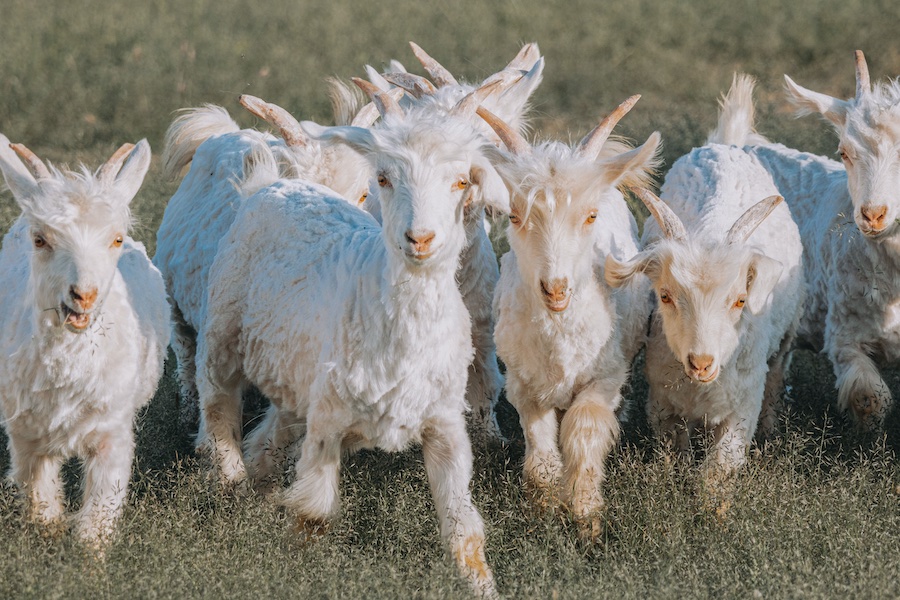
Cashmere goats © 2025 AbTF
At the invitation of the Aid by Trade Foundation (AbTF), over 70 experts from the cashmere production and supply chain, as well as other specialists, met at the GCS Unit Meeting in Shanghai, China to discuss the progress and new objectives of The Good Cashmere Standard (GCS). The meeting focused on implementation and verification of the standard, important aspects of animal welfare and the importance of the standard in the global textile market.


The Good Cashmere Standard, the largest standard in the world for sustainable cashmere, welcomed animal welfare and cashmere experts, and GCS partner companies to its two-day conference, to discuss together the future of the sustainable cashmere industry. The issues discussed included species-appropriate animal husbandry, and the expanded GSC verification system. Other important points at the meeting were exchanges of experiences with local actors regarding the implementation of standard requirements at cashmere goat farms, and the importance of seamless transparency in verified cashmere fibre in the supply chain – an issue that is becoming increasingly important due to the expected regulations in the EU and the USA.

One of the highlights was the speech by the herdswoman Chaoluomenqiqige, who runs a GSC model farm with her husband Zhaonashun. She shared her personal experiences with The Good Cashmere Standard and stressed the positive effect that the standard had had on her operation – because of the progressive animal welfare practices, for example. “It is impressive how much commitment herders put into their everyday work”, says Tina Stridde, Managing Director of the Aid by Trade Foundation. “This makes the model farms important centres of innovation and inspiration for all partners of The Good Cashmere Standard.”

Through this event, the Aid by Trade Foundation reaffirmed its commitment to continuous improvement of The Good Cashmere Standard together with local actors, and to promoting responsible cashmere production. The important conclusions from the GSC Unit Meeting will influence the further development of the standard, and help promote animal welfare, transparency, and sustainability in the cashmere production.

More News from Aid by Trade Foundation (AbTF)

#Raw Materials

Aid by Trade Foundation reaches new milestones in supply chain transparency

The Aid by Trade Foundation (AbTF) is reaching new milestones as it leads the way towards greater physical traceability for Cotton made in Africa® (CmiA) cotton. With around 700 suppliers and producers in a total of 25 countries, the Aid by Trade Foundation has reached a new record number of partners who can trace CmiA cotton from the product back to its origin. This is more than double the previous year’s figure.

#Natural Fibers

Aid by Trade Foundation publishes 2024 annual report: Growing impact for environment and people

The Aid by Trade Foundation (AbTF) is on a growth track. Despite a challenging global economy, AbTF increased its income by six percent from 2023 to 2024, reaching a total of EUR 8.6 million. This revenue has been invested in comprehensive measures for the sustainable production of cotton and cashmere as well as for expanded measures to ensure transparency in global value chains. In addition to gaining new partners in 2024—including big names like Mango, Nordstrom, and CWS Workwear—AbTF was able to expand its global stakeholder network active in the production of raw materials or textiles.

#Raw Materials

Aid by Trade Foundation receives Honorary Award of the German Africa Foundation 2025

On the evening of 25 June, the Hamburg-based Aid by Trade Foundation (AbTF) received the Honorary Award of the German Africa Foundation 2025. Prof. Dr Michael Otto, the foundation’s founder and a prominent entrepreneur, accepted the award at a ceremony held at the German Bundestag. The Parliamentary State Secretary to the Federal Minister for Economic Cooperation and Development (BMZ), Dr Bärbel Kofler, presented the award in the presence of guests from politics, business and civil society as well as representatives of African embassies.

#Sustainability

Aid by Trade Foundation turns 20, invests half a million Euros in new biodiversity fund

To effectively promote nature conservation and biodiversity, the Aid by Trade Foundation (AbTF) announced at the second Hamburg Sustainability Conference (HSC) that it would be investing 500,000 euros in the ‘AbTF Biodiversity Fund’ to mark the foundation's 20th anniversary. Since it was established in 2005 by the entrepreneur Prof. Dr Michael Otto, AbTF has been committed to transforming the textile and fashion industries.

More News on Natural Fibers

#Research & Development

Regional hemp bast for lightweight construction profiles

The cultivation of fibre hemp for the production of ropes and clothing has a long tradition in Saxony. Due to its excellent fibre properties, it is also suitable as a renewable raw material for reinforcement in fibre composites. At the STFI and IWU in Chemnitz, the CannaPul project is cur- rently investigating how a regional value chain for hemp-based lightweight construction profiles can be established. To this end, the technical processing of hemp fibres into continuous fibre strands and their embedding in a suitable bio-based matrix are being investigated.

#Raw Materials

China projected to increase cotton production, yields, and imports in 2026/27

World cotton production in the 2026/27 season is projected at 25.9 million tonnes, exceeding global consumption of 25.2 million tonnes, according to the May 2026 issue of Cotton This Month. That means both production and consumption are expected to remain close to current season levels, while global cotton trade is projected to decline by 2.7% to approximately 9.6-9.7 million tonnes.

#Raw Materials

ICAC launches Carbon Credits Initiative to deliver new income streams to cotton farmers

The International Cotton Advisory Committee (ICAC) has announced a new initiative designed to unlock additional income streams for cotton farmers through participation in carbon credit markets, linking sustainable production practices directly to financial returns.

#Raw Materials

Kraig Biocraft Laboratories reports major progress converting record-setting spider silk cocoon production into reeled silk

Kraig Biocraft Laboratories, Inc. (OTCQB: KBLB) (“the Company”, “Kraig Labs”, or “Kraig’s”), a world leader in spider silk technology*, today announced significant progress in the processing of its recently produced recombinant spider silk cocoons into reeled silk.

Latest News

#ITM 2026

ITM 2026: KARL MAYER presents new perspectives

KARL MAYER will once again showcase itself as a strong partner to the Turkish textile industry at ITM in Istanbul from June 9 to 13. At Booth 303 A in Hall 3 of the Tüyap Fair Convention and Congress Center, the industry leader will exhibit solutions for warp knitting, warp preparation, and technical textiles – tailored to a challenging economic environment.

#Spinning

Specialist in fine counts: New type 2777 ceramic oiler

With the new Type 2777 ceramic oiler, Barmag has added a solution for fine titers and microfilaments to its portfolio of original parts.

#INDEX 2026

STFI highlights textile circular economy and alternative fibres at INDEX™ 2026

From 19 to 22 May 2026, INDEX will invite visitors to Lake Geneva for the world's leading nonwovens trade fair. The Centre of Excellence in Nonwovens at the Sächsisches Textilforschung- sinstitut e.V. (STFI) will be in attendance to present the latest developments in nonwovens research. In the field of the textile circular economy, the STFI will present acoustically effective nonwovens made from chemical recycling residues. The range also includes innovations aimed at replacing conventional raw materials, such as the biobased and biodegradable polymer polybutylene succinate (PBS) and Kendyr as an alternative to cotton.

#Associations

Italian textile machinery sector faces weak start to 2026 despite domestic growth

In the first quarter of 2026, order intake for Italian textile machinery manufacturers recorded a decrease of 5% compared to the same period in 2025, reflecting a still challenging start to the year. The decline affected foreign markets (-7%), while the domestic market showed growth (+21%).

TOP