[pageLogInLogOut]

#Raw Materials

Aid by Trade Foundation receives Honorary Award of the German Africa Foundation 2025
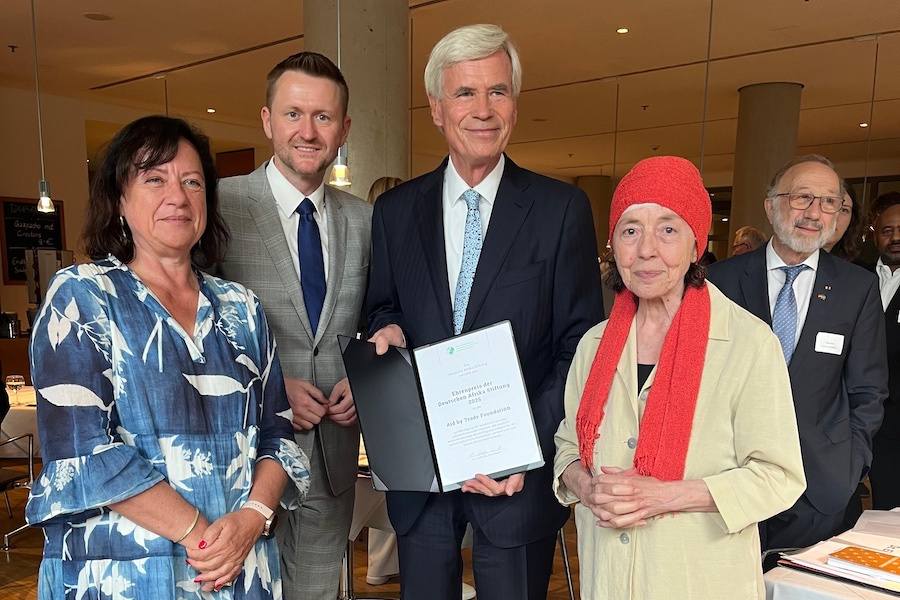
On the evening of 25 June, the Hamburg-based Aid by Trade Foundation (AbTF) received the Honorary Award of the German Africa Foundation 2025. Prof. Dr Michael Otto, the foundation’s founder and a prominent entrepreneur, accepted the award at a ceremony held at the German Bundestag. The Parliamentary State Secretary to the Federal Minister for Economic Cooperation and Development (BMZ), Dr Bärbel Kofler, presented the award in the presence of guests from politics, business and civil society as well as representatives of African embassies.
Presentation of the German Africa Foundation's honour award to the Aid by Trade Foundation. L. to right: Dr. Bärbel Kofler, MdB, Dr. Wolfgang Stefinger, MdB, Prof. Dr Michael Otto, Dr. Uschi Eid, President Deutsche Afrika Stiftung / German Africa Foundation; Credit: Deutsche Afrika Stiftung/German Africa FoundationPresentation of the German Africa Foundation's honour award to the Aid by Trade Foundation. L. to right: Dr. Bärbel Kofler, MdB, Dr. Wolfgang Stefinger, MdB, Prof. Dr Michael Otto, Dr. Uschi Eid, President Deutsche Afrika Stiftung / German Africa Foundation; © 2025  Deutsche Afrika Stiftung/German Africa Foundation
Presentation of the German Africa Foundation's honour award to the Aid by Trade Foundation. L. to right: Dr. Bärbel Kofler, MdB, Dr. Wolfgang Stefinger, MdB, Prof. Dr Michael Otto, Dr. Uschi Eid, President Deutsche Afrika Stiftung / German Africa Foundation; Credit: Deutsche Afrika Stiftung/German Africa FoundationPresentation of the German Africa Foundation's honour award to the Aid by Trade Foundation. L. to right: Dr. Bärbel Kofler, MdB, Dr. Wolfgang Stefinger, MdB, Prof. Dr Michael Otto, Dr. Uschi Eid, President Deutsche Afrika Stiftung / German Africa Foundation; © 2025 Deutsche Afrika Stiftung/German Africa Foundation


With this award, the German Africa Foundation recognises the Aid by Trade Foundation's long-standing commitment to sustainable economic development through trade. With the Cotton made in Africa (CmiA) initiative, the Aid by Trade Foundation, which was established in 2005, pursues the objective of creating decent employment through fair trade, increasing agricultural production and protecting the environment in the process. CmiA is now the world’s leading standard for sustainable cotton production from Africa.

“The Foundation's work is a successful model for public-private cooperation and it has succeeded in establishing a profitable and effective public-private partnership,” Dr Kofler emphasised at the award ceremony. About one million smallholder farmers and their families in ten African countries are now benefiting from Cotton made in Africa. The initiative, which received support from the BMZ from the outset, likewise stands for successful collaboration between the worlds of business and development cooperation—a goal that is to be further strengthened in the current legislative period.

“Together with more than 60 international trade partners, CmiA is setting an important example for ecological and social sustainability in the textile industry,” said the founder of AbTF, Prof. Dr Michael Otto. CmiA now accounts for around 30% of African cotton production and is known for its low CO?footprint, the complete absence of irrigation, and GMO-free seeds.

In addition to economic and environmental aspects, the initiative is particularly committed to social sustainability in the project regions - for example through training courses for small-scale farmers, projects in the area of education and health and the promotion of women in rural regions. The overall aim is to sustainably strengthen local structures - always in cooperation with local partners.


More News from Aid by Trade Foundation (AbTF)

#Raw Materials

Aid by Trade Foundation reaches new milestones in supply chain transparency

The Aid by Trade Foundation (AbTF) is reaching new milestones as it leads the way towards greater physical traceability for Cotton made in Africa® (CmiA) cotton. With around 700 suppliers and producers in a total of 25 countries, the Aid by Trade Foundation has reached a new record number of partners who can trace CmiA cotton from the product back to its origin. This is more than double the previous year’s figure.

#Natural Fibers

Cashmere producers stress the importance of The Good Cashmere Standard®

At the invitation of the Aid by Trade Foundation (AbTF), over 70 experts from the cashmere production and supply chain, as well as other specialists, met at the GCS Unit Meeting in Shanghai, China to discuss the progress and new objectives of The Good Cashmere Standard (GCS). The meeting focused on implementation and verification of the standard, important aspects of animal welfare and the importance of the standard in the global textile market.

#Natural Fibers

Aid by Trade Foundation publishes 2024 annual report: Growing impact for environment and people

The Aid by Trade Foundation (AbTF) is on a growth track. Despite a challenging global economy, AbTF increased its income by six percent from 2023 to 2024, reaching a total of EUR 8.6 million. This revenue has been invested in comprehensive measures for the sustainable production of cotton and cashmere as well as for expanded measures to ensure transparency in global value chains. In addition to gaining new partners in 2024—including big names like Mango, Nordstrom, and CWS Workwear—AbTF was able to expand its global stakeholder network active in the production of raw materials or textiles.

#Sustainability

Aid by Trade Foundation turns 20, invests half a million Euros in new biodiversity fund

To effectively promote nature conservation and biodiversity, the Aid by Trade Foundation (AbTF) announced at the second Hamburg Sustainability Conference (HSC) that it would be investing 500,000 euros in the ‘AbTF Biodiversity Fund’ to mark the foundation's 20th anniversary. Since it was established in 2005 by the entrepreneur Prof. Dr Michael Otto, AbTF has been committed to transforming the textile and fashion industries.

More News on Raw Materials

#Raw Materials

The 83rd Plenary Meeting: Reports from the ICAC Secretariat

Every year, one of the most anticipated sessions at the International Cotton Advisory Committee's (ICAC) Plenary Meeting is the Reports from the Secretariat — and the 83rd edition in Bremen, Germany, did not disappoint.

#Raw Materials

A Powerful Opening: Global thought leaders launch the International Cotton Conference Bremen

The International Cotton Conference Bremen will open on 25 March 2026 in the Parliament building of the Free Hanseatic City of Bremen with a keynote session of exceptional calibre. Distinguished international experts will set the stage for the conference by offering incisive perspectives on the most pressing challenges and the defining trends shaping the future of the global cotton trade. Their insights will span a broad spectrum — from geopolitically driven disruptions affecting global supply chains to the opportunities emerging from innovation-led agriculture capable of supporting a growing world population. Together, these opening keynotes will frame the dialogue of the conference, highlighting both the complexity of today’s market environment and the pathways toward a resilient and forward-looking cotton sector.

#Raw Materials

Lenzing Group positions bio‑based materials as a strategic asset for Europe’s economic security

The Lenzing Group, a leading supplier of regenerated cellulose fibers for the textile and nonwovens industries, hosted a high‑level roundtable in Brussels to discuss how bio‑based materials can strengthen Europe’s economic security and support the shift toward a fossil‑free future. Organized in cooperation with Euractiv, the event brought together representatives of the European Commission, the UK Mission to the EU, academia, civil society, and industry.

#Natural Fibers

Beyond Cotton: Natural Fibres in the Spotlight at the Bremen Cotton Conference - Branded by DNFI

Climate targets, fragile supply chains, and rising regulatory requirements are fundamentally changing the perspective of the textile industry - the focus is increasingly shifting toward the base material. Not only cotton, but natural fibres are gaining significant importance: they stand out not only because of their outstanding functional properties, but also because they make a valuable contribution to the bioeconomy and responsible product development.

Latest News

#Textile processing

Major expansion for ACG Kinna follows record year

In response to growing demand for its full textile and finished product line automation services, ACG Kinna – a member of TMAS, the Swedish textile machinery association – has inaugurated a 1,000-square-metre expansion at its headquarters in Skene, Sweden.

#Textiles & Apparel / Garment

YKK launches “YZiP® Light” aluminum alloy zipper for cotton pants

YKK Corporation (Headquarters: Chiyoda-ku, Tokyo; President: Koichi Matsushima; hereafter, YKK) has launched YZiP® Light, a lightweight aluminum alloy zipper for cotton pants, with sales beginning in late March. The introduction of YZiP® Light expands YKK’s zipper portfolio—led by the flagship YZiP® copper alloy zipper—providing customers with greater flexibility to meet diverse garment needs.

#Techtextil 2026

Shima Seiki showcases WHOLEGARMENT® and 3D knitting solutions for technical textiles at Techtextil 2026

Leading textile technology solutions provider SHIMA SEIKI MFG., LTD. of Wakayama, Japan, along with its Italian subsidiary SHIMA SEIKI ITALIA S.p.A., will be participating in the Techtextil 2026 exhibition in Frankfurt, Germany next month. On display will be WHOLEGARMENT® and other advanced three-dimensional knitting applications across a wide range of industries besides fashion apparel that are not typically associated with knitting, such as technical textiles using industrial materials and advanced three-dimensional knitting.

#Research & Development

Textilfabrik 7.0 launched: Mönchengladbach becomes a real-world lab for sustainable textile production

With the official kick-off event of the Textilfabrik 7.0 (T7), a major transformation project for the German textile and apparel industry has been launched in the Monforts Quarter in Mönchengladbach. At the “Textile Roundtable,” an event format organized by the Zukunftsagentur Rheinisches Revier, representatives from industry, research, politics, and the regional economy came together to jointly lay the foundation for CO₂-neutral, circular, and economically viable textile production in Germany.

TOP