[pageLogInLogOut]

#Europe

EU and Mercosur sign historic and ambitious partnership
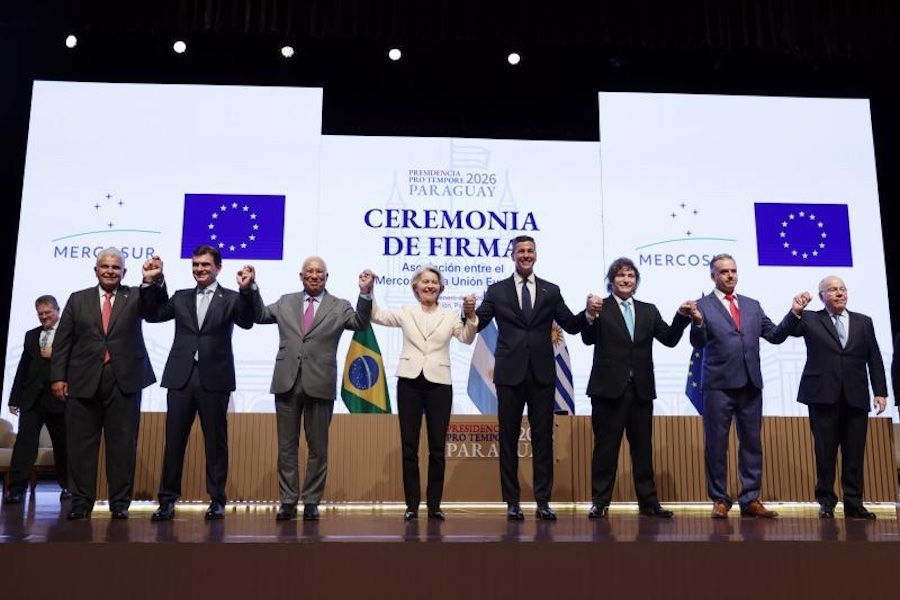
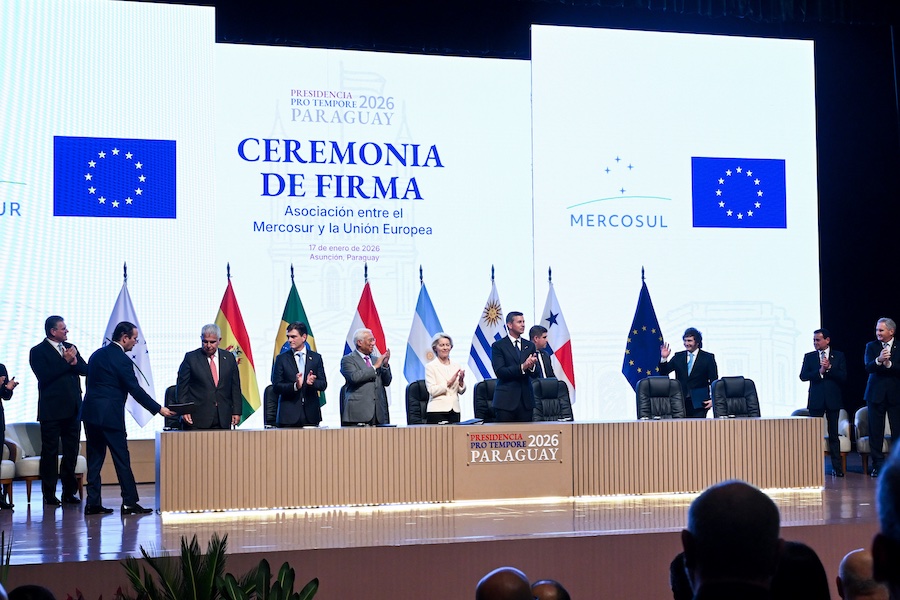
Today, the European Union and Mercosur signed a Partnership Agreement (EMPA) and an Interim Trade Agreement (iTA), representing a historic milestone between the two regions, and an ambitious platform for strengthening their economic, diplomatic and geopolitical relations.

The Agreement signed today will create one of the biggest trade zones in the world covering a market of around 700 million consumers. The Agreement will deliver substantial new commercial opportunities for companies across the EU, driving an estimated 39% increase in annual exports to Mercosur (a value of approximately €49 billion), while supporting hundreds of thousands of EU jobs.

The Agreement also sends a strong geopolitical signal, demonstrating the EU and Mercosur's shared commitment to multilateralism and the rules-based international order. At a time of global uncertainty and increasing fragmentation, this agreement underlines the value of cooperation, dialogue and international partnerships. The agreement presents significant opportunities for mutual gain through strengthened economic, geopolitical, sustainability, and security cooperation.

President of the European Commission Ursula von der Leyen, President of the European Council Antonio Costa, and leaders from Mercosur countries witnessed the signing of the EU-Mercosur Partnership Agreement (EMPA) and the EU-Mercosur Interim Trade Agreement by EU Trade Commissioner Maroš Šefčovič and his Mercosur counterparts. 

European Commission President, Ursula von der Leyen, said: “Today, two like-minded regions open a new chapter of opportunity for more than 700 million citizens. With this win-win partnership, we both stand to gain – economically, diplomatically and geopolitically. Our companies will create exports, growth and jobs. We will support each other in our clean and digital transitions. And our signal to the rest of the world is clear: the EU and Mercosur are choosing cooperation over competition, and partnership over polarisation.”

Fewer duties, more exports

The Agreement will create a wide range of economic opportunities in the EU by:

  • Removing tariffs on EU exports, including agri-food and key industrial products such as cars, machinery, and pharmaceuticals, saving EU businesses €4 billion worth of duties per year;
  • Making it easier, quicker and safer to invest in key supply chains, including critical raw materials and related goods;
  • Strengthening economic security and supporting the digital and green transitions on both sides;
  • Helping the EU and Mercosur to shape global trade rules in line with the highest EU standards.

A balanced deal for EU agriculture

The Agreement will open unprecedented access to the Mercosur region for European farmers and food producers. The deal is expected to increase EU agri-food exports to Mercosur by up to 50% by:

  • Reducing tariffs on key EU agri-food products, such as wine, spirits, dairy, and olive oil;
  • Protecting 344 EU Geographical Indications, high-value traditional food and drink products, from unfair competition and imitation.

At the same time, the EU has taken great care to ensure that sensitive agri-food sectors benefit from every necessary protection, thanks to the following measures:

  • Carefully calibrated tariff rate quotas that limit market access of sensitive products imported from Mercosur;
  • A legally binding safeguard mechanism that protects sensitive European products in case of a surge in imports from Mercosur countries;
  • Enhanced controls preventing non-compliant products from entering the EU market, including more audits and checks in third countries, and strengthened controls at EU borders;
  • Taking actions by the Commission to operationalise the commitment in the EU's Vision for Agriculture and Food, for a stronger alignment of production standards, such as pesticides and animal welfare, applied to imported products; and
  • A €6.3 billion fund, the Unity Safety net as from 2028, as an additional layer of protection for our farmers in case of market disturbances.

Sustainability and environmental commitments

The Agreement is one of the most ambitious deals ever signed by the EU in terms of sustainable development, as it features:

  • Ambitious and enforceable commitments on climate action, including the Paris Agreement as an essential element;
  • Concrete commitments on sustainable development, including on women's economic empowerment and labour rights;
  • A pledge to work towards climate neutrality by 2050; and
  • A clear contribution for trade to the green transition.


Next steps

Following the signature of the EMPA, the EU and Mercosur will now follow their respective procedures to work towards the ratification of the Agreement.

On the EU side, the EMPA will be subject to ratification by all Member States, following their national procedures. At the same time, the ITA will follow EU-only ratification process as it falls under EU exclusive competences. This will require the consent of the European Parliament and the adoption of a decision on the conclusion by the Council, after which it will enter into force.

The iTA will expire once the EMPA enters into force.


More News from European Commission

#Europe

EU aims to advance global clean transition and implementation of the Paris Agreement at UN's COP30

At the COP30 UN Climate Change Conference in Belém, Brazil, from 10-21 November, the European Union will reaffirm its strong commitment to climate action. The EU is dedicated to paving the way toward a global transition that is clean, fair, and resilient. This transition aims to provide clean and affordable energy, create business opportunities, stimulate growth, enhance industrial competitiveness, and leave no one behind.

#Recycling / Circular Economy

EU to make textile producers pay for collection and recycling

On Tuesday, Parliament gave its final green light to new measures to prevent and reduce waste from food and textiles across the EU.

#Europe

EU and Indonesia conclude negotiations on free trade agreement

Following the political agreement reached on 13 July by President von der Leyen and President Prabowo Subianto, today the EU and Indonesia finalised negotiations for a Comprehensive Economic Partnership Agreement (CEPA) and an Investment Protection Agreement (IPA). On the EU side, negotiations were led by Commissioner for Trade and Economic Security Maroš Šef?ovi?. Currently in Indonesia, he is marking this historic milestone and engaging with both European and Indonesian businesses to support the upcoming ratification and next steps.

#Europe

Commission proposes Mercosur and Mexico agreements for adoption

The European Commission has put forward its proposals to the Council for the signature and conclusion of the EU-Mercosur Partnership Agreement (EMPA) and the EU-Mexico Modernised Global Agreement (MGA). These landmark deals form a critical part of the EU's strategy to diversify its trade relations and strengthen economic and political ties with like-minded partners around the world.

More News on Europe

#Associations

European business associations celebrate the signature of the EU-Mercosur FTA

The 17th January marks a historic milestone with the signing of the EU-Mercosur Trade Agreement, creating the biggest trading block in the world. European business – represented by more than 28 associations across a wide range of sectors – warmly welcomes this signature. It sends a strong and timely signal that the EU remains open and is committed to rules-based global trade. In a time of global uncertainty, this agreement is a key growth booster.

#Nonwovens

EDANA wraps up its Sustainability & Policy Forum 2025: Uniting the industry and EU policymakers to navigate the future of nonwovens

Against a backdrop of rapidly evolving environmental legislation, the EDANA Sustainability & Policy Forum 2025 concluded the past week in Brussels, marking a step forward in the dialogue between the nonwovens industry and European policymakers. Held from 9-10 December at the historic Residence Palace, the two-day event successfully brought together business leaders, sustainability experts, and EU officials to address the dual challenges of circularity and industrial competitiveness.

#Europe

Level playing field at stake: Europe’s textile industry demands decisive action

Yesterday, the European Parliament took a welcomed and necessary step by voting a resolution calling for stronger market surveillance, reinforced customs controls and faster enforcement of the Digital Services Act in case of infringements. For Europe’s textile and clothing manufacturers, this is the first political acknowledgement that the system is broken — and that enforcement must finally match the scale of the problem.

#Nonwovens

EDANA calls for clarity and consistency on the EU Deforestation Regulation (EUDR)

EDANA, the international association representing the nonwovens and related industries, considers the European Commission’s recent U-turn on the EU Deforestation Regulation (EUDR) a missed opportunity to deliver a clear and effective framework to help effectively fight global deforestation.

Latest News

#Functional Fabrics

PERFORMANCE DAYS: Focus topic shifts to the beginning of the value chain

Following the last Focus Topic in October 2025, which placed Textile-to-Textile Recycling at its core, PERFORMANCE DAYS continues to drive the conversation around circularity – this time with an expanded and more upstream perspective. The upcoming Focus Topic, “Textile to Textile: The Role of Collectors and Sorters,” presented during the spring edition on March 18–19, will spotlight one of the most essential yet often overlooked components of a functioning circular textile system: the efficient collection and sorting of post-consumer textiles.

#Knitting & Hosiery

Proven performance, optimised costs – the new RE 6 EL

Nowadays textile companies increasingly need to produce small production runs and respond to market changes with instantaneous pattern changes in order to operate profitably – meaning they require machines that offer maximum flexibility, reliability and cost efficiency. KARL MAYER understands the challenges of the market and is launching its new RE 6 EL. The Raschel machine offers the core strengths of the classic RSE 6 EL and essentially the same performance parameters, but has been further cost-optimised largely due to local production advantages. This makes the newcomer an efficiency champion in production, especially when it comes to frequent pattern changes.

#Carpets

New DOMOTEX impresses across the Board – A complete success

Full halls, innovative products, new synergies, numerous positive discussions, and successful business deals shaped the past four days of the fair. With its new concept, DOMOTEX has reinvented itself and was able to impress both exhibitors and visitors on every level.

#Natural Fibers

AMSilk’s silk protein yarns debut in Balenciaga collection

AMSilk GmbH (“AMSilk”), a global leader in advanced biomaterials made from silk proteins, today announced that its bioengineered yarns are featured in commercially available garments within Balenciaga’s Spring 2026 collection.

TOP