[pageLogInLogOut]

#Raw Materials

The 83rd Plenary Meeting: Reports from the ICAC Secretariat

Every year, one of the most anticipated sessions at the International Cotton Advisory Committee's (ICAC) Plenary Meeting is the Reports from the Secretariat — and the 83rd edition in Bremen, Germany, did not disappoint.

The session began with a presentation by Ms Parkhi Vats, ICAC Economic Affairs Officer, who provided a world cotton market outlook. She gave early projections on world production and consumption as well as import and export figures; provided an overview of recent trade deals and tariff negotiations; and offered comprehensive data on identity and specialty cottons, including long- and extra-long staple varieties.

Economist Ms Lorena Ruiz delivered a presentation on World Textile Fiber Demand as well as the Results of the ICAC Global Survey on Women in the Cotton Sector. Global textile fiber demand continues to grow in line with GDP and population, but this growth is largely driven by polyester, particularly in China. Geopolitical tensions and expensive energy are increasing production and trade costs. Strengthening cotton’s position will require productivity gains and clearer communication of sustainability efforts, with ICAC providing support through data and coordination. The 2024 ICAC survey on women in the cotton sector indicates that, despite existing labor policies, women remain underrepresented in leadership and concentrated in manual roles, with barriers such as limited access to resources and training requiring more systemic action.

Head of Textiles Mr Kanwar Usman delivered a presentation on “Textiles Strategy: Developing the Textiles Value Chain in Cotton-Rich Countries.” He focused on the investment required for various types of textiles facilities — spinning, weaving, processing, and garments — as well as the expected daily output of each, in metric tonnes.

Chief Scientist Dr Keshav Kranthi discussed the “Global Economics of Cotton Production,” highlighting the impressive capabilities of the ICAC’s Production Data Portal, including cost of production, fertilizer and pesticide use, cotton varieties, pest distribution, and much more (and all of it available free of charge). He also provided an overview of the massive, 872-page 2025 Cotton Data Book, which analyzes the sustainability of cotton production in 38 countries.

The final speaker was Director of Communications Mike McCue, who gave an overview of the ICAC’s Efforts on Cotton Promotion. He discussed the organization's activity on social media platforms — including the popular #TruthTuesday posts — the extensive support the ICAC provides for the global World Cotton Day activities held every October 7, and the need for industry stakeholders to collaborate to raise cotton's visibility and reputation. 

All of their individual presentations can be found here.


More News from International Cotton Advisory Committee (ICAC)

#Raw Materials

China projected to increase cotton production, yields, and imports in 2026/27

World cotton production in the 2026/27 season is projected at 25.9 million tonnes, exceeding global consumption of 25.2 million tonnes, according to the May 2026 issue of Cotton This Month. That means both production and consumption are expected to remain close to current season levels, while global cotton trade is projected to decline by 2.7% to approximately 9.6-9.7 million tonnes.

#Raw Materials

ICAC launches Carbon Credits Initiative to deliver new income streams to cotton farmers

The International Cotton Advisory Committee (ICAC) has announced a new initiative designed to unlock additional income streams for cotton farmers through participation in carbon credit markets, linking sustainable production practices directly to financial returns.

#Raw Materials

Global production expected to decline in 2026/27 as policy shifts and weak demand reshape trade

Early projections for the 2026/27 season indicate that global cotton lint production will decline by 4% to 24.9 million tonnes, while world consumption is expected to remain stable at approximately 25 million tonnes, according to the April 2026 issue of Cotton This Month.

#Raw Materials

ICAC projects slight decline in production, relative stability for consumption

Global cotton production is projected to decline by 4% in the 2026/27 season to 24.8 million tonnes, while consumption is expected to remain relatively steady at 25.0 million tonnes, according to the March 2026 edition of Cotton This Month.

More News on Raw Materials

#Raw Materials

ECCO introduces first shoe featuring innovative protein-based fibre

ECCO, in partnership with Spinnova, announces the launch of the limited edition ECCO BIOM® 720, a first-of-its-kind shoe utilising an often overlooked leather by-product, transformed into a protein-based fibre. The fibres are produced using patented technology that advances material innovation while reducing waste and supporting full resource use across the leather and textile industry.

#Raw Materials

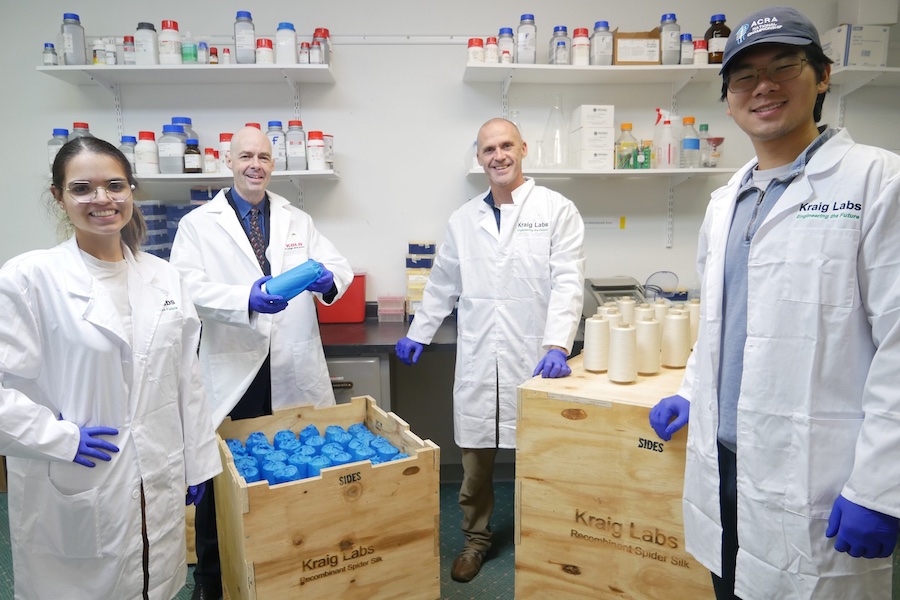
Kraig Biocraft Laboratories reports major progress converting record-setting spider silk cocoon production into reeled silk

Kraig Biocraft Laboratories, Inc. (OTCQB: KBLB) (“the Company”, “Kraig Labs”, or “Kraig’s”), a world leader in spider silk technology*, today announced significant progress in the processing of its recently produced recombinant spider silk cocoons into reeled silk.

#Textile processing

trinamiX mobile NIR spectroscopy: New applications for the footwear and textile industry

trinamiX GmbH expands its solution portfolio for the circular economy, now enabling the identification of materials used in the footwear and textile industries. With its mobile near-infrared (NIR) spectroscopy solutions, trinamiX supports manufacturers, sorters, recyclers, and brand owners in reliably identifying materials and improving transparency across increasingly complex value chains.

#Raw Materials

Fiber traceability - A vehicle to ensure sustainability or injustice?

The Bremen Cotton Exchange is making a new paper available for download. In this paper, analyst Veronica Bates Kassatly and statistician Terry Townsend examine the justifications behind this approach and assess the consequences for textile and apparel sustainability claims and global legislation.

Latest News

#Nonwovens

Temafa Maschinenfabrik GmbH supplies a complete decortication plant for processing hemp straw to Hanffaser Geiseltal eG

Temafa Maschinenfabrik GmbH, a leading supplier of machinery and plants for fibre processing, has successfully secured an order to supply a complete plant for processing hemp straw to Hanffaser Geiseltal eG, based in Mücheln.

#Techtextil 2026

FET’s revolutionary gel spinning system wins Techtextil Innovation Award

FET has received the prestigious Techtextil Innovation Award 2026 in the New Production Technology category. The Techtextil Innovation Award honours outstanding ideas in textile technology, sustainability, AI and the creation of technical textiles, selected by an international jury of experts. Ranging from new materials to new production technologies, this award recognises progressive ideas that are driving forces for numerous industries, such as automotive, medical and construction.

#ITM 2026

Savio Macchine Tessili will exhibit at ITM Istanbul 2026 presenting its flagship technologies

Savio Macchine Tessili will participate in ITM Istanbul 2026 in a corporate booth of Vandewiele Group, showcasing a selection of its most advanced winding and spinning solutions designed to support textile mills in achieving higher efficiency, flexibility and yarn quality. The company will bring to the show three flagship solutions: Proxima Smartconer®, Lybra Smartspinner® and the Phoenix Assembly Winder.

#ITM 2026

Rieter at ITM 2026: Spinning Redefined with Automation and Intelligence

Spinning mills need solutions that deliver stability, efficiency and future-proof performance. Rieter has put together a powerful portfolio for ITM 2026 in Istanbul, Türkiye. These innovations give customers the tools to enhance cost efficiency, improve responsiveness and actively develop their competitive edge. Step-by-step, Rieter is moving closer to its Vision 2027 – the fully automated spinning mill. With each new technology, Rieter enables spinning mills worldwide to operate with greater precision and reliability, ensuring they remain at the forefront of an increasingly demanding global market.

TOP