[pageLogInLogOut]

#Dyeing, Drying, Finishing

Dyeing industry first for 7H with imogo
© 2021 Imogo
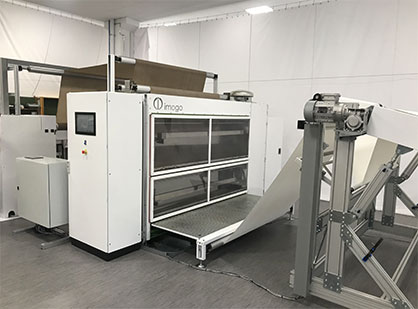
Swedish commission dyeing company 7H Färgeri is looking to propel itself to the forefront of sustainable fabric production with the installation of the first industrial scale imogo Dye-Max spray dyeing line.

Currently under construction, the line will be delivered in the first week of March to the 7H plant close to the Swedish city of Borås. It will have a full working width of 1.8 metres with an operating speed of up to 50 metres for the reactive dyeing of cellulosic fibre-based fabrics. In addition, it will be capable of carrying out the application of a wide range of fabric pre-treatments and finishing processes, providing the company with unbeatable flexibility in production. 
© 2021 Imogo
© 2021 Imogo


A proven Mini-Max laboratory unit for pre-determining application volumes and colour matching will also be delivered as part of the contract.

With the potential to slash the use of fresh water, wastewater, energy and chemicals by as much as 90% compared to conventional jet dyeing systems, the DyeMax has gained considerable attention since the concept was outlined and a prototype machine constructed in 2019.

Pilot scale trials have subsequently been carried out with many well-known international textile companies and their brand partners.

The application unit of the Dye-Max consists of a closed chamber containing a series of spray cassettes with precision nozzles for accurate and consistent coverage, in combination with the patented imogo Pro Speed valve that controls the volume to be applied.

Control and precision

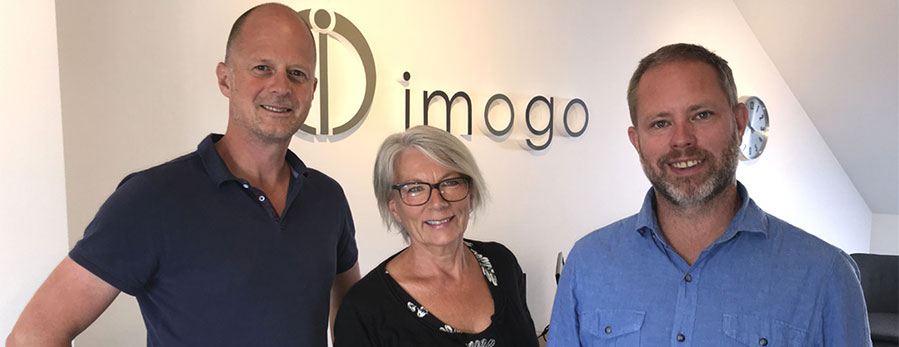
“We are achieving an extremely low liquor ratio of around 0.5-1 litres per kilo of fabric and we fully control the pickup, applying precisely what is required to the specific fabric,” says imogo founding partner Per Stenflo. “Compared to traditional padders there is no contamination of the dyebath or dilution of the dye liquor to worry about.


Fast changeovers with virtually no waste together with a high production speed enable a high productivity and unmatched production flexibility. The system is also equipped with an exhaust system and droplet separator to ensure that the environment around the unit is safe and free from particles.

The imogo Mini-Max meanwhile frees up valuable production time by avoiding wasteful pre-runs. The user simply sets the recipe with the Mini-Max and transfers the parameters to the Dye-Max recipe database for the system to be fully production ready.

7H Färgeri was founded in 1935 and has established itself as the Nordic region’s most complete dyeing and processing plant, specialising in technical and functional textiles for the automotive and soft furnishings sectors, as well as functional and protective clothing.

The family-owned business is now run by brothers Johan and Peter Engelmann.

“We are pleased to be pioneering a sustainable first for the dyeing industry,” said Johan Engelmann. “Our goal is to offer the market products and services with the highest quality in the most climate-smart and sustainable way, and imogo’s spray technology will give us the opportunity to offer innovative new services and products to both existing and new customers. It will be a very exciting journey.”

World Congress on Textile Coating

On February 12th Per Stenflo will make a presentation entitled ‘Transforming Textile Dyeing’ during the online World Congress on Textile Coating which is held over four days, between February 11th and 19th. For further details visit https://www.technical-textiles.online/WCTC/




More News from TEXDATA International

#Texprocess 2026

Texprocess 2026: Automation, digitalisation and AI reshape textile processing

Investment decisions in textile processing have become increasingly complex. Rising energy prices, labour shortages and geopolitical uncertainties are forcing companies to prioritise technologies that deliver measurable improvements in efficiency and process stability. This applies not only to apparel production, but also to the processing of technical textiles and high-performance materials. Modernisation projects are therefore being evaluated more selectively – but the pressure to upgrade production systems continues to grow. Texprocess 2026 reflects this tension between cautious investment behaviour and increasing technological demand.

#Techtextil 2026

Textile Chemicals & Dyes: Innovation in Textile Chemistry moves into focus at Techtextil 2026

From PFAS-free finishes and water-saving dyeing technologies to advanced coatings and recycling-compatible formulations, innovation in textile chemistry is accelerating across the industry. Reflecting this development, Techtextil 2026 introduces Textile Chemicals & Dyes as a dedicated product segment, highlighting the growing role of chemical solutions in shaping the next generation of technical textiles.

#Recycling / Circular Economy

textile.4U publishes special edition “Top 100 Textile Recycling Companies 2025”

With a comprehensive 176-page special edition, textile.4U is dedicating its latest issue entirely to one of the most dynamic and influential topics in today’s textile industry: textile recycling. The new issue, published exclusively in high-quality print, presents the Top 100 textile recycling companies researched and selected by TexData – organizations that already play a key role in the transition to circular textiles or are expected to have a significant impact in the near future.

#Recycling / Circular Economy

Responsible Textile Recovery Act of 2024 signed by Governor

Senator Josh Newman (D-Fullerton) is proud to announce that Senate Bill 707 (SB 707), the Responsible Textile Recovery Act of 2024, has been signed into law by the Governor of California, Gavin Newsom. This groundbreaking legislation establishes the country’s first Extended Producer Responsibility (EPR) textile recycling program, marking a significant step forward in the state’s efforts to combat waste and promote sustainability.

More News on Dyeing, Drying, Finishing

#Techtextil 2026

Smart sensors, smart savings - Reducing energy and cost in textile finishing

As energy prices, sustainability requirements and quality expectations continue to rise, manufacturers of technical textiles face increasing pressure to optimize efficiency while ensuring process reliability. At the same time, skilled labor shortages require production systems that are intuitive, automated and easy to manage. PLEVA addresses these challenges with robust, maintenance-friendly sensor technologies combined with intelligent process control.

#Dyeing, Drying, Finishing

Navis TubeTex and Fibroline announce upcoming Innovation Days

Navis TubeTex and Fibroline LLC announced their upcoming Innovation Days, a collaborative 3-day event designed to showcase advancements in product development technologies, and next-generation sustainable manufacturing solutions.

#Dyeing, Drying, Finishing

BW Converting expands Southeast Asian presence with new agency partnerships in Vietnam and Indonesia

BW Converting is strengthening its presence in Southeast Asia through new agency partnerships in Vietnam and Indonesia, reinforcing the company’s commitment to supporting textile manufacturers across the region. The expansion comes as BW Converting prepares to exhibit at SaigonTex 2026 (April 8–11, Saigon Exhibition and Convention Center, Ho Chi Minh City, Vietnam) and INDO INTERTEX 2026 (April 15–18, Jakarta International Expo, Indonesia).

#Dyeing, Drying, Finishing

Monforts unveils interactive digital platform for textile finishers

Monforts has launched a new digital platform designed to give textile manufacturers faster, more intuitive access to the company’s finishing technologies, technical expertise and aftersales support worldwide.

Latest News

#Textile chemistry

A flagship for chemical production: BASF inaugurates world-scale Verbund site in China

BASF today (March 26, 2026) celebrated the official inauguration of its newly built, world-scale Verbund site in Zhanjiang, Guangdong Province in southern China. Covering an area of around four square kilometers, it is more than a major BASF project in the chemical growth market of China. “Zhanjiang shows what the future of chemistry looks like: efficient, digital and sustainable by design. The site showcases a smart integrated Verbund structure on an industrial scale,” said Dr. Markus Kamieth, CEO of BASF, at the ceremony attended by representatives from government, customers, business partners and employees.

#Nonwovens

VEOCEL™ Lyocell production expands to Asia – Launching a new chapter for nonwovens in the region

VEOCEL™, Lenzing's flagship specialty nonwovens brand, expands production at its Thai plant in Prachinburi. This is the first-ever production of its nonwoven-grade lyocell fibers in Asia. Built in 2022 with a 100,000-ton annual production capacity, the facility - previously focused on fibers for textile applications - now can directly meet the demand for VEOCEL™’s biodegradable¹, wood-based lyocell fibers for nonwovens products. These fibers are an essential ingredient for high-quality nonwovens products, ranging from baby wipes to facial sheet masks and everyday personal hygiene items.

#Research & Development

Hof University develops sustainable textile coating for the fashion of tomorrow from mushrooms

Clothing is often treated as disposable: T-shirts for events, general merchandise, or short-term campaigns frequently end up in the trash after only a few uses. This is particularly problematic given that their production still largely relies on fossil-based materials. This is precisely where a new research project at Hof University of Applied Sciences comes in.

#Raw Materials

Fashion for Good mobilises industry to adopt mass balance attribution and accelerate decarbonisation

Fashion for Good launches today the Mass Balance Demonstrator project, a collaborative industry initiative to implement and scale the mass balance attribution (MBA) chain-of-custody model for biomass-attributed PET in textile applications. The project represents a concrete step toward accelerating brand-driven decarbonisation across the apparel value chain.

TOP