[pageLogInLogOut]

#Weaving

Major investments in climate neutrality and machinery: Lindauer DORNIER gears up for a successful future
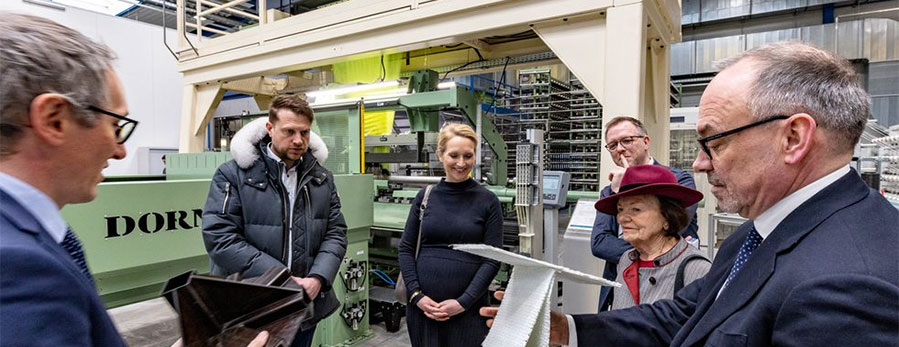
Group photo with guests from politics and business during the factory visit of Lindauer DORNIER GmbH in Esseratsweiler © 2023 Lindauer DORNIER
In order to make itself fit for the future and to take further steps towards climate neutrality, Lindauer DORNIER GmbH intends to invest more than 8 million euros at its Lindau and Esseratsweiler sites.

The money will go into photovoltaic systems and the modernisation of the machinery. For the family-owned company, this amount, financed entirely from its own resources, is the largest investment project in recent decades. When visiting the plant in Esseratsweiler, Lindau's Mayor Dr. Claudia Alfons, who is also chairwoman of the supervisory board of the public utility company Stadtwerke Lindau, and Tobias Walch, mayor of the municipality of Achberg, both expressed their delight at DORNIER's solar power, which will in future also supply the public power grid via Stadtwerke Lindau.
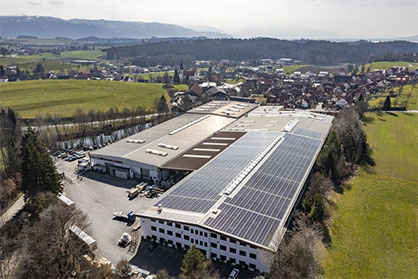
More sustainable with solar power: The new photovoltaic plant of Lindauer DORNIER will in future produce
More sustainable with solar power: The new photovoltaic plant of Lindauer DORNIER will in future produce "green" electricity for its own consumption and for the public grid in the Lindau region © 2023 Lindauer DORNIER


"This is the largest investment in our recent company history", Franz-Peter Matheis, Commercial Director at Lindauer DORNIER, emphasised the dimensions of the current investment program. The funds amounting to more than 8 million euros will be invested mainly in photovoltaic systems for the company's own power supply, a nitrogen production plant, the modernisation of the machinery and the optimization of logistics. "With these investments, we aim to navigate Lindauer DORNIER safely through the enormous challenges of our time," says Matheis. These include not only climate change, but also the shortage of skilled workers and young talent, as well as the requirements of digitalisation. The fact that the entire amount is financed from the company's own resources has a long tradition in the family business: Peter Dornier, the company's founder, already attached importance to financing even larger investments from his own resources.

Climate-neutral with self-sufficient power from photovoltaics

Measures to achieve greater climate neutrality are one of the focal points of investment. In order to be able to supply itself with self-generated solar power in the future, DORNIER put into operation a photovoltaic system on the roof of the production hall in Esseratsweiler at the end of last year. Approximately 1,900 solar modules on an area of 4,000 m² (the equivalent of about ten basketball courts) will supply about 750,000 kWh p.a. of electricity from now on.

For comparison: The average electricity consumption of a four-person household is about 4,000 kWh, which means that this output would be sufficient to supply around 185 four-person households with electricity for a whole year. It would thus be theoretically possible to cover the entire power consumption of the district of Esseratsweiler with its approx. 740 inhabitants with electricity from the DORNIER plant.

According to Stadtwerke Lindau, this makes the company's solar plant one of the largest in the region. DORNIER will use about two thirds of the solar power generated itself, such as for lighting offices and production halls or to weld and bend sheet metal parts for its machines and plants. To ensure that any unused solar power, i.e. the electricity generated at weekends, is not lost, it is fed into the public grid via the public utility company.


Mayor visits solar plant

This was particularly welcomed by Mayor Dr. Claudia Alfons during her visit to the plant in Esseratsweiler on 6 March 2023: "I am very pleased that Lindauer DORNIER is making an active contribution to more climate protection in the region with its new photovoltaic plant. Because part of the solar electricity generated here is fed into the public grid via Stadtwerke Lindau, our citizens in the Lindau region also benefit from this 'green' electricity."

As a next step, the machine and plant manufacturer also wants to generate electricity from photovoltaics at its main plant in Lindau. The challenge here: Some areas of the business premises are subject to the protection of historical monuments. In addition, DORNIER traditionally cultivates a philosophy of living, green factory premises. Thus, there are many decades-old trees between the production halls in Lindau. Nevertheless, plans for the installation of further solar plants on the rooftops are also in full swing here. CEO Peter D. Dornier: "In the long term, we want to secure our energy needs entirely from renewables and reduce our "CO2 footprint" to a minimum."

Producing sustainable products more energy-efficiently

A considerable part of the investment sum flows into machinery, EDP and logistics. One of the key questions is: How can processes be technologically optimized so that sustainable end products are produced even more economically and energy-efficiently? DORNIER customers use the company's weaving machines and film production lines to manufacture products that contribute to protecting people and the environment as well as helping to bring about the energy turnaround. Thus, DORNIER plants not only supply film for hygienic packaging, but also for solar modules as well as for batteries and capacitors in the drive train of electric cars. DORNIER weaving machines produce fabrics that protect against injuries, help to clean exhaust gases and produce hydrogen in electrolysis plants for a future "hydrogen economy".

As part of the sustainability investments, a new nitrogen plant has already been installed at the Esseratsweiler factory. It has been successfully in operation since the end of November and will supply DORNIER with self-produced nitrogen in future. This is required for flame and laser cutting of sheet metal parts and previously had to be purchased at high cost from external sources. Costs that will be eliminated in the future: "Because we also operate the nitrogen plant with our own solar power, we will in future obtain our nitrogen in a CO2-neutral way right here on site", explains Franz-Peter Matheis. As a result, CO2-intensive lorry journeys, which were necessary several times a week to transport the nitrogen in large tanks to DORNIER, will belong to the past. In the coming years, the family-owned company with an annual turnover of 370 million euros (2022) will continue to invest massively in the areas of sustainability, energy efficiency and digital transformation. Tobias Walch, mayor of Achberg, is particularly pleased about this. "We are proud that Lindauer DORNIER will continue to contribute to a positive and stable budget for the community of Achberg also in future."
More News from Lindauer DORNIER GmbH

#ITMA Asia + CITME 2026

DORNIER highlights airbag, filtration and composite weaving technologies at ITMA ASIA 2026

Lindauer DORNIER will present its latest developments in air-jet and rapier weaving technology for technical textiles at ITMA ASIA + CITME 2026. The German machinery manufacturer will focus on the reliable and efficient production of airbag fabrics, high-density filters and reinforcement textiles for fibre-reinforced composites. Alongside its A2 air-jet and P2 rapier weaving machines, DORNIER will highlight its TRITOS FLEX technology for complex 3D composite preforms, retrofit solutions and expanded service capabilities in Asia. The company will exhibit in Hall 3, Stand E02.

#Weaving

Lindauer DORNIER GmbH welcomes new apprentices and dual-study students

For 22 new “DORNIER Talents”, these days mark the beginning of a new chapter at Lindauer DORNIER. For the family-owned company, in-house training is a key pillar in developing skilled professionals and retaining them within the company for the long term.

#Weaving

"Dynamic markets do not only create uncertainty – they also create opportunities."

Volatile markets, increasingly complex materials and growing demands for flexibility are changing the weaving industry. At the same time, new opportunities are emerging in technical textiles, filtration, composites and many other specialised applications. Since taking over as Head of DORNIER's Weaving Machines Product Line at the beginning of 2026, Yvonne Schuberth has been helping to shape this development. In this interview with TexData, she explains why process stability and customer proximity remain the foundation of innovation, how digitalisation is transforming weaving mills, and why she believes the future belongs to technologically demanding applications.

#Composites

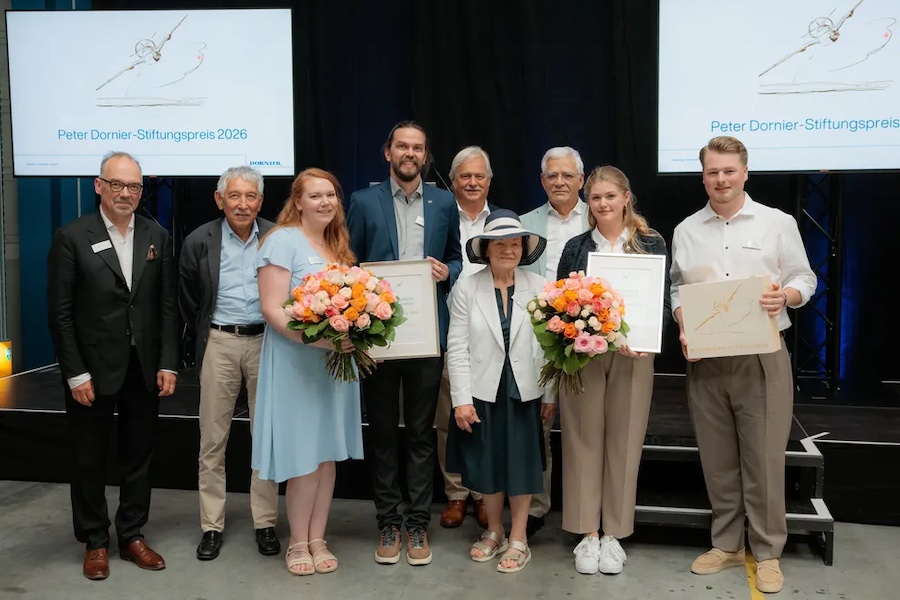
Fewer pores, greater impact tolerance: Peter Dornier Foundation Prize 2026 honours material research on fibre-reinforced composite components for aerospace industry

Microscopically small pores that form during manufacture, or barely visible impact damage, can severely impair the load-bearing capacity and service life of fibre-reinforced composite components. Two young researchers have presented groundbreaking work in this field and will both be awarded the 2026 Peter Dornier Foundation Prize: Dr.-Ing. Benedikt Neitzel from the Technical University of Ilmenau for his doctoral thesis on pore minimisation in the RTM process, and Johanna Buschmann, M.Sc., for her master’s thesis, completed at the German Aerospace Centre, on the improved impact tolerance of 3D fabrics compared to 2D laminates.

More News on Weaving

#Weaving

“A complex design is only useful if the machine can reproduce it consistently”

Andreas Schnabel, Head of R&D for Technical Weaving Systems at Stäubli, discusses how 3D weaving can create textile reinforcements tailored to the loads within a composite component, where near-net-shape weaving can reduce processing steps and material waste, and what it takes to produce complex structures reliably and economically. He also explains how manufacturers can adapt Stäubli’s modular TF weaving platforms to new applications and how the company’s centre of excellence in Bayreuth supports the transition from research to industrial production.

#Weaving

unspun and Arvind partner to bring 3D weaving into industrial-scale apparel production

US fashion technology company unspun and Indian textile manufacturer Arvind Limited have announced a strategic partnership to introduce OneWeave™ 3D weaving technology into industrial-scale apparel manufacturing. Two machines are expected to become operational at Arvind’s Ahmedabad facility by December 2026, with plans for a potential expansion involving more than 30 additional machines across India and North America in 2027 and 2028.

#ITMA Asia + CITME 2026

Itema brings textile versatility to ITMA ASIA + CITME 2026

Itema announces its participation in ITMA ASIA + CITME 2026, taking place November 20–24 at the National Exhibition and Convention Center in Shanghai. In Hall 3 – Stand D06, the company will showcase two Galileo-RX rapier weaving machines weaving heavy denim and conveyor belt fabrics, demonstrating its ability to address different textile requirements with application-specific configurations. Five additional Itema machines at partner booths will extend the exhibition lineup to upper shoe fabric, label, Jacquard leno fabrics, and shirting, offering visitors a broader view of Itema rapier and air-jet weaving technologies.

#India ITME 2026

Stäubli to introduce new S3292 dobby for high-speed weaving at ITME India 2026

Stäubli will introduce its new S3292 dobby at ITME India 2026, taking place from December 4 to 9 at the India Expo Centre & Mart in Greater Noida, Uttar Pradesh. Designed for high-speed air-jet weaving, the new machine will be among the highlights of the company's presentation, which also includes warp preparation systems, cam motions, Jacquard technologies and digital services.

Latest News

#Associations

Christoph René Holler to succeed Uwe Mazura as managing director of textil+mode

Christoph René Holler will take over as managing director of textil+mode, the German textile and fashion industry confederation, on 1 January 2027. He succeeds Uwe Mazura, who has led the association for 13 years and will remain in charge of collective bargaining policy through the next round of negotiations before retiring.

#Heimtextil 2027

Heimtextil and The Florentin showcase the role of textiles in hotel design

Heimtextil has partnered with Frankfurt hotel The Florentin by Althoff Collection for its new Interior.Architecture.Hospitality campaign. The collaboration will give architects, interior designers and other contract-sector professionals a closer look at how textiles were used in the hotel. The two studios behind the project will discuss their work at Heimtextil on 14 January 2027 in Hall 4.1.

#EU Textile Strategy

EU Commission proposes advanced materials agenda with targets for 2035

The European Commission has proposed an Advanced Materials for Europe agenda to accelerate the development, production and adoption of safer and more sustainable advanced materials. The proposal sets three benchmarks for 2035 and calls for closer coordination among EU member states to help move new materials from the laboratory into industrial production.

#Research & Development

Empa develops liquid-core fibre for insecticide-treated mosquito nets

Empa researchers have developed a liquid-core fibre for mosquito nets that can incorporate insecticides unsuitable for conventional melt spinning. The fibre gradually releases the active ingredient through a polymer sheath. The team developed and tested the yarn over three years in the Innosuisse project MalCoFil with Swiss industry partners Vestergaard and Monosuisse.

TOP