[pageLogInLogOut]

#Textile chemistry

RUDOLF HUB1922 : Innovation rooted into aspirational chemistry
© 2020 Rudolf
The textile industry, one of the major industrial sectors worldwide, is going through a significant revolution, with changes taking place in various sections of textile processing. Biotechnology and biomimicry, for example, are continuously playing an important role in redefining the influence of the textile industry on society, and so is progress made in auxiliary chemistry, with advances investigated and then applied in almost every section of textile processing. The outcome is amazingly promising.

Modern, real science is inextricably intertwined with environmental consciousness and they are definitely not mutually exclusive.

At RUDOLF GROUP modern, real science means pushing R&D so to constantly explore new technology and innovations that help transform the textile and fashion industries. We work to reduce the overall dependency on traditional and virgin resources. Getting textile manufacturers as well as brand and retailers on board is key to achieve real change. By 2030 we aim for a significant fraction of our products to be either sourced through paths alternative to the traditional petrochemicals, or by upcycling waste and/or byproducts from other industries.

“This is the kind of genuine, tangible, environmental consciousness that truly defines us and that entails that RUDOLF GROUP has a responsibility for the needs of society as a whole.” Said Alberto De Conti, Head of Rudolf Fashion Division “We have a maniacal attention to the environmental impact of our operations and products. We have truly embedded in ourselves the notion that “sustainability” is a key issue and critical to the long-term survival of our company and of society at large. “

The combination of modern, real science and environmental consciousness leads to what RUDOLF GROUP call aspirational chemistry something unique and something that positions us as shining example and guiding light throughout the industry. That is, in fact, BETTER CHEMISTRY.

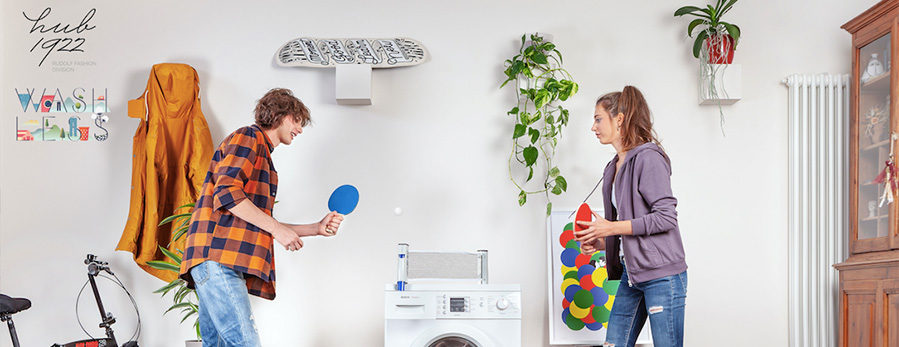
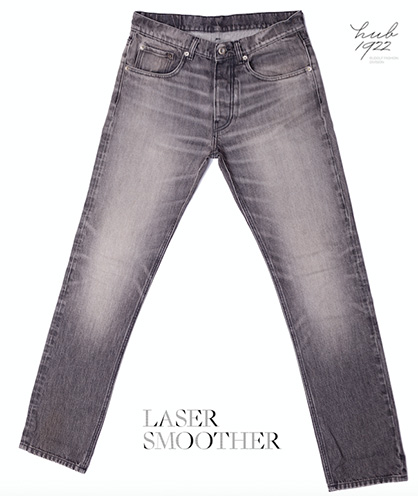
Two are the innovations rooted in aspirational chemistry that RUDOLF HUB1922 presents. The first one is our WASHLESS technology and the second one is a brand new launch: LASER SMOOTHER, which supports laser technology and helps creating much better denim looks.

WASHLESS

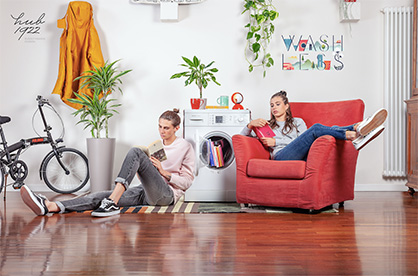
HUB1922 WASHLESS, which can be applied to both denim and non-denim, is the simultaneous application of

  • proprietary fluorine-free DWR (Durable Water Resistance) based on biomimicry to repel dirt
  • anti-microbial, anti-bacteria and anti-viral, non-migrating chemistry to stop body odour.

The combination of the 2 translates into garments that don’t require to be washed as much.

Life cycle assessment studies on clothes, detergents and washing machines show that home laundering is always the most energy-demanding period during these products' life cycle, even higher than production or transportation phases.
© 2020 RUDOLF GROUP
© 2020 RUDOLF GROUP


“WASHLESS aims at changing consumer habits in clothing maintenance to a more environmentally friendly direction and represents a change that is the most feasible and efficient. Making washing machines obsolete is impossible, but even though the technologies in clothes cleaning have improved greatly, the washing frequency has not been reduced. We own more and more clothing and wash it more frequently. This increased amount of washing counteracts the technological improvements in home laundry. “ said De Conti.
© 2020 RUDOLF GROUP
© 2020 RUDOLF GROUP


It is only by understanding the climate change impact associated with home laundering that product innovations and consumer education can be explored. Studies consistently show that a carbon dioxide reduction of 105 MT and electricity savings of 142 thousand GWh can be obtained by reducing home laundering, on average, by 1/3. This is roughly equivalent to removing 12% of the 140 M passenger cars in the US, or taking 23 coal power plants off the grid.

In addition, more than 60% of water consumed while laundering (2,000 billion liters) can be reduced through these strategies.

© 2020 RUDOLF GROUP
© 2020 RUDOLF GROUP


LASER SMOOTHER

Laser denim is the current dominant technology available to the denim industry to create locally abraded areas, vintage effects, whiskers, patterns, patches, and even intentional holes and tears in a garment. Laser technology uses less water, harmful chemicals (such as potassium permanganate) and energy to create a wide variety of denim looks.

However, laser is not always able to produce the desired look, on the desired fabric, in the desired time. Therefore, chemical companies have been developing laser boosters that can be pre-applied to the garments in order to intensify the effect of the laser to mimic heavier bleaching applications. Unfortunately, laser boosters can create blurred images where the definition is lower and the overall image less natural.
© 2020 RUDOLF GROUP
© 2020 RUDOLF GROUP


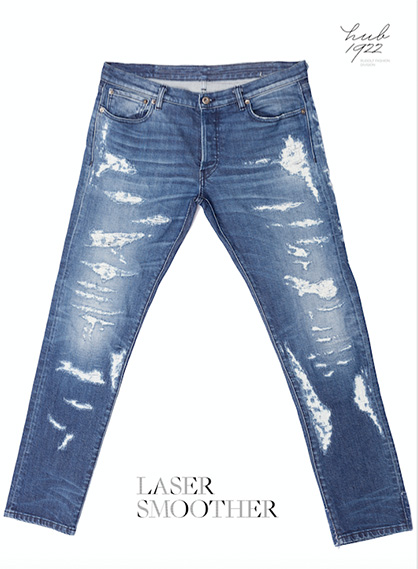
The brand new RUDOLF HUB1922 LASER SMOOTHER is an all-in-one formulation, very easy to pre-apply to garments before laser burning and that return a very natural image which is very similar to the highly desirable hand scraping. Laser smoother can be applied by traditional exhaust or through nebulization and it dries at normal temperature in normal tumble driers.  Advantages of LASER PRIMER are:

  • Remarkable enhancement of the fabric’s characteristics (heightening of material)
  • Overall effect much more natural and similar to manual scraping (craftsmanship dimension)
  • Reduced required laser power to achieve the wanted effect (conspicuous energy saving)
  • A faster laser burning process (significant time saving, depending on the final effect)
  • Any other chemical spray is not required (environmental friendliness) 
  • Reduced cost compared to other solution (financial viability)



More News from TEXDATA International

#Texprocess 2026

Texprocess 2026: Automation, digitalisation and AI redefine textile processing

Making investment decisions in textile processing has become significantly more demanding. Increasing energy costs, a shortage of skilled labour and ongoing geopolitical uncertainties are compelling companies to focus on technologies that deliver clear gains in efficiency and process reliability. This applies equally to apparel manufacturing and to the processing of technical textiles and high-performance materials. As a result, modernisation initiatives are assessed more carefully – even as the need to upgrade production systems continues to intensify.

#Techtextil 2026

Techtextil 2026: Between innovation pressure & market reality

From 21 to 24 April 2026, Techtextil in Frankfurt am Main will once again become the central meeting point for the international technical textiles and nonwovens industry. Running in parallel, Texprocess will focus on the industrial implementation of textile processing technologies as the leading platform in this field. Together, the two trade fairs form a closely integrated presentation and working platform along the entire textile value chain – from material development to finished applications.

#Techtextil 2026

Between geopolitical pressure and industrial resilience

In this interview, Dr. Janpeter Horn (VDMA) discusses the current challenges facing textile machinery manufacturers, shaped by geopolitical tensions, regulatory developments and subdued investment. He also outlines why innovation strength, integrated solutions and strategic positioning remain key to global competitiveness.

#Texprocess 2026

Between investment restraint and modernization pressure

Texprocess 2026 takes place in a complex market environment shaped by uncertainty and innovation pressure. In this interview, Elgar Straub (VDMA) explains why the trade fair is particularly relevant this year and which technologies are driving efficiency and competitiveness.

More News on Textile chemistry

#Sustainability

bluesign technologies introduces bluepass

bluesign technologies ag (www.bluesign.com) today announces the launch of bluepass, a new certification mark and product labeling system created to deliver clear, substantiated, and verifiable sustainability claims at scale.

#Textile chemistry

Officina39 expands in South Asia with dual trade show presence and new low-impact dyeing innovation

Officina39 reinforces its strategic expansion in South Asia by announcing its participation in two key textile industry events in Bangladesh and India, alongside the launch of a new solution designed to reduce the environmental impact of reactive dyeing.

#Techtextil 2026

Speed and connectivity: Techtextil and Texprocess provided market-ready solutions for industries under pressure

With more than 36,000 visitors and 1,700 exhibitors from a total of 112 countries, Techtextil and Texprocess 2026 demonstrated how innovation comes into industrial use. The convergence of research, industry and application proved to be a breeding ground for new material solutions, manufacturing and processing technologies. Natural fibres, performance apparel, connected systems and AI-driven processing technologies emerged as key growth and future markets.

#Techtextil 2026

RUDOLF is pioneering the future of technical textiles by developing innovative, functional solutions

At Techtextil 2026, RUDOLF presents its latest innovations for textile auxiliaries, textile care and construction chemicals. Based in Geretsried, Bavaria, the company draws on more than 100 years of experience and continues to position itself as a global technology partner focused on quality, innovation and sustainability.

Latest News

#INDEX 2026

ANDRITZ at INDEX ’26: Driving sustainability with next-generation nonwoven technologies

From May 19-22, ANDRITZ Nonwoven & Textile is presenting its innovative solutions for the nonwoven & textile industry in Geneva, Switzerland. ANDRITZ will focus on technologies for sustainable and durable nonwovens, converting, sustainable fiber processes, textile recycling, and life-cycle services on booth 2114 in hall 02.

#INDEX 2026

INDEX™26: World’s leading nonwovens exhibition presents groundbreaking product launches, exclusive seminars and immersive experiences

From 19 to 22 May 2026, 620 exhibitors from 44 countries will gather in Geneva at Palexpo for INDEX™26. The exhibition aims to demonstrate how the future of technical materials will increasingly be shaped by collaborative supply chains and integrated innovation across the nonwovens industry. This year’s edition focuses not only on individual technological advances, but also on how cooperation throughout the value chain can enhance the performance, sustainability and value of nonwoven solutions.

#INDEX 2026

The LYCRA Company launches LYCRA® ADAPTIV fiber for nonwovens, advancing comfort and fit in disposable hygiene at INDEX™ 26

The LYCRA Company, a leader in innovative and sustainable fibers for apparel and personal care, today announced the official global launch of LYCRA® ADAPTIV fiber for nonwovens at INDEX™ 26, in Geneva, Switzerland, May 19–22. This breakthrough stretch fiber, already trusted by leading global apparel brands, now ushers in a new era of comfort, fit, and performance for baby diapers, disposable hygiene products, adult incontinence, and feminine care.

#INDEX 2026

Innovations for today – solutions for tomorrow: Trützschler Nonwovens at INDEX™ 2026

From 19 to 22 May, Trützschler Nonwovens will present itself at booth 1641 as a long-term partner to its customers. The focus will be on new products for all nonwoven processes, further developments of the digital working environment T‑ONE, and an expanded service portfolio.

TOP