[pageLogInLogOut]

#Sustainability

Aid by Trade Foundation turns 20, invests half a million Euros in new biodiversity fund

To effectively promote nature conservation and biodiversity, the Aid by Trade Foundation (AbTF) announced at the second Hamburg Sustainability Conference (HSC) that it would be investing 500,000 euros in the ‘AbTF Biodiversity Fund’ to mark the foundation's 20th anniversary. Since it was established in 2005 by the entrepreneur Prof. Dr Michael Otto, AbTF has been committed to transforming the textile and fashion industries.
Prof. Dr Otto, Entrepreneur and Founder of the Aid by Trade Foundation © 2025 Aid by Trade Foundation


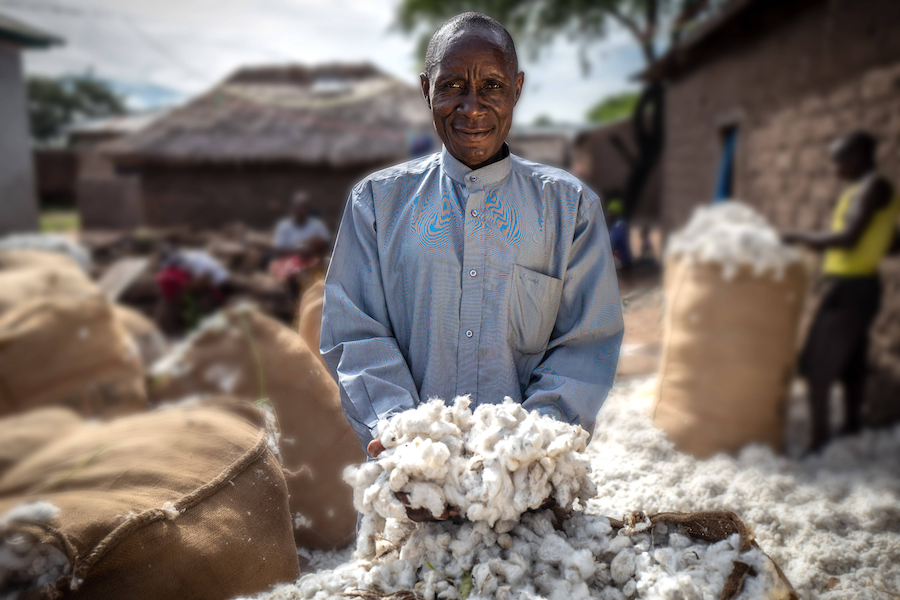
The foundation has made it its mission to conserve nature in areas where cotton and cashmere are produced. It pursues these goals through its internationally recognised sustainability standards as well as by supporting farming families in optimising their agricultural operations. Its support enables them to improve their living conditions and build up the resilience of their farming to climate change and market fluctuations.

Aid by Trade Foundation launches biodiversity fund

“In view of the global climate and environmental crises, we need to fundamentally rethink our actions and their impact on the environment,” explains Tina Stridde, the managing director of the Aid by Trade Foundation, adding, “Our ‘Aid by Trade’ approach is succeeding in activating trade to create positive effects for nature, people, and animals and to provide essential funding for an issue close to our hearts: the preservation of biodiversity.”

The first project funded by the AbTF Biodiversity Fund will be implemented in collaboration with African People and Wildlife (APW), a renowned organisation for community-oriented nature conservation based in Tanzania. APW has earned international recognition for its efforts in promoting peaceful coexistence between people and endangered wildlife.

The Aid by Trade Principle

The Aid by Trade Foundation has changed the textile and fashion industry worldwide over the past 20 years through its sustainability standards: Cotton made in Africa® (CmiA), Cotton made in Africa Organic, The Good Cashmere Standard® (GCS), and the Regenerative Cotton Standard® (RCS).

In 2005, against the backdrop of the WTO conference in Cancún in 2003, AbTF was founded by the entrepreneur Prof. Dr Michael Otto with three primary aims: making a decisive and measurable contribution to the sustainability of raw-material producers and their communities, improving their working and living conditions, and protecting nature. What began with Cotton made in Africa in three African countries is now a global foundation that maintains four recognised sustainability standards for cotton and cashmere. These standards are opening doors for retailers and brands, raw-material producers, and the textile supply chain, not to mention for consumers. AbTF has always remained true to the principle of activating market forces to provide aid—and this approach is only growing more successful.

“Who, in 2005, would have thought that a global alliance of fashion brands and textile companies would now be demanding raw materials verified according to the standards of the Aid by Trade Foundation?” asks Prof. Dr Michael Otto. “I am thrilled that this is the case today,” he continues, “and I am convinced that the foundation will keep making a significant contribution to sustainable fashion and will lead the way for people and the environment through its new biodiversity fund.”

Success in Trade and in the Field

The Aid by Trade Foundation has been continuously expanding its operations since 2005. Every year, millions of textiles bearing a label of the Hamburg-based Aid by Trade Foundation are sold. More than 3,000 partners in the market are implementing their sustainability goals with AbTF. By partnering with the foundation, they also make a significant contribution to nature conservation, animal welfare, and more dignified working and living conditions in cultivation regions.

AbTF launched its first initiative, CmiA, in 2006 with 100,000 small-scale farmers in three countries in Africa South of the Sahara. Now, in 2025, CmiA works with 22 cotton companies, 65 retailers and brands, and approximately 800,000 small-scale farmers in ten African countries. This means that the standard is verifying over one third of all cotton produced in Africa.

Eventually, two other cotton standards were added: Cotton made in Africa Organic and Regenerative Cotton Standard®. The launch of RCS with its holistic approach also represented AbTF’s first expansion of a cotton standard beyond Africa, to India. The Good Cashmere Standard®, established in 2019 as the first standard for sustainable cashmere from Inner Mongolia, has also proved its effectiveness. Having quickly risen to become a global leader in verifying sustainable cashmere production, GCS is now in demand by more than 50 fashion brands and textile companies, including H&M, J.Crew, Zadig&Voltaire, and The White Company. In China’s Inner Mongolia, GCS works with around 5,500 herders on whose farms 2.4 million goats live.


More News from Aid by Trade Foundation (AbTF)

#Raw Materials

Aid by Trade Foundation reaches new milestones in supply chain transparency

The Aid by Trade Foundation (AbTF) is reaching new milestones as it leads the way towards greater physical traceability for Cotton made in Africa® (CmiA) cotton. With around 700 suppliers and producers in a total of 25 countries, the Aid by Trade Foundation has reached a new record number of partners who can trace CmiA cotton from the product back to its origin. This is more than double the previous year’s figure.

#Natural Fibers

Cashmere producers stress the importance of The Good Cashmere Standard®

At the invitation of the Aid by Trade Foundation (AbTF), over 70 experts from the cashmere production and supply chain, as well as other specialists, met at the GCS Unit Meeting in Shanghai, China to discuss the progress and new objectives of The Good Cashmere Standard (GCS). The meeting focused on implementation and verification of the standard, important aspects of animal welfare and the importance of the standard in the global textile market.

#Natural Fibers

Aid by Trade Foundation publishes 2024 annual report: Growing impact for environment and people

The Aid by Trade Foundation (AbTF) is on a growth track. Despite a challenging global economy, AbTF increased its income by six percent from 2023 to 2024, reaching a total of EUR 8.6 million. This revenue has been invested in comprehensive measures for the sustainable production of cotton and cashmere as well as for expanded measures to ensure transparency in global value chains. In addition to gaining new partners in 2024—including big names like Mango, Nordstrom, and CWS Workwear—AbTF was able to expand its global stakeholder network active in the production of raw materials or textiles.

#Raw Materials

Aid by Trade Foundation receives Honorary Award of the German Africa Foundation 2025

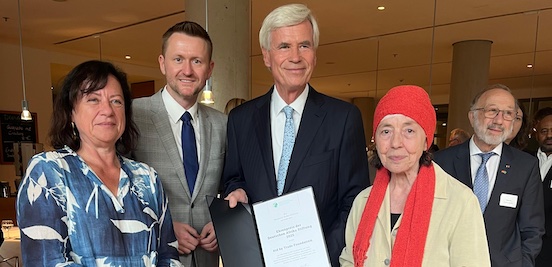
On the evening of 25 June, the Hamburg-based Aid by Trade Foundation (AbTF) received the Honorary Award of the German Africa Foundation 2025. Prof. Dr Michael Otto, the foundation’s founder and a prominent entrepreneur, accepted the award at a ceremony held at the German Bundestag. The Parliamentary State Secretary to the Federal Minister for Economic Cooperation and Development (BMZ), Dr Bärbel Kofler, presented the award in the presence of guests from politics, business and civil society as well as representatives of African embassies.

More News on Sustainability

#Sustainability

Textile Exchange unveils commitment-based pathway for members to accelerate responsible raw material production

Textile Exchange has unveiled further details about its new membership structure, designed to guide the fashion, textile, and apparel industry in a collective course of action toward preferred production systems for raw materials and fibers.

#Textile chemistry

Jeanologia urges industry to accelerate PP Spray phase-out following ZDHC Watchlist update

Potassium permanganate has officially entered the Chemical Watchlist of the ZDHC Foundation, signaling increased scrutiny and potential phase-out of one of the most hazardous chemicals still used in denim finishing. The inclusion confirms an industry shift that Jeanologia anticipated more than a decade ago.

#Textiles & Apparel / Garment

Global Standard strengthens presence in Southeast Asia at VIATT 2026

Global Standard will participate in the Vietnam International Trade Fair for Apparel, Textiles and Textile Technologies (VIATT) 2026, organized by Messe Frankfurt, the first textile trade show in the APAC region this year. Global Standard will host a booth and Felica Shi will lead a seminar on Global Organic Textile Standard (GOTS). The trade fair will take place from February 26 to 28, 2026, in Ho Chi Minh City, Vietnam.

#Sustainability

Ying McGuire becomes new CEO of Cascale

Cascale today announced the appointment of Ying McGuire as Chief Executive Officer, effective June 1, 2026.

Latest News

#Techtextil 2026

Monforts to showcase advanced coating solutions at Techtextil 2026

Over the past few years Monforts has significantly advanced its technologies for coating, with the successive introductions of the MontexCoat, coaTTex and VertiDry systems combining flexibility, precision and energy efficiency for the technical textiles market.

#Composites

JEC World 2026 returns with an unprecedented content program

Recognized worldwide as the leading trade exhibition for composite materials and their applications, JEC World returns on March 10-12, 2026, at Paris Nord Villepinte as the most ambitious edition to date, in line with its motto “Pushing the limits”. As the must-attend event for the composites industry, JEC World will offer an unprecedented program, blending conferences, markets insights, technical sessions, awards, and above all, a unique experience and invaluable connections.

#Raw Materials

Beyond the wardrobe – innovative cotton takes the spotlight

Cotton can do more – a lot more. Cutting-edge textiles and high-tech products made from 100% cotton prove just how powerfully performance and sustainability can come together. That very surge of innovation is front and centre at the 38th Bremen Cotton Conference, taking place March 25–27, 2026, at Bremen’s Parliament on the historic market square – culminating in a bold and dedicated closing session on Friday. In the spotlight: performance upgrades for pure cotton, smart strategies for circular textile waste solutions, and pioneering concepts for demanding technical applications. From natural fibre–reinforced composites to highly effective flame-retardant solutions, cotton steps out of the closet and shows the future potential woven into every fibre.

#Digital Printing

Keeping print inclusive: Empowering women in the print industry

Across all industries, cultivating a diverse and inclusive workplace is increasingly recognised as valuable and essential to long-term success. However, despite the print industry’s significant advancements in technology and innovation, visible representation of women remains limited. As the sector grapples with low recruitment, it’s important to challenge outdated perceptions. Creating real change, however, requires collective effort - no single company can do it alone.

TOP