[pageLogInLogOut]

#Weaving

Major investments in climate neutrality and machinery: Lindauer DORNIER gears up for a successful future
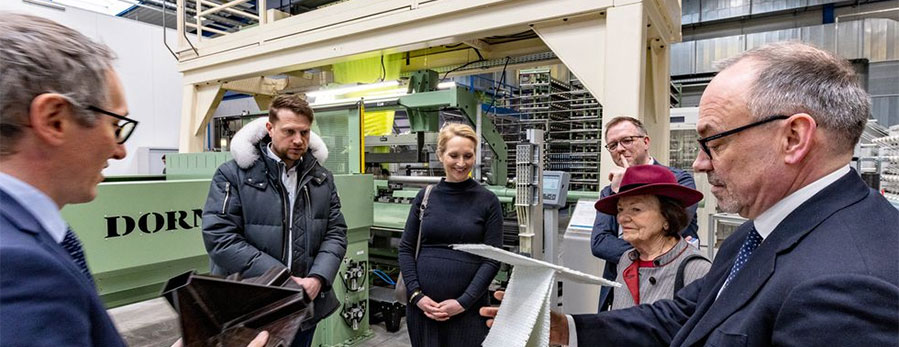
Group photo with guests from politics and business during the factory visit of Lindauer DORNIER GmbH in Esseratsweiler © 2023 Lindauer DORNIER
In order to make itself fit for the future and to take further steps towards climate neutrality, Lindauer DORNIER GmbH intends to invest more than 8 million euros at its Lindau and Esseratsweiler sites.

The money will go into photovoltaic systems and the modernisation of the machinery. For the family-owned company, this amount, financed entirely from its own resources, is the largest investment project in recent decades. When visiting the plant in Esseratsweiler, Lindau's Mayor Dr. Claudia Alfons, who is also chairwoman of the supervisory board of the public utility company Stadtwerke Lindau, and Tobias Walch, mayor of the municipality of Achberg, both expressed their delight at DORNIER's solar power, which will in future also supply the public power grid via Stadtwerke Lindau.
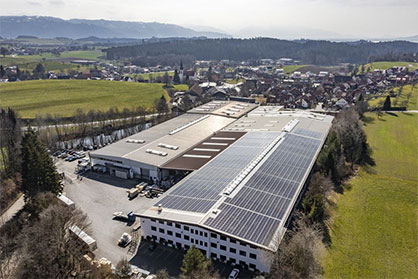
More sustainable with solar power: The new photovoltaic plant of Lindauer DORNIER will in future produce
More sustainable with solar power: The new photovoltaic plant of Lindauer DORNIER will in future produce "green" electricity for its own consumption and for the public grid in the Lindau region © 2023 Lindauer DORNIER


"This is the largest investment in our recent company history", Franz-Peter Matheis, Commercial Director at Lindauer DORNIER, emphasised the dimensions of the current investment program. The funds amounting to more than 8 million euros will be invested mainly in photovoltaic systems for the company's own power supply, a nitrogen production plant, the modernisation of the machinery and the optimization of logistics. "With these investments, we aim to navigate Lindauer DORNIER safely through the enormous challenges of our time," says Matheis. These include not only climate change, but also the shortage of skilled workers and young talent, as well as the requirements of digitalisation. The fact that the entire amount is financed from the company's own resources has a long tradition in the family business: Peter Dornier, the company's founder, already attached importance to financing even larger investments from his own resources.

Climate-neutral with self-sufficient power from photovoltaics

Measures to achieve greater climate neutrality are one of the focal points of investment. In order to be able to supply itself with self-generated solar power in the future, DORNIER put into operation a photovoltaic system on the roof of the production hall in Esseratsweiler at the end of last year. Approximately 1,900 solar modules on an area of 4,000 m² (the equivalent of about ten basketball courts) will supply about 750,000 kWh p.a. of electricity from now on.

For comparison: The average electricity consumption of a four-person household is about 4,000 kWh, which means that this output would be sufficient to supply around 185 four-person households with electricity for a whole year. It would thus be theoretically possible to cover the entire power consumption of the district of Esseratsweiler with its approx. 740 inhabitants with electricity from the DORNIER plant.

According to Stadtwerke Lindau, this makes the company's solar plant one of the largest in the region. DORNIER will use about two thirds of the solar power generated itself, such as for lighting offices and production halls or to weld and bend sheet metal parts for its machines and plants. To ensure that any unused solar power, i.e. the electricity generated at weekends, is not lost, it is fed into the public grid via the public utility company.


Mayor visits solar plant

This was particularly welcomed by Mayor Dr. Claudia Alfons during her visit to the plant in Esseratsweiler on 6 March 2023: "I am very pleased that Lindauer DORNIER is making an active contribution to more climate protection in the region with its new photovoltaic plant. Because part of the solar electricity generated here is fed into the public grid via Stadtwerke Lindau, our citizens in the Lindau region also benefit from this 'green' electricity."

As a next step, the machine and plant manufacturer also wants to generate electricity from photovoltaics at its main plant in Lindau. The challenge here: Some areas of the business premises are subject to the protection of historical monuments. In addition, DORNIER traditionally cultivates a philosophy of living, green factory premises. Thus, there are many decades-old trees between the production halls in Lindau. Nevertheless, plans for the installation of further solar plants on the rooftops are also in full swing here. CEO Peter D. Dornier: "In the long term, we want to secure our energy needs entirely from renewables and reduce our "CO2 footprint" to a minimum."

Producing sustainable products more energy-efficiently

A considerable part of the investment sum flows into machinery, EDP and logistics. One of the key questions is: How can processes be technologically optimized so that sustainable end products are produced even more economically and energy-efficiently? DORNIER customers use the company's weaving machines and film production lines to manufacture products that contribute to protecting people and the environment as well as helping to bring about the energy turnaround. Thus, DORNIER plants not only supply film for hygienic packaging, but also for solar modules as well as for batteries and capacitors in the drive train of electric cars. DORNIER weaving machines produce fabrics that protect against injuries, help to clean exhaust gases and produce hydrogen in electrolysis plants for a future "hydrogen economy".

As part of the sustainability investments, a new nitrogen plant has already been installed at the Esseratsweiler factory. It has been successfully in operation since the end of November and will supply DORNIER with self-produced nitrogen in future. This is required for flame and laser cutting of sheet metal parts and previously had to be purchased at high cost from external sources. Costs that will be eliminated in the future: "Because we also operate the nitrogen plant with our own solar power, we will in future obtain our nitrogen in a CO2-neutral way right here on site", explains Franz-Peter Matheis. As a result, CO2-intensive lorry journeys, which were necessary several times a week to transport the nitrogen in large tanks to DORNIER, will belong to the past. In the coming years, the family-owned company with an annual turnover of 370 million euros (2022) will continue to invest massively in the areas of sustainability, energy efficiency and digital transformation. Tobias Walch, mayor of Achberg, is particularly pleased about this. "We are proud that Lindauer DORNIER will continue to contribute to a positive and stable budget for the community of Achberg also in future."
More News from Lindauer DORNIER GmbH

#Weaving

Lindauer Dornier announces leadership transition in weaving machine business

After more than ten successful years at Lindauer DORNIER GmbH, Mr Wolfgang Schöffl will leave the family-owned company at the end of the year to enter well-deserved retirement.

#ITMA Asia + CITME Singapore 2025

DORNIER celebrates its anniversary at ITMA Asia + CITME

To mark its 75th anniversary, machine and plant manufacturer Lindauer DORNIER will be presenting the latest developments in its rapier and air-jet weaving machines at ITMA Asia + CITME in Singapore (Hall 2, Stand B401) from 28 to 31 October 2025. The focus will be on energy-efficient weaving technologies, new IoT solutions for networked textile production and systems for the series production of modern fibre composite components.

#Weaving

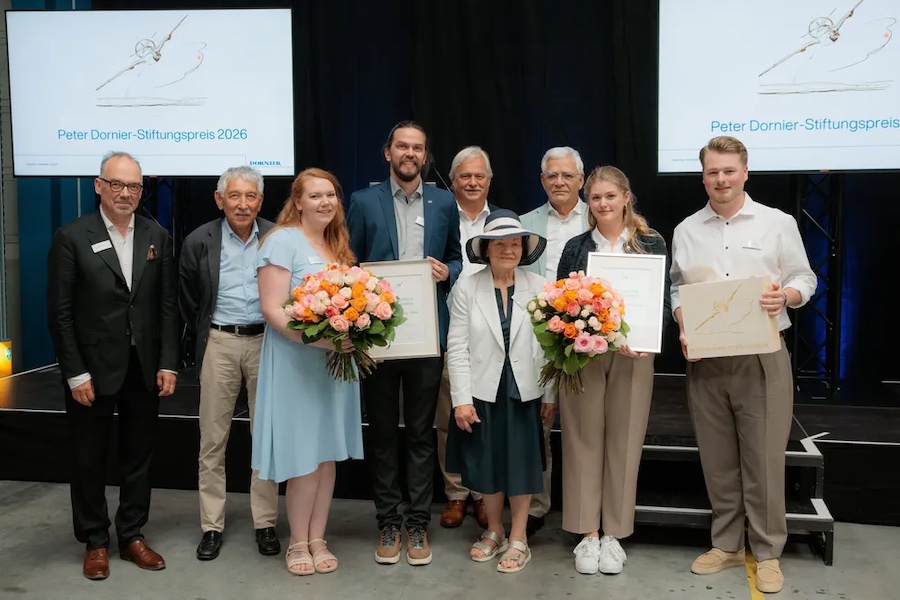
From the Venus flytrap to foldable aircraft wings: Peter Dornier Foundation Prize 2025 honours bionic research on 3D weaving technology

Long wings with foldable tips have the potential to reduce aircraft fuel consumption and make aviation more sustainable. An interdisciplinary research team has now developed a new solution based on the Venus flytrap: Freely movable wingtips made of fibre composites which are produced using innovative 3D weaving technology. For this pioneering combination of textile technology, aviation and bionics, researchers Patrick Meyer (TU Braunschweig) and Michael Vorhof (TU Dresden) were awarded the Peter Dornier Foundation Prize 2025 in mid-July.

#Weaving

Pattern-controlled “pic-a-pic” setting of rapier release timing on right-hand side

DORNIER PIRO enables the operator to set the timing of the rapier release on the right-hand side of the machine “pic-a-pic” and pattern-controlled. For applications with weft yarns of different fineness or elasticity, the optimum timing can be set for each weft channel. This offers great potential for reducing weft waste on the right-hand side.

More News on Weaving

#Research & Development

More safety and comfort for protective clothing thanks to auxetic fabrics

When everyday materials are pulled, they stretch or elongate in the direction of the pull and become narrower in cross-section. We can also observe this property in two-dimensional textiles. Auxetic structures behave differently here. They have the striking property of not changing under tensile stress or even increasing their width or thickness. These properties are advantageous, for example, in protective textiles or textile filter media. The DITF are researching auxetic fabrics for various applications.

#Weaving

Itema announces strategic partnership with Ivy Decarb to accelerate decarbonization in weaving process

Itema is pleased to announce the strategic partnership with Ivy Decarb, the digital platform helping textile companies measure and reduce their carbon footprint.

#Exhibitions & Events

Groz-Beckert showcases textile innovation at ShanghaiTex 2025

From December 16 to 19, 2025, the global textile industry will gather at ShanghaiTex at the Shanghai New International Expo Center (SNIEC), where Groz-Beckert will present its latest highlights and innovations across its five product areas – Knitting, Weaving, Nonwovens, Sewing, and Spinning – at Hall N3, Booth A05.

#Weaving

Vandewiele Group: Innovation across the textile value chain at ICFE Istanbul 2026

At the 2026 Istanbul Carpet & Flooring Expo (ICFE), Vandewiele Group presents its latest advancements spanning the entire textile value chain. From spinning and weaving to tufting, carpet manufacturing and digital finishing, the Group demonstrates how integrated innovation can boost performance, efficiency and sustainability across all stages of production. As a global technology leader, Vandewiele continues to develop solutions that strengthen processes, enhance product quality and enable smarter, greener manufacturing.

Latest News

#Textile chemistry

Devan unveils innovative textile solutions to enhance comfort during sleep at Heimtextil 2026

From 13 to 16 January 2026, Devan was exhibiting at Heimtextil in Frankfurt, the world’s leading international trade fair for home and contract textiles. The event brought together key players from across the global textile value chain, providing the ideal platform for Devan to present its latest innovations.

#Heimtextil 2026

Confidence driving the textile industry: Heimtextil 2026 sharpened its global market relevance by attracting more top-level decision-makers

With 148 participating nations, rising global relevance and a marked increase in visitor quality, Heimtextil 2026 stood for stability and reliability in a volatile market environment. Once again, 3,000 exhibitors from across the globe placed their trust in the industry’s central platform in Frankfurt, presenting current collections, materials and textile solutions for holistic interior design to over 48,000 buyers. Under the motto “Lead the Change”, Heimtextil brought evolving market dynamics, Artificial Intelligence (AI) and new business opportunities to life.

#Recycled_Fibers

Borealis invests EUR 49 million in Burghausen, Germany to accelerate design for circularity

Borealis announces a EUR 49 million strategic investment to scale up production of Borstar® Nextension polypropylene (PP) at its manufacturing site in Burghausen, Germany. This will expand commercial production of next-generation single-site polypropylene (ssPP) grades that deliver enhanced purity, processability, and performance - supporting customers in key sectors including packaging, healthcare, mobility, and fibers, to meet evolving market and regulatory demands.

#Associations

Latest news from Bremen: ICAC Plenary Meeting to take place right before the International Cotton Conference

The International Cotton Advisory Committee (ICAC) will hold its 83rd Plenary Meeting on 23–24 March 2026 at the Parliament building in Bremen. The meeting will take place immediately ahead of the 38th International Cotton Conference Bremen (25–27 March 2026) and marks a historic premiere: for the first time, the ICAC Plenary will be hosted in close cooperation with the Bremen Cotton Exchange and the Faserinstitut Bremen e.V. (FIBRE).

TOP