[pageLogInLogOut]

#Textile chemistry

Bluesign announces partnership with SCTI to create the first comprehensive sustainable chemistry index for the textile industry
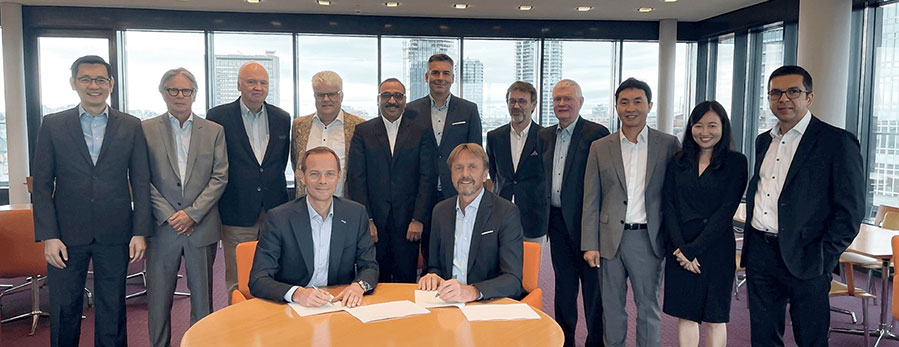
Seated from left: Wolfgang Anton Schumann, Chairman of SCTI and Kurt Schläpfer, Head of Customer Relation Management of Bluesign at the signing ceremony. Standing from left: Kin Keong Chan, Peter Waeber, Dennis Dalton, Thomas Schäfer, Rohit Aggarwal, Benoit Moutault, Marcos Furrer, Simon Collinson, Sung Yong Cho, Marilyn Chua, Ümit Yaldiz © 2022 Bluesign
Bluesign has teamed up with Sustainable Chemistry for the Textile Industry (SCTI™) to develop a sustainable chemistry index that will provide a standard communication guide for chemical suppliers, manufacturers, brands, and NGOs

The first-of-its-kind index is intended to inspire change in the industry by making it easier for stakeholders to assess the sustainability of textile chemical products against the highest standards while safeguarding the intellectual property (IP) of participating chemical companies. IP protection is critical to ensuring ongoing investment in sustainable solutions.

SCTI™ is an alliance of leading chemical companies that strives to empower the textile and leather industries to apply sustainable, state-of-the-art chemistry solutions that protect factory workers, local communities, consumers and the environment.

Bluesign will implement and manage the sustainable chemistry index as an independent authority with a holistic approach to help companies throughout the textile supply chain improve their sustainability performance.

Chemical products, such as dyes and textile auxiliaries, are often characterized with the attribute of “free of a certain substance”. Rather than prioritizing ingredients only, the bluesign® SYSTEM already goes beyond this. The chemicals and the production site where they were created must meet certain criteria regarding environmental performance, occupational health and safety, and product stewardship performance to be bluesign® APPROVED.

The sustainable chemistry index will be reserved for substances that offer transparency on a number of additional indicators including the chemical’s circularity viability, greenhouse gas emissions during production, and the source of the raw materials. The sustainable chemistry index will also require that the downstream use of the chemical is optimized, meaning, for example, that it promotes resource saving in textile finishing. Additionally, excellent corporate governance paired with well-defined environmental and social (ESG) goals will be a pre-condition.


Dr. Wolfgang Anton Schumann, SCTI™ Chairman, said: “Through its independent position, Bluesign has earned the industry’s trust to provide sustainable chemical solutions and impact reductions across the supply chain for the past two decades.This partnership exemplifies our organizations’ joint expertise and how collaboration creates solutions that can drive meaningful change across an industry to reduce impact on people and our planet.”

Daniel Rüfenacht, Bluesign CEO, added: “SCTI™ offers deep sustainability knowledge in the chemical industry. The new sustainable chemistry index will help the industry progress beyond current regulations and realize the EU Chemicals Strategy for Sustainability by providing textile chemical users a clear rating on a substance’s environmental and social impact to advance decision-making”.

The mission for the joint partnership between Bluesign and SCTI™, and the sustainable chemistry index in particular, is to drive transformational change through sustainable chemical solutions. Providing textile and apparel industry players with a verified inventory of sustainable chemical products is a first step on this shared journey.




More News from TEXDATA International

#Recycling / Circular Economy

textile.4U publishes special edition “Top 100 Textile Recycling Companies 2025”

With a comprehensive 176-page special edition, textile.4U is dedicating its latest issue entirely to one of the most dynamic and influential topics in today’s textile industry: textile recycling. The new issue, published exclusively in high-quality print, presents the Top 100 textile recycling companies researched and selected by TexData – organizations that already play a key role in the transition to circular textiles or are expected to have a significant impact in the near future.

#Recycling / Circular Economy

Responsible Textile Recovery Act of 2024 signed by Governor

Senator Josh Newman (D-Fullerton) is proud to announce that Senate Bill 707 (SB 707), the Responsible Textile Recovery Act of 2024, has been signed into law by the Governor of California, Gavin Newsom. This groundbreaking legislation establishes the country’s first Extended Producer Responsibility (EPR) textile recycling program, marking a significant step forward in the state’s efforts to combat waste and promote sustainability.

#Textiles & Apparel / Garment

Modtissimo promotes sustainability with 28 coordinates in the Green Circle

Modtissimo is proving more and more to be a textile and clothing show that delivers the latest innovations in the area of sustainability, with the iTechStyle Green Circle being the main showcase for companies' creations. In this 60+4 edition, taking place on 12 and 13 September, 28 coordinates will be exhibited in a section organised by CITEVE and curated by Paulo Gomes.

#Europe

The EU and Egypt team up to mobilise private sector investments at Investment Conference and sign a Memorandum of Understanding underpinning €1 billion in macro-financial assistance for Egypt

At the EU-Egypt Investment Conference, co-organised by the EU and the Government of Egypt on 29-30 June, the EU and Egypt are teaming up to intensify private sector investments in Egypt. They are also signing a Memorandum of Understanding (MoU) for the disbursement to Egypt of up to €1 billion in Macro-Financial Assistance.

More News on Textile chemistry

#Textile chemistry

DyStar Group Announces Board Transition to Drive Innovation

DyStar, a leading specialty chemical company with a heritage of more than a century in product development and innovation, announced today the appointment of Ruan Cunfan to its Board of Directors, effective 20 February 2026.

#Textile chemistry

Jeanologia urges industry to accelerate PP Spray phase-out following ZDHC Watchlist update

Potassium permanganate has officially entered the Chemical Watchlist of the ZDHC Foundation, signaling increased scrutiny and potential phase-out of one of the most hazardous chemicals still used in denim finishing. The inclusion confirms an industry shift that Jeanologia anticipated more than a decade ago.

#Textile chemistry

RUDOLF gets the exclusive global distribution rights for Sanitized® textile technologies

With effect from today, RUDOLF officially assumes exclusive global distribution rights for Sanitized® textile technologies from SANITIZED AG. This is the next milestone in the strategic collaboration announced in 2025, with the partnership between the two companies now fully implemented and expanded worldwide.

#Denim

organIQ seek: smart alternative to potassium permanganate

CHT Group announces new technical findings within its organIQ seek platform that significantly advance the transition toward permanganate-free denim bleaching. Through extensive industrial testing and application research, CHT confirms that organIQ seek can now be used with remarkable effectiveness as a substitute for potassium permanganate in spray bleach, while remaining aligned with sustainability expectations and cost realities in the European market. At the COLOMBIATEX in Medellín as well as at the Exintex in Puebla and the Kingpins Show in Amsterdam the CHT Group will present organIQ seek as an alternative to potassium permanganate.

Latest News

#Techtextil 2026

Knowledge that drives progress: Techtextil and Texprocess forums strengthen the global textile industry with a future-oriented programme

From AI-supported production optimisation and digital manufacturing solutions to circular technologies and bio-based high-performance materials: the Techtextil and Texprocess forums provide answers to the key challenges of the global textile industry with a curated content programme. As hubs for innovation and knowledge, they enhance competitiveness and offer orientation in changing markets. From 21 to 24 April 2026, Frankfurt is once again the global meeting point for thought leaders from industry, research and business.

#Techtextil 2026

Enhanced protection without added weight: Innovative technology for flame-retardant textiles doubles reaction time and ensures high wearing comfort

Flame-retardant textiles have long faced the same dilemma: the higher the level of protection, the greater the compromise in comfort, weight and breathability. This is especially important for workwear and protective clothing worn for long hours, where comfort is crucial to wearer acceptance and satisfaction. At Techtextil 2026 in Frankfurt, Swiss company Textilcolor AG will unveil pyroshell™, an innovative flame-retardant technology designed to tackle this challenge. Protection is provided by a graphite-based functional layer integrated into the textile structure, which doubles the reaction time before burns occur while significantly enhancing comfort. The material does not release any toxic fumes and offers textile manufacturers entirely new opportunities to design and produce protective and functional garments. It is also durable enough to withstand up to 50 industrial washes.

#Composites

JEC WORLD 2026 opens: Paris becomes the World Capital of composites

JEC World 2026 opens tomorrow, March 10, at Paris Nord Villepinte, bringing together the entire composites ecosystem for three days of exhibitions, conferences, technical sessions, strategic industry gatherings, and business meetings. As the “festival of composites”, JEC World is also a destination for a broad spectrum of other professional visitors, eager to discover how these advanced materials can offer sustainable solutions to their industries.

#Spinning

Barmag presents the next generation of POY production – energy-efficient and partial-automated

With POY 2.0, Barmag is introducing a completely redesigned spinning concept that takes the production of partially oriented yarn (POY) to a new level in terms of technology and economy. The solution, which was presented to a selected audience of experts for the first time at ITMA Asia + CITME 2025, was met with great enthusiasm: several yarn producers worldwide immediately expressed their interest in a pilot plant.

TOP