[pageLogInLogOut]

#Sustainability

Epson publishes its 2021 ‘Green Choice’ European sustainability report

Report evidences Epson’s actions and progress towards sustainable transformation through technology innovation

Epson publishes its 2021 ‘Green Choice’ European sustainability report

Report evidences Epson’s actions and progress towards sustainable transformation through technology innovation

“Above all else, our chief aim is to deliver the very best in sustainable technologies for our customers.” Yoshiro Nagafusa - President and CEO, Epson EMEAR.
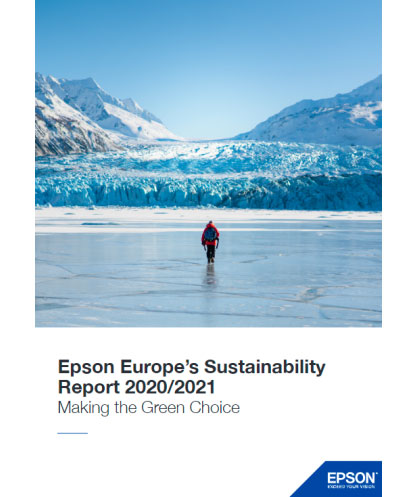
© 2021 Epson
© 2021 Epson


Epson showcases significant progress towards to fully sustainable operations today, with the publication of its 2021 European Sustainability Report, Making the Green Choice. Beyond Epson’s investment in its own transformation, the report details innovations — such as heat-free technologies — that will help every customer achieve a sustainable future.

Sustainability — ambition and investment

Yoshiro Nagafusa, President and CEO, Epson EMEAR, added, “As the world realigns after COP26, Epson continues its ambitious sustainability commitments, investment and objectives. Our lower carbon, less wasteful, heat-free technologies will empower our customers as we all work to deliver on the promise of a sustainable society.”

Epson is targeting ¥100 billion (around €770 million) at its sustainability transformation over the next decade. This will see investment to decarbonise and close resource loops (maximising resource use) internally. Externally, Epson innovation will reduce the environmental impact of customers and develop new products that are inherently sustainable.

Sustainability — commitment

In 2021, Epson has committed to ensure it will, by or before:

• 2023— reduce emissions to align with the 1.5 degree warming target

• 2023 ­— achieve 100% renewable energy use across all Group operations

• 2025 —target reductions in direct (19%) and indirect (44%) emissions

• 2030 —meet the UN’s Sustainable Development Goals — adding goals 1, 2 and 16 to its commitments in 2021, ensuring that all 17 UN SDGs are now in scope

• 2050 —become carbon negative and underground resource (e.g. oil, metals) free


Sustainability — innovation

Today’s Sustainability Report details Epson’s customer-focused and sustainability-led innovation. The company’s heat free printers, for example, can cut power consumption and CO 2emissions by up to 83%. Europe-wide adoption of these technologies would cut 1 billion kWh of energy use a year and 410,000 tonnes of CO 2. Epson’s heat free technologies have inspired a partnership with National Geographic and its work to reverse the thaw of permafrost and an accompanying increase in methane emissions.

Epson’s EcoTank printerssimilarly bring benefits across the value chain, eliminating the need for ink cartridges. To date, EcoTank printers have removed 1.6 million tonnes of plastic based consumable waste from the environment. Further gains can be seen in Epson’s development of new textile printing technologies, which can slash water use by up to 90% and energy by 30%.

Epson also helps customers to close the resource loop with PaperLab.It is a world first dry fibre process that allows in-office paper recycling — to significantly reduce water consumption and the need for transport to offsite recycling centres.

Sustainability — oversight

Epson’s Sustainability Report also details the company’s commitment to independent, robust and internationally respected oversight.

In 2021 Epson has achieved its second consecutive Platinum Status rating with EcoVadis, one of the world’s most trusted business sustainability rating platforms. Platinum status places Epson in the top 1% of sustainability performers in the computer and peripheral equipment manufacturing industry.

Epson’s platinum rating recognises the company’s global corporate social responsibility (CSR) initiatives. In the four themes EcoVadis assessed, Epson received the highest “Outstanding” rating for the environment, as well as high scores for sustainable procurement, labour and human rights and ethics.

Epson has also been awarded Platinum Status with the Responsible Business Alliance (RBA)- the world's largest industry coalition dedicated to corporate social responsibility in global supply chains. Platinum Status is only awarded to those companies that meet the highest standards of Corporate Social Responsibility. Epson has undergone a robust assessment and shown that it is a company dedicated to meaningful sustainability and the wellbeing of its employees.

The past year has also seen Epson:

• Move into the not for profit, global disclosure CDP platform’s A-List — and selected for the second year running as global supply chain leader.

• Join the RE100 initiative through its commitment to 100% renewable electricity

• Operate to ISO 9001 and 14001 standards

• Included in FTSE4Good Index Series for the 18 thconsecutive year

Henning Ohlsson, Director Sustainability, Epson Europe, said, “Epson’s Sustainability Report is much more than an overview of this year’s strategy and progress. It is a covenant that further commits our company to its role as an indispensable partner — innovating technologies that are sustainable as they are used in the real world, not simply when we produce them. It is only by looking at the bigger picture and working together — with scientists, partners and customers — that we can all move to a truly sustainable future.”



More News from Epson Europe

#Digital Printing

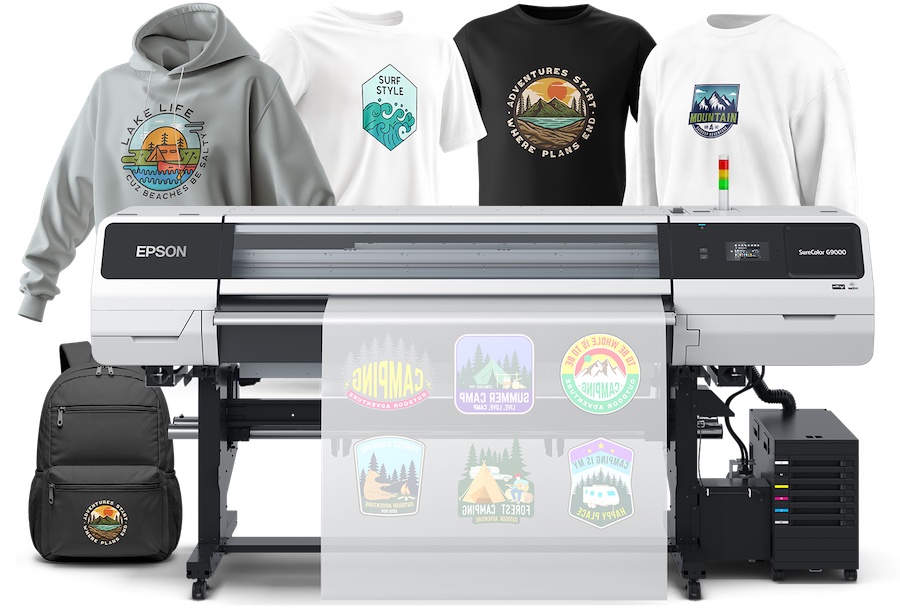
Epson launches SureColor G9000: high-production Direct-To-Film printer delivering greater productivity and reliability

Epson today announces the launch of the SureColor G9000, a new high-production Direct-To-Film (DTFilm) printer designed to meet growing global demand for flexible and efficient textile transfer printing. Expanding Epson’s DTFilm line-up alongside the SC-G6000, the SC-G9000 introduces enhanced speed, reliability and ease of maintenance for commercial garment decorators and textile producers.

#Digital Printing

Epson future proofs textile printing with Epson Textile Academy 2.0

Technology leader Epson today hosted its second Textile Academy Event at the company’s Textile Innovation Centre in Lutterworth, Leicestershire. Building on the success of its inaugural Textile Academy earlier this year, the event welcomed Textile Design BA students from Nottingham Trent University (NTU) and Loughborough University. The event features workshops designed to enhance student’s practical textile printing skills; corporate and entrepreneurial business acumen; marketing and self-branding; and environmental awareness around the textile industry.

#Recycling / Circular Economy

HKRITA and Epson develop silk-like regenerated fiber from cotton

The Hong Kong Research Institute of Textiles and Apparel ("HKRITA") and Seiko Epson Corporation ("Epson"; TSE: 6724) have succeeded in developing new regenerated cellulose fiber with a silk-like sheen from waste cotton fabric through a new production process.

#Digital Printing

Epson unveils Monna Lisa ML-16000JQ for more efficient and sustainable Jacquard fabric printing

Global technology firm Epson announces a new direct-to-fabric digital textile printer designed for jacquard fabrics. The Monna Lisa ML-16000JQ delivers direct-to-fabric double-sided printing on jacquard fabrics, meeting the needs of fashion designers looking to enhance their creativity by seamlessly integrating vibrant colours with intricate woven patterns.

More News on Sustainability

#Sustainability

GOTS version 8.0 released: advanced supply chain accountability, from fibre to finished product

Global Standard is pleased to announce the release of GOTS Version 8.0, the latest update to the world's leading processing standard for organic textiles. The updated Standard strengthens requirements for air emissions and waste management, as well as criteria for product safety. It introduces new provisions on circularity, microfibre management and updates in residue testing. Version 8.0 also elevates due diligence obligations and formalises governance requirements, including ESG disclosure, anti-corruption policies and conflict-of-interest safeguards, to support credible, responsible business conduct.

#Sustainability

The nova-Institute establishes new Renewable Feedstock Department to lay the groundwork for industrial defossilisation

The transition from fossil-based to renewable carbon – sourced from biomass, CO₂ utilisation and recycling – is the cornerstone of a climate-neutral chemical industry. The nova-Institute’s new department is dedicated to providing the essential data, analyses and strategic roadmaps required to secure a reliable future feedstock supply and make this transition a commercial and ecological reality.

#Sustainability

Textile Exchange unveils commitment-based pathway for members to accelerate responsible raw material production

Textile Exchange has unveiled further details about its new membership structure, designed to guide the fashion, textile, and apparel industry in a collective course of action toward preferred production systems for raw materials and fibers.

#Textile chemistry

Jeanologia urges industry to accelerate PP Spray phase-out following ZDHC Watchlist update

Potassium permanganate has officially entered the Chemical Watchlist of the ZDHC Foundation, signaling increased scrutiny and potential phase-out of one of the most hazardous chemicals still used in denim finishing. The inclusion confirms an industry shift that Jeanologia anticipated more than a decade ago.

Latest News

#INDEX 2026

EDANA unveils nominees for INDEX™26 Awards: Highlighting the next generation of nonwoven excellence

EDANA is proud to unveil the highly anticipated nominees for the INDEX™26 Awards, the nonwoven industry’s highest accolade for technical and sustainable excellence. Out of a record-breaking field of entries, these finalists represent the cutting edge of material science—from bio-based hygiene fibers and PFAS-free protective textiles to revolutionary water-filtration machinery. Each nominee has been selected by a jury of industry experts for their ability to solve critical global challenges, including the transition to a circular economy and the pursuit of enhanced consumer performance.

#Raw Materials

Lenzing Group positions bio‑based materials as a strategic asset for Europe’s economic security

The Lenzing Group, a leading supplier of regenerated cellulose fibers for the textile and nonwovens industries, hosted a high‑level roundtable in Brussels to discuss how bio‑based materials can strengthen Europe’s economic security and support the shift toward a fossil‑free future. Organized in cooperation with Euractiv, the event brought together representatives of the European Commission, the UK Mission to the EU, academia, civil society, and industry.

#Natural Fibers

Beyond Cotton: Natural Fibres in the Spotlight at the Bremen Cotton Conference - Branded by DNFI

Climate targets, fragile supply chains, and rising regulatory requirements are fundamentally changing the perspective of the textile industry - the focus is increasingly shifting toward the base material. Not only cotton, but natural fibres are gaining significant importance: they stand out not only because of their outstanding functional properties, but also because they make a valuable contribution to the bioeconomy and responsible product development.

#Textiles & Apparel / Garment

Coats to showcase innovative reinforcement and filler materials for leather goods and accessories at APLF 2026

Coats, a world-class Tier 2 manufacturer and trusted partner for the apparel and footwear industries, will be promoting four advanced materials from its ‘Lifestyle Solutions’ portfolio at APLF 2026 in Hong Kong in March. Each innovation has been specifically engineered to help luxury and premium brands elevate the craft, durability, sustainability and creative expression required in the manufacturing of handbags, purses, and other high-end designer accessories.

TOP