[pageLogInLogOut]

#Sustainability

Sateri and Conservation International collaborate to restore health and biodiversity of China’s largest freshwater lake
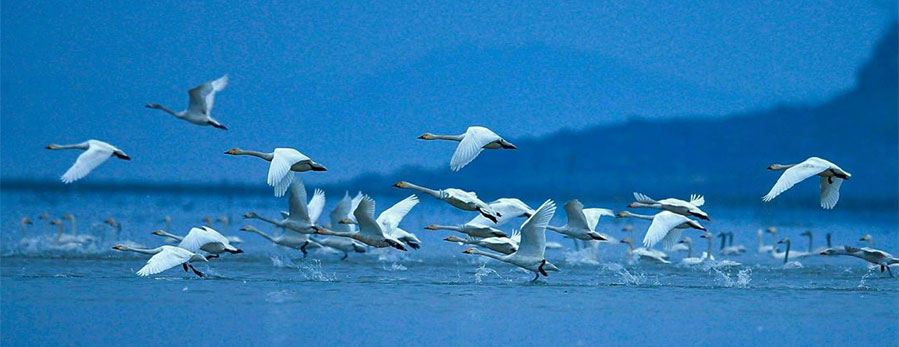
Tundra Swan in Poyang Lake © YangFan
Sateri and Conservation International today announced their partnership on the wetland conservation of Poyang Lake, China’s largest freshwater lake. This initiative aims to improve the ecosystem’s health, restore biodiversity and provide sustainable livelihoods to local people.

Located in Jiangxi Province, in the southeastern part of the country, Poyang Lake plays a critical role in regulating floods in the Yangtze River, and is a vital ecosystem for the environment, culture, and economy. The lake supports the livelihoods of more than 45 million people living in the province, and contributes more than 15% of the Yangtze River’s annual runoff. It is also a wetland of national and global importance — providing a habitat for flora and fauna of high conservation value, including the critically endangered Siberian crane and finless porpoise.

The five-year partnership, which began in 2019, evaluates the health of Poyang Lake and develops strategies for managing and protecting it, while also supporting communities to live in harmony with nature. To guide this work, a preliminary assessment of the Poyang Lake was conducted using Conservation International’s Freshwater Health Index. This scientific tool analyzes the health of the freshwater ecosystem, and measures human uses, needs and impacts providing decisionmakers with clear, scientific guidance on how best to sustainably manage these wetlands.

Richard Jeo, Conservation International’s Asia-Pacific Field Division Senior Vice President, said “Water security and biodiversity loss are two of the most pressing challenges facing humanity and the environment. Our strategic partnership with Jiangxi Provincial Forestry Bureau and Sateri at the Poyang Lake, China’s largest freshwater Lake, demonstrates how government, corporate and communities can work together on conservation, and will go a long way towards addressing these challenges, and finding solutions that benefit both people and nature.”


Allen Zhang, President of Sateri, said, “The protection of biodiversity and the sustainable use of resources in production must go hand-in-hand. The Poyang Lake initiative is a good example of how manufacturers can support nature-based solutions in parallel with community development. It also aligns with our Vision 2030 aspiration to be net-positive, giving more than we take.”

This project also supports the United Nations’ Sustainable Development Goals and China’s commitment at the recent UN Biodiversity Conference (CBD COP 15) by improving protection and management of the Duchang Nature Reserve and Poyang Protected Areas Network for these important wetlands.





More News from TEXDATA International

#Texprocess 2026

Texprocess 2026: Automation, digitalisation and AI redefine textile processing

Making investment decisions in textile processing has become significantly more demanding. Increasing energy costs, a shortage of skilled labour and ongoing geopolitical uncertainties are compelling companies to focus on technologies that deliver clear gains in efficiency and process reliability. This applies equally to apparel manufacturing and to the processing of technical textiles and high-performance materials. As a result, modernisation initiatives are assessed more carefully – even as the need to upgrade production systems continues to intensify.

#Techtextil 2026

Techtextil 2026: Between innovation pressure & market reality

From 21 to 24 April 2026, Techtextil in Frankfurt am Main will once again become the central meeting point for the international technical textiles and nonwovens industry. Running in parallel, Texprocess will focus on the industrial implementation of textile processing technologies as the leading platform in this field. Together, the two trade fairs form a closely integrated presentation and working platform along the entire textile value chain – from material development to finished applications.

#Techtextil 2026

Between geopolitical pressure and industrial resilience

In this interview, Dr. Janpeter Horn (VDMA) discusses the current challenges facing textile machinery manufacturers, shaped by geopolitical tensions, regulatory developments and subdued investment. He also outlines why innovation strength, integrated solutions and strategic positioning remain key to global competitiveness.

#Texprocess 2026

Between investment restraint and modernization pressure

Texprocess 2026 takes place in a complex market environment shaped by uncertainty and innovation pressure. In this interview, Elgar Straub (VDMA) explains why the trade fair is particularly relevant this year and which technologies are driving efficiency and competitiveness.

More News on Sustainability

#Sustainability

Number of GOTS-certified facilities grow 15% globally as demand for credible sustainability standards continues to strengthen

Global Organic Textile Standard (GOTS) certification continued to grow in 2025, with nearly 18,000 certified facilities worldwide, despite ongoing geopolitical uncertainty and rapidly evolving regulatory requirements across global textile supply chains.

#Sustainability

bluesign technologies introduces bluepass

bluesign technologies ag (www.bluesign.com) today announces the launch of bluepass, a new certification mark and product labeling system created to deliver clear, substantiated, and verifiable sustainability claims at scale.

#Research & Development

Hohenstein publishes 2025 Sustainability Report

The testing and research service provider Hohenstein has published its latest sustainability report, outlining key progress and strategic initiatives. The report focuses on ambitious CO₂ reduction targets, the company’s new mission statement and the systematic expansion of sustainable services for customers worldwide.

#Natural Fibers

Global Standard gGmbH launches second public consultation for GRTS Draft 2 for the textile industry (1–30 April 2026)

Global Standard gGmbH is pleased to announce the release of Draft 2 of the Global Responsible Textile Standard (GRTS) for its second public consultation. The consultation will be open from 1 April 2026 to 30 April 2026, inviting stakeholders across the textile and apparel value chain to provide input and contribute to the further development of this new Standard.

Latest News

#Raw Materials

ECCO introduces first shoe featuring innovative protein-based fibre

ECCO, in partnership with Spinnova, announces the launch of the limited edition ECCO BIOM® 720, a first-of-its-kind shoe utilising an often overlooked leather by-product, transformed into a protein-based fibre. The fibres are produced using patented technology that advances material innovation while reducing waste and supporting full resource use across the leather and textile industry.

#Man-Made Fibers

The LYCRA Company strengthens sustainability leadership, appoints Alistair Williamson as VP of Product Sustainability

The LYCRA Company has appointed longtime executive Alistair Williamson as vice president of product sustainability, reaffirming its commitment to developing sustainable solutions for apparel and personal care products. In this role, he will guide the company’s next chapter of sustainability strategy and oversee all initiatives aimed at reducing environmental impact across products, operations, and innovation platforms.

#Raw Materials

Kraig Biocraft Laboratories reports major progress converting record-setting spider silk cocoon production into reeled silk

Kraig Biocraft Laboratories, Inc. (OTCQB: KBLB) (“the Company”, “Kraig Labs”, or “Kraig’s”), a world leader in spider silk technology*, today announced significant progress in the processing of its recently produced recombinant spider silk cocoons into reeled silk.

#Textile processing

trinamiX mobile NIR spectroscopy: New applications for the footwear and textile industry

trinamiX GmbH expands its solution portfolio for the circular economy, now enabling the identification of materials used in the footwear and textile industries. With its mobile near-infrared (NIR) spectroscopy solutions, trinamiX supports manufacturers, sorters, recyclers, and brand owners in reliably identifying materials and improving transparency across increasingly complex value chains.

TOP