[pageLogInLogOut]

#Industry 4.0 / Digitalization

Jeanologia and BCome connect factory data with Life Cycle Assessment and Digital Product Passports

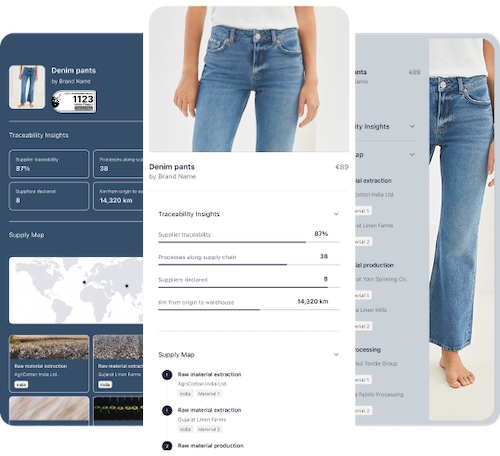
A new white paper by EIM by Jeanologia and BCome demonstrates how primary environmental data from denim finishing processes can be integrated into a garment's Life Cycle Assessment (LCA) and prepared for use in a Digital Product Passport (DPP). A comparative case study highlights significant improvements at the production stage while also showing how these translate into the environmental performance of the finished garment.

The fashion industry can invest in technologies that cut water, energy and chemical use in its factories. But how does that information reach the brand? And how does it become reliable data on a garment's impact?

EIM by Jeanologia and BCome tackle these questions in The Denim Passport, a new white paper demonstrating how primary data collected during production can be connected to a garment's Life Cycle Assessment and its Digital Product Passport.

The initiative addresses one of the textile industry's outstanding challenges: while factories are making progress in measuring and reducing their impacts, much of that information remains siloed within their facilities. Without access to supplier-specific data, brands may be forced to rely on industry averages that don't necessarily reflect actual manufacturing conditions.

“We need to understand what lies behind the product, connect the different stages and get the whole chain speaking the same language. Measure to understand, compare and improve”, says Begoña García, Director of EIM.

From industry averages to real production data

The white paper presents a case study of a 100% cotton denim garment that connects two complementary levels of information.

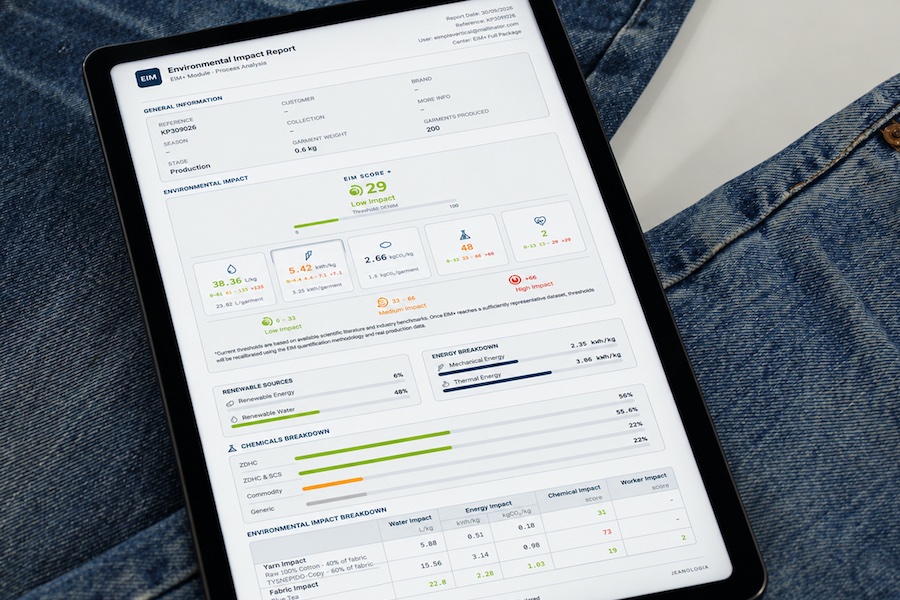
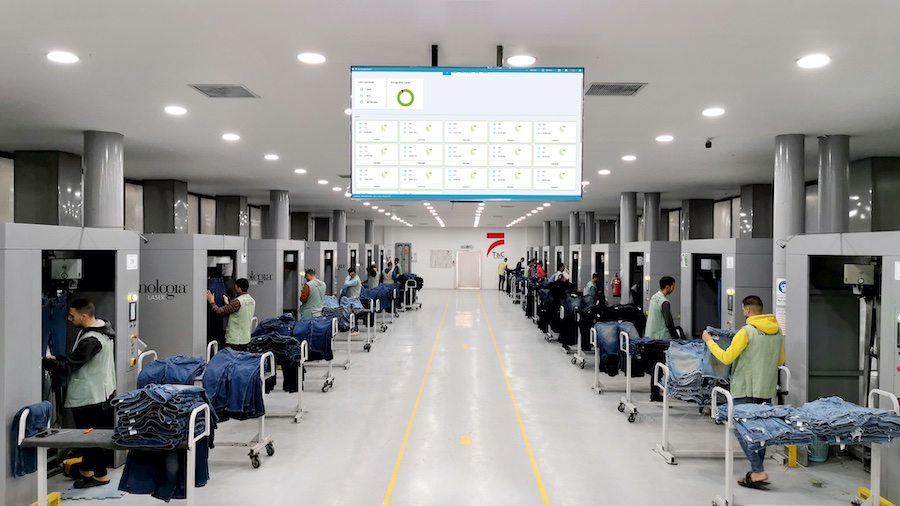
EIM by Jeanologia measures the impact of finishing processes directly on the factory floor, including water and energy consumption, chemical use and worker health. BCome integrates this specific data into the garment's Life Cycle Assessment, also accounting for the impacts of earlier stages in the supply chain.

The case study uses real data to compare a conventional finish, using stone wash and potassium permanganate spray, with Jeanologia's ATMOS technology. Factory measurements show reductions of 96.3% in water consumption, 20.8% in energy consumption and 38.2% in process-related emissions. Chemical impact also falls by 77%, and the worker health indicator improves by 93%. These improvements are reflected in the EIM Score, which drops from 78 points (high impact) for the conventional process to 17 points (low impact) with ATMOS.

By incorporating this data into the Life Cycle Assessment, the study evaluates the improvements in the context of the whole product. The results show reductions of 1.99% in global warming impact, 1.18% in the water scarcity indicator and 9.88% in marine eutrophication.

Beyond the figures, the exercise illustrates why it matters to connect factory-specific measurements with the rest of the product information. This view helps brands better understand where their impacts come from, assess production alternatives and base their decisions on more representative information.
© 2026 Jeanologia
© 2026 Jeanologia


The Digital Product Passport starts long before the QR code

The upcoming EU Digital Product Passport requirements for textiles have made collecting, structuring and sharing product information one of the sector's priorities.

However, having a QR code or a digital product sheet does not, on its own, guarantee the quality of the information behind it. For the : to be useful, the data must be linked to the product, structured and backed by reliable sources.

The collaboration between EIM by Jeanologia and BCome shows how to move in that direction. EIM captures and standardizes primary data from finishing processes, while BCome integrates it into the Life Cycle Assessment, following the EU Product Environmental Footprint (PEF) framework, and structures the results for inclusion in the Digital Product Passport.

The model connects information that has traditionally remained separate and carries it from the production floor to the brand's information systems. Environmental data thus stops being just an operational metric and becomes useful information for traceability, product assessment and readiness for upcoming regulatory requirements.

“The quality of a : depends on the quality of the data that feeds it. That's why collecting primary data from the supply chain is an essential part of the process”, say Alba García and Anna Cañadell, co-founders of BCome.

From transparency to data-backed decisions

The Denim Passport shows that connecting factories and brands is not just a technological matter. It is also a prerequisite for improving the quality of environmental information, substantiating product claims and reducing reliance on generic estimates.

For brands, the challenge now is to connect the data that already exists across their supply chain and turn it into coherent, traceable information ready for different uses, from internal decision-making to product communication and the :.

The white paper offers a practical example of how industrial measurement and Life Cycle Assessment can be combined to work towards that goal in one of the fashion industry's most representative categories: denim.

Further information: Download the

White paper – The Denim Passport


More News from JEANOLOGIA S.L.

#Textile processing

Jeanologia combines digitalisation, laser and ozone technology to strengthen China’s textile competitiveness

At ITMA Asia + CITME 2026 in Shanghai, Jeanologia showcased how the combination of digitalisation, laser technology and G2 Ozone can help China’s textile industry improve productivity, speed, quality and efficiency. With its Compact Super Flash laser system and integrated production concepts, the Spanish technology specialist demonstrated how connecting product development and industrial production can enable faster, more automated and sustainable manufacturing processes.

#Textile processing

Jeanologia and Sue Barrett explore new interpretations of camouflage in COMMON GROUND

Jeanologia has collaborated with Sue Barrett, founder of Denim Forum, to create COMMON GROUND, a new denim collection that reinterprets camouflage through nature-inspired patterns, vintage garments and modern finishing technologies. Developed as part of Jeanologia’s Denim Métiers initiative, the project combines archival references and creative experimentation with laser and ozone technologies to explore new possibilities in contemporary denim design.

#Industry 4.0 / Digitalization

Jeanologia presents expanded EIM platform and COMMON GROUND collection at Kingpins Amsterdam

Jeanologia is presenting two approaches to textile product development at Kingpins Amsterdam on October 14–15: measuring the environmental impact of textile production and exploring new creative possibilities through garment finishing technologies.

#Industry 4.0 / Digitalization

EIM evolves into a new Environmental Intelligence to measure the impact of textile production

¿Do we really know the environmental impact behind a garment? Answering this question remains one of the textile industry’s major challenges. Garment production involves multiple stages, from yarn and fabric to final finishing, carried out by different players across the supply chain. Accesing reliable data from each process, connecting it and establishing a common language are essential to understanding a product’s true impact.

More News on Industry 4.0 / Digitalization

#Industry 4.0 / Digitalization

Smartex.ai names Tony Fadell chairman and previews new fabric inspection system

Smartex.ai has appointed Tony Fadell as chairman and will present its new fabric inspection hardware and software at SmartCollab Hong Kong on 27 November. Fadell co-designed Inspect, the hardware at the centre of the system, which Smartex developed with a supplier in H&M Group’s network.

#Industry 4.0 / Digitalization

Coats Digital wins SaaS award for AI in apparel manufacturing

Coats Digital has been named Best Company in AI-Powered Fashion Technology at the 2026 Best in SaaS Awards. The company’s AI applications cover garment costing, the analysis of operational data and the use of computer vision to study how tasks are performed on the factory floor.

#Industry 4.0 / Digitalization

White House reduces production planning time by up to 80% with Coats Digital’s FastReactPlan

Indian garment manufacturer White House has reduced its production planning cycle by 60–80% following the implementation of Coats Digital’s FastReactPlan software. The integrated planning solution provides greater visibility across production, capacity and material requirements while supporting faster decision-making and improved delivery performance.

#Software

UNIFEQ Europe adopts Coats Digital’s GSDCost and AI-powered GSDQuest to support rapid growth

Coats Digital is pleased to announce that rapidly growing Polish defence and uniform manufacturer UNIFEQ Europe Sp. z o.o. has invested in its award-winning GSDCost solution together with its AI-powered GSDQuest platform to establish a consistent approach to garment costing, improve sewing-floor productivity and accelerate labour costing for tenders and new products.

Latest News

#CINTE Techtextil China 2027

Cinte Techtextil China confirms 2027 dates with focus on high-value technical textiles and nonwovens

Cinte Techtextil China will return to Shanghai from 31 August to 2 September 2027, reaffirming its role as a major platform for the technical textiles and nonwovens industry in Asia. In 2026, the exhibition welcomed over 300 exhibitors from 15 countries and regions and recorded nearly 19,000 visits from 86 represented markets. The upcoming edition will focus on high-growth application areas, technological innovation, sustainability and targeted business networking.

#India ITME 2026

BRÜCKNER combines premium technology with cost efficiency at India ITME 2026

At India ITME 2026 in Greater Noida, BRÜCKNER will showcase its advanced technologies for textile finishing and coating in Hall 16, Booth A29, with a particular focus on its POWER-FRAME SFP-2 product line. The German machinery manufacturer is specifically addressing customers who demand high standards of quality and efficiency while also placing great importance on cost-effective investment and long-term economic competitiveness.

#ITMA Asia + CITME 2026

KARL MAYER reports strong customer response at ITMA ASIA 2026 and Product Show in Changzhou

KARL MAYER has reported strong customer interest during the first days of ITMA ASIA + CITME 2026 in Shanghai and its accompanying Product Show in Changzhou. With two exhibition booths (Hall 4.1, Booth C18 and Hall 3, Booth A24) and a total of eleven machines demonstrated live across its presentations, the company has received positive feedback on its strategy of combining local market proximity, advanced machine technology and textile innovation.

#Textile chemistry

Flame protection and OEKO-TEX® certification: Gulec Chemicals clears an important hurdle

Three halogen-free flame retardants from German specialist Gulec Chemicals have been included in the OEKO-TEX® list of accepted Active Chemical Products (ACP). The listing opens up additional opportunities for textile finishers, coaters and manufacturers of technical textiles seeking to combine demanding fire protection requirements with certification according to OEKO-TEX® STANDARD 100.

TRÜTZSCHLER SPINNING - FROM WASTE TO VALUE
TOP