[pageLogInLogOut]

#Sustainability

NILIT® unveils “Making Nylon Sustainable,” the Company’s Corporate Sustainability Report

NILIT, the global leader in high-quality Nylon 6.6 for apparel, and owner of the SENSIL® sustainable brand, is proud to announce the publication of its sustainability report covering the period 2017-2020. The document, entitled “Making Nylon Sustainable,” details the company’s significant achievements to improve its environmental footprint as well as its plans to positively influence the textile and apparel industry to choose more sustainable products and use them in more responsible ways.

“Sustainability is a core value at NILIT,” says Ilan Melamed, General Manager. “We are dedicated to providing the most consumer-relevant, highest quality, and most sustainable premium Nylon 6.6 products to the apparel market. To attain this goal, we continually invest in operations and product development, leveraging our partnerships throughout the supply chain. ‘Making Nylon Sustainable’ captures our vision and our commitment to environmental and social responsibility, and we are very pleased to make this public statement.”

“Making Nylon Sustainable” shares NILIT’s accomplishments as well as the company’s ongoing plans to continuously improve the ecological and social influence of its operations and practices in the market and in the communities where the company operates. Through collaboration with brands, retailers, customers, employees, and vendors, NILIT has developed the largest portfolio of sustainable premium Nylon 6.6 products under its SENSIL® consumer brand. The SENSIL® portfolio includes performance products that directly address the apparel industry’s most pressing environmental issues, such as water and energy consumption, waste reduction, use of recycled inputs, and impact to ecosystems.

Also, NILIT has been applauded for its many sustainability achievements in its facilities around the world, especially its innovations in clean energy cogeneration that reduced CO2 by 40% and eliminated emissions of toxic gases.


In addition, the NILIT Total Product Sustainability program ensures that all NILIT products meet stringent criteria for responsible production. The company also introduced QR Codes in all SENSIL® hangtags. Produced with FSC paper and distributed on certified garments from brands worldwide, these hangtags guarantee authenticity and provide more information to consumers about the technologies and benefits of premium Nylon.

“Our industry’s journey toward sustainability relies on creativity, commitment, and partnership,” continues Melamed. “Our vision is to be the world’s most innovative and sustainable Nylon producer, creating solutions that transform businesses as well as lives. By publishing this report, we openly share this idea with all our stakeholders and invite our industry colleagues to join us in this crucial endeavor.”

Learn more about NILIT’s commitment to a more sustainable apparel industry by downloading “Making Nylon Sustainable” at:

http://www.nilit.com/sustainability/#sustainability-policy.



More News from TEXDATA International

#ITM 2026

ITM 2026: The new geography of textile production

New production hubs are emerging across North Africa and Central Asia, while Türkiye is accelerating its transformation toward higher-value, technology-driven and more sustainable textile manufacturing.

#Research & Development

“Production is a product”

From technical textiles and AI-driven robotics to the limitations of textile circularity: Professor Dr Thomas Gries looks back on more than two decades of development at ITA Aachen. In the interview, he explains why production technology remains a decisive success factor, discusses international collaborations and innovation ecosystems, and shares his views on the transformation of production landscapes and the challenges facing an increasingly regulated industry.

#Knitting & Hosiery

“We need to move away from the price trap and return to a value-driven mindset.”

With its new Textile Innovation Center, KARL MAYER is sending a strong signal for innovation, collaboration, and the future of textile applications. In this interview, Karl Josef Mayer discusses new opportunities in warp knitting, the processing of staple fibres, recycling, the changing role of machinery manufacturers, and why the textile industry must once again focus more strongly on the value of textiles. by Oliver Schmidt

#Associations

“Innovation, resilience and international experience remain the great strengths of the Swiss textile machinery industry”

Geopolitical uncertainty, growing competitive pressure from China, new free trade agreements and the shift towards a circular economy are currently reshaping the global textile industry. In this interview, Cornelia Buchwalder discusses the current mood within the Swiss textile machinery sector, the industry’s distinctive innovative strength, new market opportunities in India and Asia, and the technological trends that could shape the upcoming trade fair cycle leading up to ITMA 2027.

More News on Sustainability

#Sustainability

Closing the Footwear Loop reveals challenges and opportunities for circular footwear

The footwear industry faces one of the most complex circularity challenges in the fashion sector. A new Phase 1 report from the Fashion for Good initiative Closing the Footwear Loop, developed together with Circle Economy, provides new insights into the composition, condition and recycling potential of post-consumer footwear waste.

#Man-Made Fibers

The updated poster on biodegradable Polymers in various environments has been released

As part of the PerPlacsBio project, nova-Institute has updated its popular poster on the biodegradability of polymers in different environments. The updated version reflects current standards, certifications and the latest scientific findings. The poster can be used to assess biodegradable alternatives for use in agriculture and forestry, and it is now available in German for the first time.

#Sustainability

A new standard to combat plastic waste in forests

With DIN SPEC 35808 “Tree Shelter for Forestry Applications,” the testing and research service provider Hohenstein, in collaboration with Rottenburg University of Forestry, as well as forestry authorities and industry partners, has established a clear framework for bio-based and fully biodegradable tree shelters. The pre-standard defines requirements and practical testing methods designed to reduce plastic waste in forests and strengthen the long-term protection of soil and the environment.

#Denim

Denim moves towards sustainability

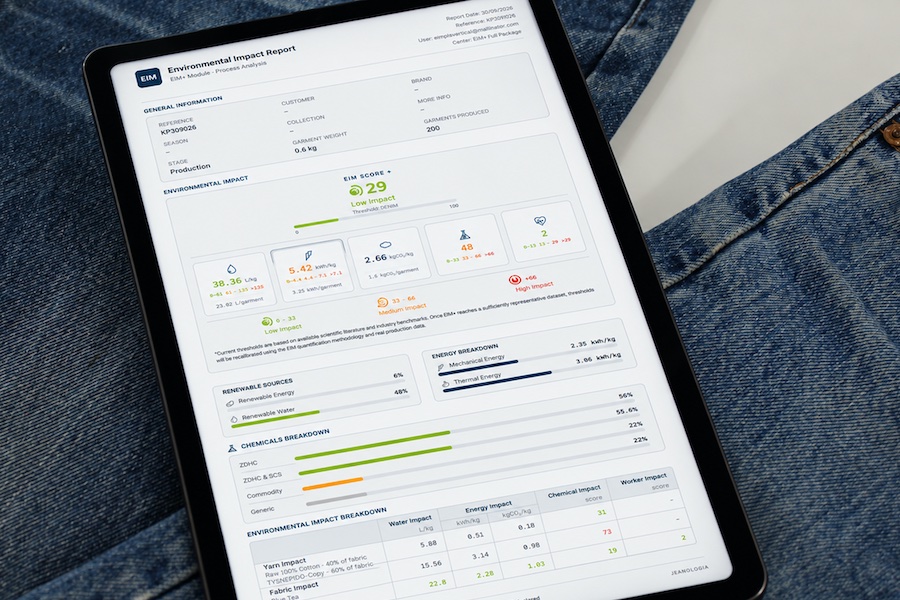
EIM (Environmental Impact Measurement), the global reference platform for measuring the environmental impact of garment finishing, presents the second edition of its annual report Denim Industry Progress & Insights 2025. The study analyses over 100,000 real denim finishing processes, providing an accurate and up-to-date view of the industry’s evolution towards more sustainable models.

Latest News

#ITM 2026

Sweden targets Türkiye’s textile future at ITM 2026

Following the opening of its new showroom and test centre in Sweden, imogo will be introducing its groundbreaking new Dye-Max spray dyeing technology to Türkiye’s textile manufacturers at ITM 2026 in Istanbul from June 9-13.

#Knitting & Hosiery

TM WEFT, 270" – More width, more design freedom for the fashion world

KARL MAYER is expanding its successful TM WEFT series with an innovative model that opens up new possibilities, particularly in the fashion & apparel sectors. With a working width of 270", this new machine with weft-insertion not only offers significantly higher output than its narrower counterparts but is also specifically tailored to the demands of dynamic clothing market – particularly in China and Türkiye. A well-thought-out upgrade also ensures even greater design versatility.

#Textile processing

YKK invests USD 150 million in new manufacturing facility in India

YKK Corporation has announced plans to construct a new manufacturing facility in India, reinforcing its long-term commitment to one of the world's fastest-growing textile and apparel production hubs. The new factory will be built at Origins by Mahindra in Chennai, Tamil Nadu, and will become the third manufacturing site of YKK India Private Limited. The facility is expected to be completed by February 2028 and represents an investment of approximately USD 150 million, covering land, buildings, machinery and equipment.

#ITM 2026

Marzoli promotes ‘Don’t Replace, Repower’ approach at ITM 2026

At ITM 2026 in Istanbul, Marzoli will place a strong focus on spinning mill modernization, presenting retrofitting and reengineering solutions designed to improve efficiency, extend machine lifetime and maximize the value of existing assets.

TOP