[pageLogInLogOut]

#Sustainability

Responsibility from raw material purchasing to customer product

Sustainability does not begin and end at the CHT Group's factory gates, as the Group focuses on both its supply chain and its customers.

Responsible Care Award 2019 goes to CHT Germany

CHT's wide-ranging spectrum has now been submitted to the Responsible Care competition 2019 under the title "Demanding and promoting sustainability - we take responsibility from purchasing to customer application" and convinced the jury. For the second time in a row the CHT Group was able to win the VCI Baden-Württemberg State Award. This year, sustainability in the supply chain was the central topic.

To ensure sustainability along the supply chain the CHT Group's suppliers have been evaluated comprehensively in terms of their sustainability since 2014. All suppliers worldwide are analysed accordingly to uniform criteria and receive an overall rating that includes ecological and social criteria in addition to classic performance criteria such as quality safety, delivery reliability and competitive prices. As a minimum requirement for the status "Sustainable Supplier", in addition to a positively evaluated and documented self-disclosure, the countersigned Code of Conduct of CHT as well as valid certificates according to ISO 9001 and ISO 14001 have to be provided.

Suppliers that do not meet the required status are either replaced directly, or packages of measures are defined in a targeted manner, the implementation of which is then evaluated in a subsequent review. The current sustainability rate for CHT suppliers was 88% at the end of 2018.

(c) 2019 CHT
(c) 2019 CHT


(c) 2019 CHT
(c) 2019 CHT

On the sales side, CHT focuses on process chemicals and additives that help customers worldwide optimise their manufacturing processes while saving resources, energy, time and water. This sustainable approach has been gradually extended in recent years to include CHT's service functions. In addition to mere certification, CHT offers its customers comprehensive support and transparency with the QRPI tool (Quality & Regulatory Product Information), especially in the business field of Consumer Care Solutions.

The QRPI report concisely presents all information of the CHT product regarding quality, product safety, certification, legal regulations and chemical composition.

This new product passport helps customers not only with the application. The added value is immense, especially in the regulatory evaluation of their formulations and products with regard to subsequent declarations and certifications.

For CHT, sustainability therefore begins with the purchase of raw materials, it is an integral part of its own production and value creation and is also documented and made transparent for customers.
More News from TEXDATA International

#ITM 2026

ITM 2026: The new geography of textile production

New production hubs are emerging across North Africa and Central Asia, while Türkiye is accelerating its transformation toward higher-value, technology-driven and more sustainable textile manufacturing.

#Research & Development

“Production is a product”

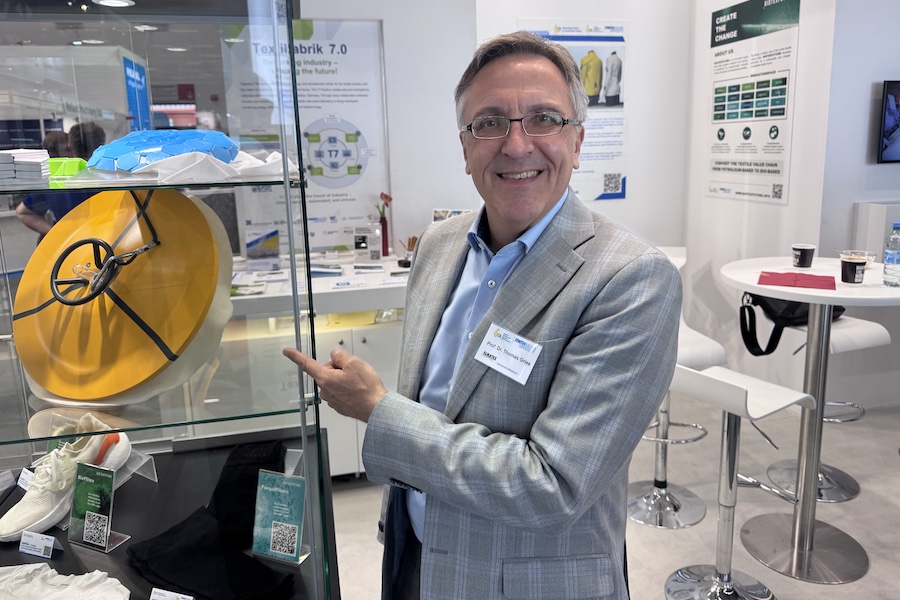
From technical textiles and AI-driven robotics to the limitations of textile circularity: Professor Dr Thomas Gries looks back on more than two decades of development at ITA Aachen. In the interview, he explains why production technology remains a decisive success factor, discusses international collaborations and innovation ecosystems, and shares his views on the transformation of production landscapes and the challenges facing an increasingly regulated industry.

#Knitting & Hosiery

“We need to move away from the price trap and return to a value-driven mindset.”

With its new Textile Innovation Center, KARL MAYER is sending a strong signal for innovation, collaboration, and the future of textile applications. In this interview, Karl Josef Mayer discusses new opportunities in warp knitting, the processing of staple fibres, recycling, the changing role of machinery manufacturers, and why the textile industry must once again focus more strongly on the value of textiles. by Oliver Schmidt

#Associations

“Innovation, resilience and international experience remain the great strengths of the Swiss textile machinery industry”

Geopolitical uncertainty, growing competitive pressure from China, new free trade agreements and the shift towards a circular economy are currently reshaping the global textile industry. In this interview, Cornelia Buchwalder discusses the current mood within the Swiss textile machinery sector, the industry’s distinctive innovative strength, new market opportunities in India and Asia, and the technological trends that could shape the upcoming trade fair cycle leading up to ITMA 2027.

More News on Sustainability

#Sustainability

Closing the Footwear Loop reveals challenges and opportunities for circular footwear

The footwear industry faces one of the most complex circularity challenges in the fashion sector. A new Phase 1 report from the Fashion for Good initiative Closing the Footwear Loop, developed together with Circle Economy, provides new insights into the composition, condition and recycling potential of post-consumer footwear waste.

#Man-Made Fibers

The updated poster on biodegradable Polymers in various environments has been released

As part of the PerPlacsBio project, nova-Institute has updated its popular poster on the biodegradability of polymers in different environments. The updated version reflects current standards, certifications and the latest scientific findings. The poster can be used to assess biodegradable alternatives for use in agriculture and forestry, and it is now available in German for the first time.

#Sustainability

A new standard to combat plastic waste in forests

With DIN SPEC 35808 “Tree Shelter for Forestry Applications,” the testing and research service provider Hohenstein, in collaboration with Rottenburg University of Forestry, as well as forestry authorities and industry partners, has established a clear framework for bio-based and fully biodegradable tree shelters. The pre-standard defines requirements and practical testing methods designed to reduce plastic waste in forests and strengthen the long-term protection of soil and the environment.

#Denim

Denim moves towards sustainability

EIM (Environmental Impact Measurement), the global reference platform for measuring the environmental impact of garment finishing, presents the second edition of its annual report Denim Industry Progress & Insights 2025. The study analyses over 100,000 real denim finishing processes, providing an accurate and up-to-date view of the industry’s evolution towards more sustainable models.

Latest News

TOP