#Spinning
When the mill manager is happy in his work…
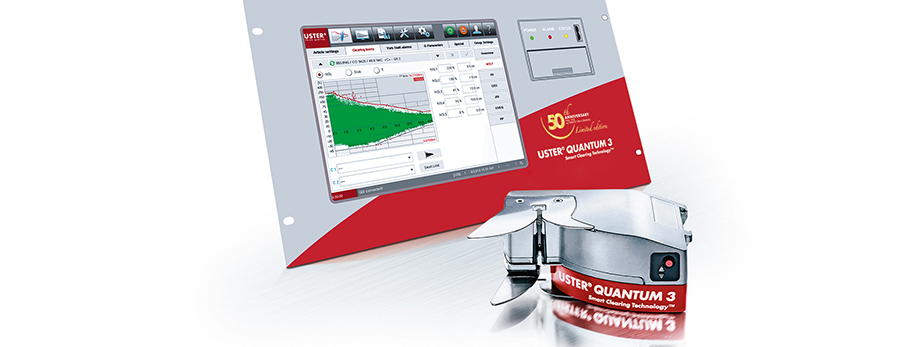
The combination of the USTER® QUANTUM 3 Anniversary Edition and the USTER® QUANTUM EXPERT 3 makes quality management efficient, profitable and secure
Uster, Switzerland, June 1, 2016 – The job of the modern mill manager is an extremely demanding one – with the heavy responsibility of producing top quality textiles while also ensuring the company’s efficiency and profitability goals are met. Today’s systems for quality testing and monitoring systems are designed to make these challenges achievable, with solutions such as USTER® QUANTUM 3 yarn clearers and USTER® QUANTUM EXPERT 3 data systems offering total control of every aspect of quality management.
Since the USTER® QUANTUM 3 Anniversary Edition was installed in his spinning mill, Mehmet has been more relaxed. The USTER® QUANTUM EXPERT 3 had already made his job much easier. Now, it’s a combination he is really happy with. Thanks to USTER’s yarn quality assurance system, the mill manager’s morning routine is completed much faster. He no longer needs to patrol from machine to machine or wade through piles of data reports. The USTER systems provide all the quality assurance he needs. A single print-out alerts him to any possible issues, and the USTER® QUANTUM EXPERT 3 analyzes the whole picture, customized to his own needs.
For management meetings, Mehmet is perfectly prepared in a short time, thanks to detailed reports based on data collected from the winding machine control units. The USTER® QUANTUM EXPERT 3 also provides the unique YARN BODY visualization, as well as a clear overview of quality and productivity trends. That means discussions are based on hard facts and decisions made on the basis of precise data. Mehmet and his team have become highly efficient at handling daily issues – so they can devote their thinking to ways of improving productivity still further.
Mehmet is a typical spinning mill manager working for a company in Turkey – although it could be anywhere in the world. His mill produces export-quality yarn, sold to leading brands worldwide, and he is in charge of a modern, well-equipped production unit, with a good level of expertise. Mehmet is conscientious and dedicated, with a strong commitment to delivering the yarn quality his customers demand, as well as the productivity needed for the mill’s sustained profitability. Avoiding customer complaints and claims for off-quality is a crucial element of this.
Mehmet already realizes that the company’s investment in the USTER® QUANTUM 3 Anniversary Edition yarn clearers is going to be paid back quickly. He is totally convinced of the need for constant yarn monitoring to guarantee customers receive the quality they demand. It’s especially helpful for him to have early warnings of any possible problems. The special and unique innovations with the USTER® QUANTUM 3 Anniversary Edition are already helping him to achieve his goal of producing better yarn which will ultimately give his customers better fabrics.

Pic: USTER® QUANTUM 3 Anniversary Edition – The passport to a new world of yarn quality
Since Mehmet’s mill produces core yarn – an elastane center with an outer sheath – this has been a major cause of headaches in the past. Missing or off-center cores lead to expensive claims because of wasted fabric. The Core Yarn Clearing option with the USTER® QUANTUM 3 Anniversary Edition has provided the perfect remedy. Unique USTER® sensors automatically identify areas in the yarn where the core component is either missing or off-center at a significant level and over long lengths. This potential cause of fabric rejects is now effectively eliminated before reaching the final package – and Mehmet can enjoy the relief.
For fabrics made from mélange and colored yarns, variations in color and shade are critical – so avoiding this likely cause of ‘seconds’ is another priority for Mehmet. USTER’s advanced foreign matter sensor now incorporates a Shade Variation feature with USTER® QUANTUM 3 Anniversary Edition. Even very small divergences from the base yarn shade can be detected and cleared.
Hairiness variations in yarn can lead to a ‘cloudy’ appearance in finished fabric – another potential source of pain for mill managers. With USTER® QUANTUM 3 Anniversary Edition, the clearers introduce online measurement of true yarn hairiness, so that outlier bobbins can be removed. Additionally, in Mehmet’s mill with linked spinning and winding, it can now monitor the condition of rings and travelers.
Absolute quality control Online control with USTER® QUANTUM 3 Anniversary Edition make reports available quickly and essential data easy to find. So, it’s not only Mehmet who benefits here: his team’s workload is also reduced. For example, they don’t need frequent checks at ring spinning machines for possible issues with core yarn, since the clearers now monitor and control everything. The personnel can now also easily identify machines with possible defects and take the necessary action to fix them. For a busy mill manager, it’s vital that software is simple and intuitive to use, and with the USTER® QUANTUM EXPERT 3 this aspect has given Mehmet an absolutely indispensable tool for managing the mill’s article assortment and optimizing the production process. It organizes quality management centrally, even though production is decentralized production. Here, Mehmet values the ability to compare the quality parameters of yarn produced in different units, which is crucial when supplying the same customer from several locations. Mehmet’s bosses at the mill also value USTER’s yarn quality assurance system from another aspect: the USTER® QUANTUM EXPERT 3 eliminates the risk of mistakes by staff. The system is secure, from central management of clearer settings to protecting against individual parameter settings and changes at the winding machine by unauthorized personnel. Full control for Mehmet is combined with total confidence for the top management.
Essential data, practical benefits The combination of the USTER® QUANTUM 3 Anniversary Edition and the USTER® QUANTUM EXPERT 3 reduces the risk of quality claims from customers, while enhancing efficiency in yarn production. Ahmet Meric, Sales & Technology Manager, Uster Teknoloji Ticaret A.Ş, cites quality management with both the USTER® QUANTUM 3 Anniversary Edition and the USTER® QUANTUM EXPERT 3 as a practical embodiment of the USTER® philosophy: “The USTER® systems provide a wide range of quality parameter data, presented in valuable reports. The USTER® QUANTUM 3 Anniversary Edition combined with the USTER® QUANTUM EXPERT 3 is an excellent example of how USTER handles data, so that spinning mills can benefit from the potential of data-driven quality management. This is a key element of USTER’s proposal for `Managing a spinning mill with quality in mind´ towards sustainable profitability.
“I’m excited to learn how mill managers like Mehmet perceive the new the USTER® TESTER 6 which we present at ITM 2016 in Istanbul.”