[pageLogInLogOut]

#Spinning

T-SCAN: Indian customers confirm impressive performance
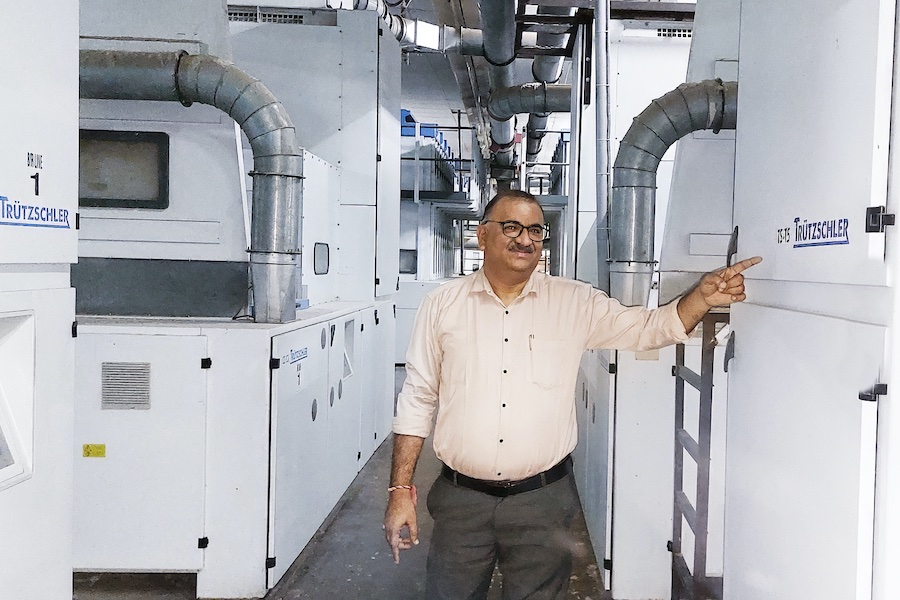
Removing foreign parts from cotton is a challenging task. That’s why the Trützschler T-SCAN technology features multiple modules that detect contaminations and reliably eject them as part of the blowroom process. After establishing T-SCAN in cotton ring lines, the Indian customers are now enjoying the benefits of the intelligent solutions in rotor applications.
Ashish Raval, Vice President Spinning, Nandam Terry: “Installing TS-T3 and TS-T5 technologies has drastically reduced color contaminations and improved fabric appearance, satisfying high-end brands and our end users.”  © 2025 Trützschler
Ashish Raval, Vice President Spinning, Nandam Terry: “Installing TS-T3 and TS-T5 technologies has drastically reduced color contaminations and improved fabric appearance, satisfying high-end brands and our end users.” © 2025 Trützschler


When cotton travels out of fields and into spinning mills, it sometimes carries a few unwelcome passengers. Leaves, stems, stones, plastic or jute particles from transport bags, bits of metal or shreds of paper can find their way into cotton bales. Some of these foreign parts sneak past the first cleaning steps in the blow room. Colored parts and plastics like polypropylene create particularly big problems for spinners: They can cause yarn breaks during spinning and weaving, take dye in a different way than the raw material and therefore show up on the surface of the final textile product. And if that happens, the yarn might get rejected or returned to the spinner! In ring spinning, sophisticated yarn clearers with an option to detect and cut polypropylene and colored contaminants are the main solution to this problem. However, the usage of such a yarn clearer in rotor spinning is in practice very limited, especially the detection of polypropylene.

Trützschler is emphasizing its T-Scan system as an answer to the problems. The state-of- the-art system ejects foreign parts out of cotton via its comprehensive range of sensor modules for detecting contamination. The TS-T3 and TS-T5 are the latest versions of this market-proven technology. They empower spinners to maximize quality and avoid costly rejections – even when dealing with low-contrast, small or thread-like foreign parts. This technology detects and removes a wide variety of polypropylene types, such as transparent or glossy polypropylene, or polypropylene that reacts to different UV light intensities. Especially in the rotor and recycling segments, these foreign part separators can be a good solution to effectively deal with contaminants.

Proven performance in the rotor and recycling segment

Real-world tests from Trützschler customers, particularly in rotor applications, are confirming the impressive capacity to kick out contaminations, boost quality and avoid rejections with the TS-T5 and TS-T3 systems.

Nandam Terry and Nandam Denim are among those pioneering customers. The companies are one of the biggest denim manufacturers based in Ahmedabad, India. They make 45 tons per day of denim and 10 tons per day of terry towel products. “Since installing TS-T3 and TS-T5 technologies, we have drastically reduced color contaminations with minimum ejection of cotton,” says Ashish Raval, Vice President Spinning. “The appearance of our fabric has improved very much and we are now selling contamination-controlled yarn to high-end brands. Our end users are really happy.”

Thiagarajar Mills Ltd. in Madurai, India, is a vertically integrated group in South India known for quality fine yarns and fabrics. The company runs 25 Trützschler machines to produce 250 tons of yarn per month for denim products. After successfully establishing TS-T5 in ring spinning, the customer continued with the Trützschler foreign part separator in rotor spinning. “The quality of our yarn, in terms of contamination, is much improved with the TS-T5,” says Muthupalaniappa M, Senior Vice President (Technical). “It is easy to operate and maintain, with improved cleaning for polypropylene. Along with great support from the Trützschler team, we are making excellent progress with the various challenges related to contamination.”
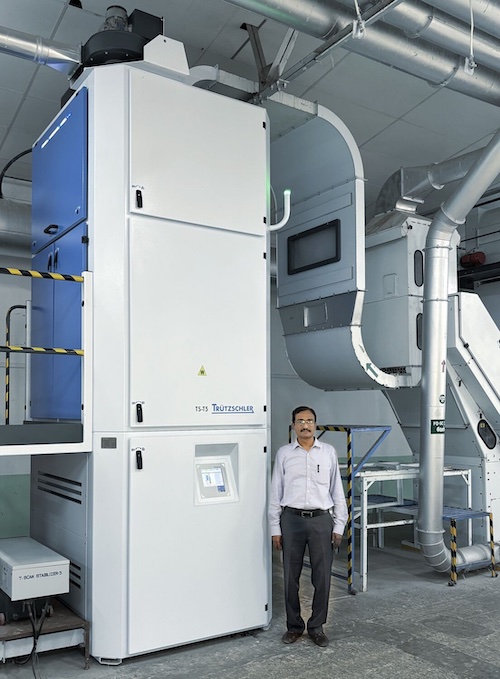
Muthupalaniappa M., Senior Vice President (Technical), Thiagarajar Mills Ltd.: “The TS-T5 has significantly improved our yarn quality by reducing contamination and is easy to operate and maintain, with great support from Trützschler
Muthupalaniappa M., Senior Vice President (Technical), Thiagarajar Mills Ltd.: “The TS-T5 has significantly improved our yarn quality by reducing contamination and is easy to operate and maintain, with great support from Trützschler". © 2025 Trützschler


Further positive feedback recently arrived from Blue Rose Cotspin LLP. This company based in northern India produces 20 tons of yarn per day, mainly for hosiery and weaving customers. “We have not received any complaints about contamination since installing the TS-T3 from Trützschler,” says Ashwani Garg, Managing Director. “The performance is excellent and it’s capable of ejecting all types of contamination while protecting good fibers. The auto-calibration is really valuable for us.”
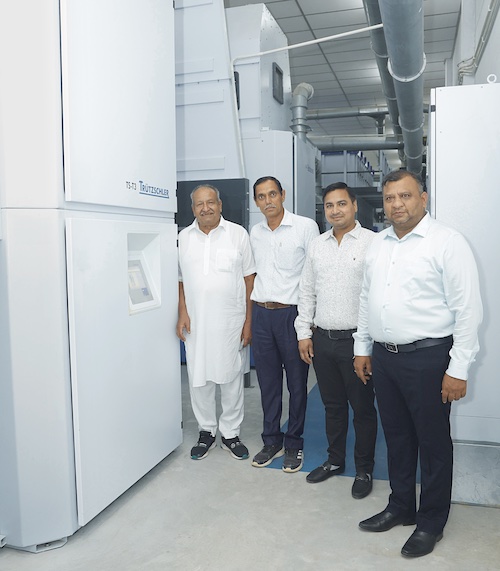
Blue Rose Cotspin LLP  is happy with the performance of the TS-T3. From left to right: Ganesh Bansal (Chairman), Sawant Singh Kulhari (General Manager of the plant) Ashwani Garg (Managing Director) and Vikas Bansal (Managing Director) © 2025 Trützschler
Blue Rose Cotspin LLP is happy with the performance of the TS-T3. From left to right: Ganesh Bansal (Chairman), Sawant Singh Kulhari (General Manager of the plant) Ashwani Garg (Managing Director) and Vikas Bansal (Managing Director) © 2025 Trützschler


Kamal Kumar, owner of Patiala Gold LLP, is enthusiastic about the user-friendly cleaning and maintenance of the TS-T3: “This reduces downtime to an absolute minimum without any loss of performance." Based in Samana, Punjab, the company operates twelve Trützschler cards with IDF, producing up to 30 tons of rotor yarn per day, mainly for bottomweight and bed sheets. “Compared to other foreign part separators, the production efficiency of our blow room and card lines is significantly higher with the TS-T3,” says Kamal Kumar. Blue Rose Cotspin and Patiala Gold are using the TS-T3 in rotor recycling applications, even for polycotton blends. They have also placed repeat orders for their new units based on the performance of the TS-T3.
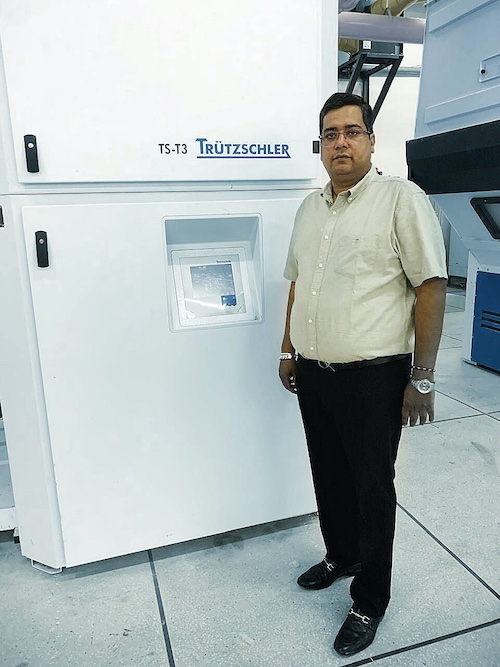
Kamal Kumar, Managing Director, Patiala Gold LLP: “The TS-T3’s user-friendly maintenance minimizes downtime and boosts production efficiency compared to other foreign part separators”. © 2025 Trützschler


Info: Minimal Maintenance, Maximum Effiency

The TS-T5 and TS-T3 achieve maximum foreign part separation with very low levels of good fiber loss. They are energy-efficient solutions that use up to 80 % less compressed air than comparable systems. The TS-T5 and TS-T3 also have minimal requirements for cleaning and maintenance, which customers value highly. Their range of functions and detection modules are unique in the market.
More News from Truetzschler GmbH & Co. KG

#Spinning

Perfect quality through collaboration: Machinery from Trützschler, Toyota and Murata at Zirve Tekstil

In today’s textile industry, excellence is not achieved by chance – it’s the result of deliberate decisions, technical expertise, and the courage to go beyond conventional paths. The Turkish company Zirve Tekstil has done just that: by combining the best technologies from Trützschler, Toyota and Murata, they’ve created a production setup that delivers outstanding yarn quality – recognized worldwide.

#Spinning

Details matter: How Trützschler cylinder wires boost efficiency in Pakistan’s spinning sector

Pakistan’s textile industry, especially its spinning sector, is the backbone of the national economy and a vibrant hub of innovation. Today’s spinning mills face growing demands for efficiency, quality, and sustainability. From the serene northern valleys to the vibrant port city of Karachi in the south, mills like Suraj Cotton Mills, Liberty, and Nishat Chunian are turning to advanced solutions.

#ITMA Asia + CITME Singapore 2025

T-CAN – Revolutionizing can transport

In virtually all spinning mills, transporting sliver cans is still done manually. Rising labor costs, lack of operators and increasing quality requirements make this a growing challenge. With T-CAN, Trützschler introduces a practical solution: a fully automated can transport system that will be presented live at ITMA ASIA 2025 in Singapore.

#Spinning

Pre-Cleaner CL-X: The future of cotton cleaning

What if the future of cotton cleaning was already here – setting a new standard for cleaning efficiency, productivity and energy savings? That future has a name: CL-X. Since its market launch in 2022, the Pre-Cleaner CL-X has become a true bestseller, proving its value in several hundred customer applications worldwide. Now, new results from Türkiye demonstrate again how the Pre-Cleaner CL-X outperforms the competition.

More News on Spinning

#Techtextil 2026

RETECH showcases high-precision godets for high-performance fiber processing at Techtextil 2026

RETECH designs and manufactures godets and draw frames for heated, ambient and cooled processes, enabling precise heat treatment and consistently high yarn quality for a wide range of polymers and applications, with process temperatures of up to 400 °C for high-performance fibers. The company’s key competence lies in exact and stable temperature and speed control, individually adapted to the specific material and process requirements.

#Spinning

Barmag presents the next generation of POY production – energy-efficient and partial-automated

With POY 2.0, Barmag is introducing a completely redesigned spinning concept that takes the production of partially oriented yarn (POY) to a new level in terms of technology and economy. The solution, which was presented to a selected audience of experts for the first time at ITMA Asia + CITME 2025, was met with great enthusiasm: several yarn producers worldwide immediately expressed their interest in a pilot plant.

#Spinning

Development of bio-based polyethylene fibers for textile applications – BB Engineering partici-pates in the bioPEtex research project

In the German research project bioPEtex, BB Engineering (BBE) is working with other partners to develop textiles made from 100% bio-based polyethylene (PE). The aim is to make use of this poly-mer, which has hardly been used in the chemical fiber industry to date. BBE is contributing its spinning and texturizing expertise and developing the texturing process on an industrial scale. The first promising results are already available – opening up new opportu-nities for sustainable and economically attractive applications in the textile industry.

#Techtextil 2026

Saurer sets new standards at Techtextil 2026

When the international textile industry gathers at Techtextil in Frankfurt from April 21 to 24, Saurer is going to present a powerful solution for the growing demands in the field of technical yarns with the TechnoCorder TC2plus.

Latest News

#INDEX 2026

EDANA unveils nominees for INDEX™26 Awards: Highlighting the next generation of nonwoven excellence

EDANA is proud to unveil the highly anticipated nominees for the INDEX™26 Awards, the nonwoven industry’s highest accolade for technical and sustainable excellence. Out of a record-breaking field of entries, these finalists represent the cutting edge of material science—from bio-based hygiene fibers and PFAS-free protective textiles to revolutionary water-filtration machinery. Each nominee has been selected by a jury of industry experts for their ability to solve critical global challenges, including the transition to a circular economy and the pursuit of enhanced consumer performance.

#Raw Materials

Lenzing Group positions bio‑based materials as a strategic asset for Europe’s economic security

The Lenzing Group, a leading supplier of regenerated cellulose fibers for the textile and nonwovens industries, hosted a high‑level roundtable in Brussels to discuss how bio‑based materials can strengthen Europe’s economic security and support the shift toward a fossil‑free future. Organized in cooperation with Euractiv, the event brought together representatives of the European Commission, the UK Mission to the EU, academia, civil society, and industry.

#Natural Fibers

Beyond Cotton: Natural Fibres in the Spotlight at the Bremen Cotton Conference - Branded by DNFI

Climate targets, fragile supply chains, and rising regulatory requirements are fundamentally changing the perspective of the textile industry - the focus is increasingly shifting toward the base material. Not only cotton, but natural fibres are gaining significant importance: they stand out not only because of their outstanding functional properties, but also because they make a valuable contribution to the bioeconomy and responsible product development.

#Textiles & Apparel / Garment

Coats to showcase innovative reinforcement and filler materials for leather goods and accessories at APLF 2026

Coats, a world-class Tier 2 manufacturer and trusted partner for the apparel and footwear industries, will be promoting four advanced materials from its ‘Lifestyle Solutions’ portfolio at APLF 2026 in Hong Kong in March. Each innovation has been specifically engineered to help luxury and premium brands elevate the craft, durability, sustainability and creative expression required in the manufacturing of handbags, purses, and other high-end designer accessories.

TOP