[pageLogInLogOut]

#Spinning

TRUECYCLED: A holistic approach to textile recycling success
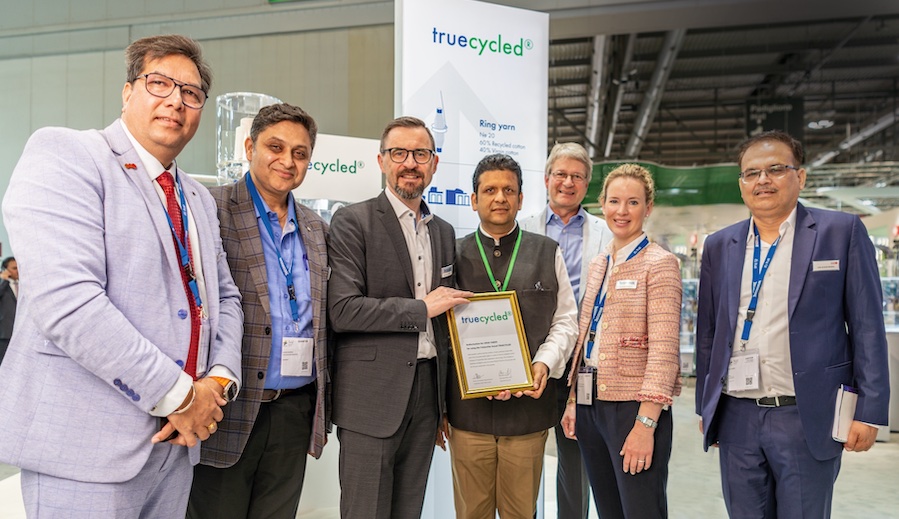
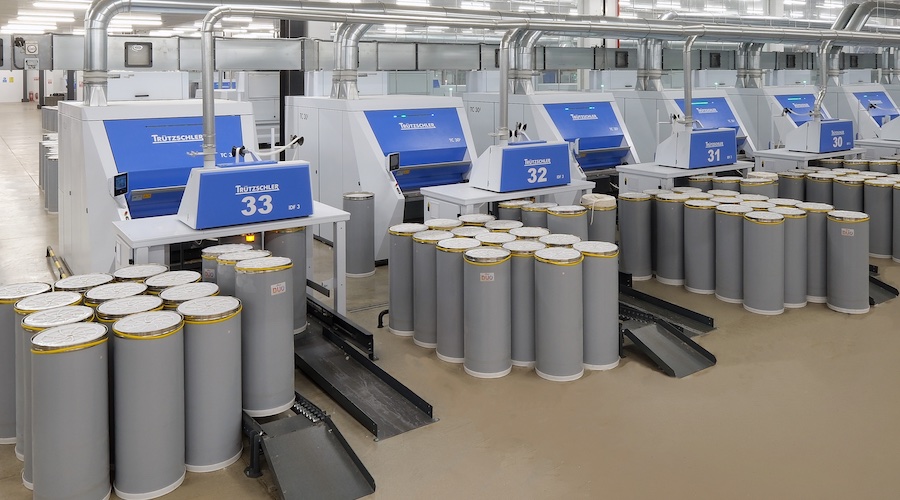
USHA yarns, a leading Indian yarn manufacturer, is producing recycling yarns in a state-of-the-art TRUECYCLED line - and got a special certificate for this at the ITMA 2023 © 2024 Trützschler
Trützschler has taken a bold step to tackle the global problem of textile waste: They expanded their portfolio to become the first full-liner in the preparation of textile waste – from mechanical recycling to the spinning preparation of torn secondary fibers. Tearing and spinning preparation are both key processes for achieving the best possible quality from secondary fibers. That means Truetzschler customers can tap into a competitive advantage by embracing this holistic approach.

The new complete TRUECYCLED solution is the result of a cooperation with the company Balkan Textile Machinery INC.CO. in Turkey, which Trützschler announced at the ITMA 2023 trade event in Milan. Since then, Trützschler has received many inquiries for recycling systems. More and more customers are now producing recycled yarns on a TRUECYCLED line: State-of-the-art recycling installations, configured and fine-tuned by Trützschler experts based on the customer’s specific requirements.

Success with a systems approach

Recycling systems face significant technological challenges. On average, torn fibers are much shorter than virgin fibers. The percentage share of short fibers in the fiber mass is much higher. Unopened yarn and fabric particles are also difficult to process. Not surprisingly, much academic and practical research is currently conducted to find solutions for these problems. Dr. Georg Stegschuster, a researcher specializing in textile recycling, believes a systems approach is needed. He is working at the Recycling atelier, a model factory for mechanical recycling in Augsburg, Germany, which is committed to delivering the latest technological insights for textile recycling. “A perfect fine-tuning between tearing and spinning preparation is key for obtaining the best possible quality results and avoiding unnecessary fiber shortening,” he says. “This can be achieved if you are in control of both processes – and have the necessary expertise for both processes too.”

Gentle but effective

In some cases, for example, it may be advantageous to have less aggressive settings in the tearing line. This can help avoid unnecessary fiber shortening. The remaining higher share of unopened fabric must then be handled in a high-performance spinning preparation line. This starts with the right blow room configuration for perfect opening, cleaning and blending. A card that is specially designed for recycling materials, such as the new TC 30Ri, can also enable gentle but effective treatment of fibers.

A shortened drafting process is also a must. The integrated draw frame IDF 3 can make this possible. The draft is high enough to provide excellent levelling of the numerous short fibers, but low enough to prevent floating fibers. “There is a lot of technological potential for improving the quality of the end-product through the right configurations and settings,” Stegschuster says. “There’s a growing number of examples that show how higher quality end-products can be achieved from recycled materials, and how the share of pre- or postconsumer waste in yarns can be increased without compromising on quality.” A new chapter in mechanical recycling is now beginning – and Trützschler’s TRUECYCLED system will play a leading role in this exciting story!

First full-liner in mechanical recycling and preparation of textile waste

Trützschler now offers a complete system covering the whole process, from cutting and tearing textile waste through to carding and drawing secondary fibers. Thanks to this holistic approach and Trützschler’s expertise for the whole process, manufacturers can avoid unnecessary fiber shortening and achieve the best possible quality results.
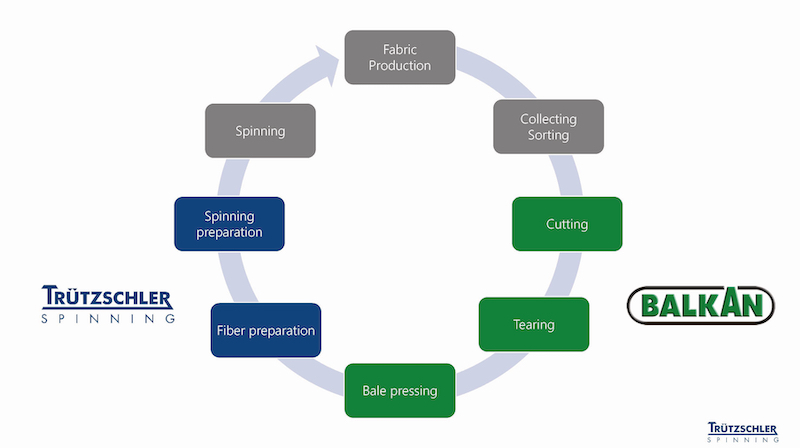
Truecycled concept with Balkan  © 2024
Truecycled concept with Balkan © 2024


More News from Truetzschler GmbH & Co. KG

#Spinning

Trützschler’s latest spinning and card clothing innovations at CAITME 2026

From September 8 to 10, 2026, Trützschler will present its latest innovations in spinning and card clothing for state-of-the-art fiber processing at CAITME in Tashkent, Uzbekistan. Visitors are invited to meet the experts at Pavilion 2, Booth D50 and explore solutions designed to increase productivity, streamline processes, and ensure consistently high yarn quality. Key topics include the next-generation card TC 30i, the integrated draw frame IDF 3, the high-performance comber TCO 21XL as well as Trützschler Card Clothing’s new flat top series STEELTOP®.

#Spinning

Pre-Cleaner CL-X: Proven in cotton cleaning – creating value beyond the spinning mill

Since its market launch, the CL-X has firmly established itself in blowroom lines worldwide. Hundreds of installations confirm its ability to deliver superior cleaning efficiency, lower waste, higher productivity and significant energy savings. Now, new customer applications show that the CL-X not only continues to excel in spinning preparation – it is also entering a completely new field of application: ginning.

#Spinning

STEELTOP®: A new benchmark in flat tops for spinning preparation

Modern carding generations achieve higher production performance, placing significantly greater stress on flat tops. Higher cylinder speeds and increased fiber density, combined with tighter carding gaps, create more demanding operating conditions. At the same time, poorer raw material quality and the increased use of recycled materials further intensify these challenges. With STEELTOP®, Trützschler introduces a new full steel flat top series developed for these demanding modern carding processes.

#Spinning

Ibrahim Fibres and Trützschler: A strong partnership enters its next phase with the TC 30Si

For more than two decades, Ibrahim Fibres and Trützschler have grown side by side, driven by a shared ambition to continuously improve spinning performance, strengthen technology leadership and set new benchmarks in the textile industry. Today, Ibrahim Fibres is a leading yarn and polyester staple fiber manufacturer in Pakistan. The company operates the largest number of Trützschler cards in the country, with more than 200 machines running across its mills in Faisalabad, and plays an important role in one of Asia’s largest textile industries.

More News on Spinning

#Spinning

BICO BCF yarn delivers impressive performance in field testing

In a joint development project with other partners, Barmag and Object Carpet have successfully tested BICO BCF yarn in the carpet manufacturing process. The results show that this innovative yarn technology offers significant performance advantages and opens up new possibilities for recycling-oriented carpet constructions.

#Spinning

Barmag expands its portfolio for PA6/PA6.6 applications — also available as a retrofit solution

With the new type 6020 ceramic oiler, Barmag is introducing a powerful addition to its product portfolio for processing PA6 and PA6.6 yarns. The solution is specifically designed for low-titer applications in the range of 5 to 100 denier.

#Recycling / Circular Economy

Rieter and partners launch Recycling Powerhouse for industrial-scale textile recycling

Recycling Powerhouse Ltd. was established in July 2026 to industrialize, standardize and scale textile recycling. Based in Switzerland, the venture will operate a franchise-driven business model that enables the production of high-quality, certified recycled yarns. The project is supported by the following partners: Rieter Group, the world’s leading system supplier for natural and man-made fibers, Säntis Textiles, a Swiss textile engineering company, and Valvan, a Belgian sorting technology company. The first blueprint franchise operation is scheduled to launch early 2027 in partnership with Suhail Industrial Holding Group in Qatar.

#Spinning

Rieter sees Barmag integration on track as orders and sales rise

The first half of 2026 was shaped by the successful completion of the largest acquisition in Rieter’s history. The Man-Made Fiber Division enables entry into the growth segment of man-made fibers and sustainably strengthens Rieter’s market position in the Asia region. The expanded Group is now the world’s leading system supplier for the processing of natural and man-made fibers. In the first half of the year, initial cost savings in material costs and operating expenses have already been realized. The targeted synergies are expected to amount to at least CHF 20 million by the end of the 2028 financial year. Due to the completion of the acquisition on February 2, 2026, the first half of the year for the Man-Made Fiber Division only amounts to five months.

Latest News

#Functional Fabrics

PERFORMANCE DAYS announces new focus topic & forums for October 2026

With its upcoming October 13–14, 2026 edition, PERFORMANCE DAYS is placing the spotlight on one of the textile industry’s most important transformations: “Bio-Based Materials – From Fiber to Fabric”, a two-part Focus Topic exploring the future of bio-based innovation across the textile value chain. Part 1, presented in October 2026, will focus on fibers and next-generation material developments, while Part 2 at the March 2027 edition will shift the perspective toward dyeing, finishing, additives, and processing technologies.

#Nonwoven machines

MENANG rapidly resumes production with new ANDRITZ airlay line after major fire

MENANG, a Malaysian manufacturer of nonwoven automotive components, has resumed production after a major fire severely damaged its airlay line in mid-March 2026. A new airlay line supplied by ANDRITZ enabled production to restart within only four months.

#Exhibitions & Events

Febratex 2026 to be the largest edition of the leading textile trade fair in the Americas with 10 exhibition halls

Febratex 2026 will be the largest edition in the history of the leading textile trade fair in the Americas. Dedicated to the textile and apparel manufacturing industries, the event will take place from August 18–21, 2026, in Blumenau, Santa Catarina, Brazil, with a strong focus on technology, sustainability, and business generation.

#Raw Materials

Cotton Brazil Dialogues field trip brings international stakeholders closer to Brazil’s cotton production chain

How do you build trust across the global textile value chain? By opening the farm gates. This is the principle behind the Cotton Brazil Dialogues. At the end of July, the programme welcomed its first group of international participants for a five-day immersion into Brazilian cotton production, combining field visits with technical workshops to showcase the quality, sustainability, innovation and traceability behind one of the world’s leading cotton origins.

TOP