#Spinning
Belairo – The perfect yarn for towels

For towel manufacturers, the demands on yarn quality and yarn structure are high: pilling-free, sufficient strength and stretch and few imperfections. With Belairo yarns spun on the Autoairo air spinning machine, it is possible to fulfil all these wishes and also offer towel manufacturers new economic prospects. A towel made from Belairo yarn lasts up to 10 times longer and retains its shape better, thus contributing to sustainable use.
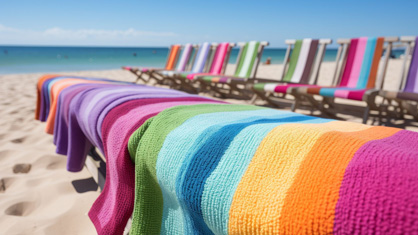
Everyday life without terry cloth towels is unimaginable. Everyone uses them every day in the bathroom, swimming pool, hotel or at the beach. For the user, it is important that they be soft, absorbent, easy to wash (at least 60 degrees), colour-fast and made of natural materials - preferably cotton. Towels should match the furnishings, be affordable for every budget and be produced as sustainably as possible without using a lot of chemicals.
A high-quality terry towel for private use weighs between 400 and 500 grams per square metre. Velour towels are somewhat lighter, as the loops are cut open and shortened to achieve that velvety velour effect.
Belairo yarn - a real alternative to combed ring-spun yarns
In order to meet consumer demands and be successful on the market, towel manufacturers are looking at how they can optimise the production process. One important lever for cost optimisation is the yarn used. Up to 80% of the weight of the towel is made up of the pile yarn, the yarn that comes into contact with the skin.
The classics for pile yarns are combed ring-spun yarns: durable, high quality, complex to produce and correspondingly expensive. The ring yarns are combed to reduce the hairiness of the yarns and the associated formation of unwanted fibre fluff on the towel.
The combing process ensures that the towels do not become thinner through frequent washing, during which short, less-bonded fibres are washed out. The short fibres responsible for this in the yarn are eliminated from the outset by combing, which accounts for approx. 10-15% of the fibre mass. Towels made from cheaper, uncombed, exclusively carded ring yarns lose fibres over time due to the yarn structure.
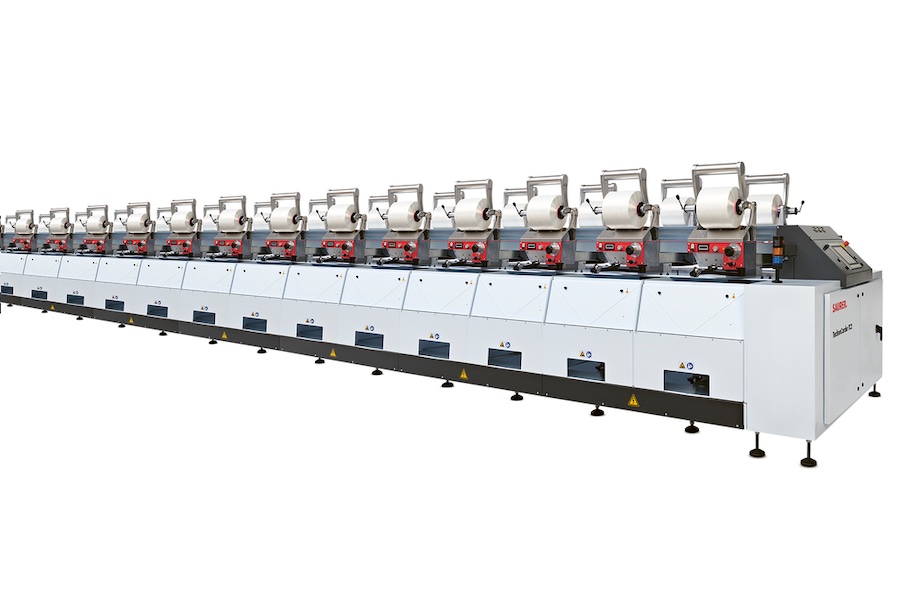
But there is another way – with Belairo yarn which is similar to ring-spun yarn. The yarn produced on the Autoairo air spinning machine is a cost-effective alternative to classic ring yarns. Thanks to the yarn structure with parallel core fibres and the defined twisting of the wrapping fibres, all of the fibres are optimally integrated, even the shorter ones. During the air spinning process, fibres that are too short are removed pneumatically. However, this proportion is significantly lower than in a classic combing process. Belairo yarns therefore offer the best conditions for lint-free towels. Thanks to the high rub resistance of the towels, hardly any fibres come loose from the fabric composite during washing. Fibre migration is zero with Belairo yarns.
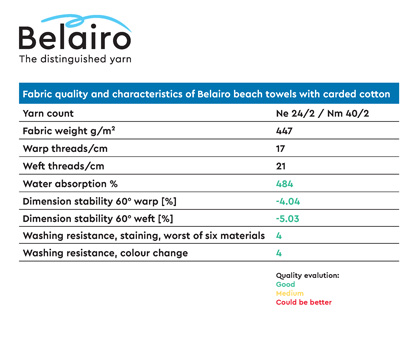
If you compare towels made from ring yarn with towels made from Belairo yarns, you will notice that the surface appearance of Belairo towels is more even, their absorbency is higher, and their drying time is shorter. These properties result from the special Belairo yarn structure and are particularly popular with private and industrial consumers (Graph 1).
The hairiness of Belairo yarn is generally very low. In order to achieve comparable values for ring yarns, these must be combed. Due to the low hairiness of Belairo yarns, their tendency to pill is also considerably reduced. Colour contrasts or motif contours in the towels are thus retained even after long periods of use. The Belairo yarn structure also gives the towels a high degree of dimensional stability. They shrink hardly at all and do not warp, even after numerous washes. Belairo beach towels keep their shape better and are more resistant to washing than towels made from ring yarn (Graph 2).
It is not necessary to comb the Belairo yarns; carded yarns already deliver the best results for terry cloth fabrics. A sustainable process in terms of fibre utilisation, as significantly more fibres are used than with combed ring-spun yarns.
Belairo yarn – environmentally friendly and economical
The production process of carded Belairo yarns differs from that of combed ring yarns, and this has a massive impact on spinning costs. Belairo yarns for towels can be spun at take-up speeds of up to 400 m/min. This corresponds to 18 times the productivity of a ring spinning machine. A special feature of Belairo yarn production is that there is an increase in quality with each increase in production speed. In contrast to conventional spinning processes, where increased productivity can be at the expense of yarn quality, the opposite is often true for Belairo yarns. The faster the Autoairo produces, the better the yarn quality.
Thanks to the enormously high productivity in Belairo yarn production, towel yarns can be produced up to 45% more cost-effectively. Savings can be made in terms of energy consumption, personnel requirements, space requirements and the associated costs of air-conditioning for manufacturing.
In order for the Belairo yarns to withstand the stresses of high production output on the weaving machine and to achieve optimum machine utilisation effects, they must meet minimum quality standards, particularly regarding strength, elongation, and thin places (Graph 3). Due to their specific structure, Belairo yarns are slightly weaker and sometimes less elastic than combed ring yarns, but this additional strength of the ring yarns is not fully utilised during weaving. What matters is the minimum requirements for the weaving process. Belairo yarns exceed yarn strength requirements by almost 30% and yarn elongation requirements by more than 10%.
Yarn imperfections, in particular the number of thin places, are also relevant as they could conceal potential weak points that influence the efficiency of the weaving machines. Belairo yarns have 80% fewer thin places than the maximum values permitted in weaving mills. The low dust and linting tendency of Belairo yarns is also very advantageous, whether in terry cloth-weaving or warp-knitting machines, which are often used for towels in hotels and hospitals. This extends the cleaning intervals on the weaving and warp knitting machines, even at high feed rates.
Belairo yarns and towelling - a perfect duo. The pile yarns that make up a high-quality towel can be produced almost half as cost-effectively with Belairo yarn as with combed ring-spun yarns while at the same time producing a perfect towel with a life expectancy that is up to ten times longer than a towel made from ring-spun yarn (Graph 3).
Also, the environmental balance of Belairo terry cloth towelling is also positive. Chemical softeners are often used in the final finishing of towels made from ring yarns to make them pleasant to the touch to potential purchasers. Chemical substances are however being scrutinised ever more critically by consumers. There is no need for softeners in the final finish, as Belairo yarns have an appealing feel without chemicals. In yarn dyeing, Belairo yarns require less dye and in weaving, less sizing is needed for the warp beams. The use of Belairo yarns reduces wastewater pollution and protects the environment.