[pageLogInLogOut]

#Spinning

Sensor specialist becomes employee owned

The rock-solid reliability of Dent sensors makes them integral to the yarn spinning and winding processes. © 2022 Dent Instrumentation
BTMA member Dent Instrumentation – a specialist in contactless yarn sensors – has become an employee-owned business following the formation of a new Employee Ownership Trust (EOT).

The company, based in Colne, Lancashire, has been family owned since its founder Geoffrey Dent secured a patent for the very first contactless yarn sensor in the 1960s. It has been successfully run by his son Andrew and the family for many years.

“This deal ensures a smooth succession as well as the preservation of the company’s core family values and the Dent Instrumentation name,” said Managing Director Colin Hull. “The EOT structure will maintain the integrity of the business for years to come.”
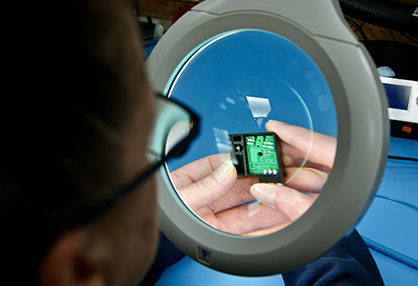
The detection response of the sensors can be adapted to each individual unit according to customer requirements. © 2022 Dent Instrumentation


“The success of Dent Instrumentation has been down to the dedication and talents of the whole team so putting it in their hands feels fantastic,” added Chairman Andrew Dent. “It was incredibly important to protect our heritage and way of working and I couldn’t think of anyone better to do that than the very people who helped to grow the business.”

Reliability

The rock-solid reliability of Dent sensors makes them integral to the yarn spinning and winding processes and they have become the standard throughout the textile industry, recognised for their quality, performance and value. They are used by major manufacturers of textiles and textile machinery under either Dent or OEM machine builder brands.

The highly accurate sensors are effective at speeds as low as 3m/min up to 8,000m/min, and their detection response can be adapted to each individual unit according to customer requirements.

The ‘fit and forget’ sensors are extremely durable in all operating environments and encapsulated in epoxy resin to provide protection from spin finish, oil, wax, water and any other potential contaminants. A unique optical compensation system also contributes to ensuring very little cleaning is required.


The textile processes Dent sensors are developed for include those for filament yarns on machines for the high speed winding of POY and FDY at high speeds, as well as elastomeric yarns etc. For DTY yarns, Dent provides a sensor capable of operating over the full range of speeds and yarn counts, with wrap detection on take up rollers providing early warning of dangerous wraps.

The ‘fit and forget’ sensors are extremely durable in all operating environments. © Dent Instrumentation


For staple fibre operations, low cost and reliable sensors cover ring, Open End and friction spinning machines, as well as assembly winding. Specially-designed multi position sensors are suitable for many creel applications and also twisting machines, particularly for glass fibre operations.

A recent new development is that of the Nelson Twin sensor which incorporates two independent sensing circuits instead of the traditional single circuit and as a retrofit upgrade for machines currently in the field can significantly boost efficiency.

Impartial

Dent’s continuing independence means it is able to offer impartial design advice, with a high priority placed on development by personnel who are not only highly skilled in electronics, but also experienced in textile processes.

“The workforce at Dent Instrumentation is highly skilled and highly valued,” said Jason Kent, CEO of the British Textile Machinery Association (BTMA). “It was a key priority for the Dent family that those jobs and the Dent culture be protected in the delivery of a succession plan. The transition to employee-ownership is a perfect solution.”




More News from TEXDATA International

#Recycling / Circular Economy

textile.4U publishes special edition “Top 100 Textile Recycling Companies 2025”

With a comprehensive 176-page special edition, textile.4U is dedicating its latest issue entirely to one of the most dynamic and influential topics in today’s textile industry: textile recycling. The new issue, published exclusively in high-quality print, presents the Top 100 textile recycling companies researched and selected by TexData – organizations that already play a key role in the transition to circular textiles or are expected to have a significant impact in the near future.

#Recycling / Circular Economy

Responsible Textile Recovery Act of 2024 signed by Governor

Senator Josh Newman (D-Fullerton) is proud to announce that Senate Bill 707 (SB 707), the Responsible Textile Recovery Act of 2024, has been signed into law by the Governor of California, Gavin Newsom. This groundbreaking legislation establishes the country’s first Extended Producer Responsibility (EPR) textile recycling program, marking a significant step forward in the state’s efforts to combat waste and promote sustainability.

#Textiles & Apparel / Garment

Modtissimo promotes sustainability with 28 coordinates in the Green Circle

Modtissimo is proving more and more to be a textile and clothing show that delivers the latest innovations in the area of sustainability, with the iTechStyle Green Circle being the main showcase for companies' creations. In this 60+4 edition, taking place on 12 and 13 September, 28 coordinates will be exhibited in a section organised by CITEVE and curated by Paulo Gomes.

#Europe

The EU and Egypt team up to mobilise private sector investments at Investment Conference and sign a Memorandum of Understanding underpinning €1 billion in macro-financial assistance for Egypt

At the EU-Egypt Investment Conference, co-organised by the EU and the Government of Egypt on 29-30 June, the EU and Egypt are teaming up to intensify private sector investments in Egypt. They are also signing a Memorandum of Understanding (MoU) for the disbursement to Egypt of up to €1 billion in Macro-Financial Assistance.

More News on Spinning

#Spinning

Rieter responds to higher raw material prices

Global political and economic developments have been leading to rising raw material and energy costs for some time. The textile machinery industry is also affected by this trend. Rieter machines and components consist to a large extent of steel, copper, aluminum and electronics. These materials in particular have seen higher demand and higher prices in recent months.

#ITM 2026

The hub of smart and sustainable transformation in yarn technologies: ITM 2026

With global fiber production projected to reach 169 million tons by 2030, yarn manufacturing is becoming one of the most strategic fields within the textile machinery industry. Located in Halls 6, 7, and 10, the Yarn Hall at ITM 2026 is set to bring together industry professionals with innovative solutions developed around automation, energy efficiency, digitalization, and circular production.

#Spinning

Barmag: DTY efficiency for the future of fancy yarns

Fancy yarns continue to gain importance in the textile market: Whether in fashion, home textiles or the automotive industry - the trend towards individuality is fueling the demand for textured, haptically differentiated and at the same time comfortable yarns.”

#Spinning

Perfect quality through collaboration: Machinery from Trützschler, Toyota and Murata at Zirve Tekstil

In today’s textile industry, excellence is not achieved by chance – it’s the result of deliberate decisions, technical expertise, and the courage to go beyond conventional paths. The Turkish company Zirve Tekstil has done just that: by combining the best technologies from Trützschler, Toyota and Murata, they’ve created a production setup that delivers outstanding yarn quality – recognized worldwide.

Latest News

#Sustainability

Ying McGuire becomes new CEO of Cascale

Cascale today announced the appointment of Ying McGuire as Chief Executive Officer, effective June 1, 2026.

#Technical Textiles

Sustainable, lightweight, and sound absorbing: Polyester-based front trunk solution for BEVs

As car manufacturers look to further reduce their carbon footprint, Autoneum has developed an innovative front trunk solution for battery electric vehicles (BEVs), made entirely from polyester-based textile. The Ultra-Silent Frunk offers significant weight reduction, improved acoustic and thermal insulation, and uses up to 70 percent recycled material, supporting sustainable and efficient vehicle design. Autoneum, global technology leader in acoustic and thermal management for vehicles, has already received orders for the new frunk from three major OEMs in Asia and Europe to be built in three BEV models. Series production for two BEVs has been underway in China and Germany since last year.

#Raw Materials

Modern testing methods for raw cotton

The 38th International Cotton Conference Bremen will take place from 25 to 27 March 2026 at the Bremen Parliament. This conference has traditionally stood for in-depth expertise and international exchange. The program will focus on technical innovations, market trends, and regulatory frameworks across the entire value chain – from agriculture to the circular economy. With high-profile speakers, the conference is regarded as the key meeting point for the global cotton industry. Today’s focus: Cotton quality and testing methods.

#Weaving

Stäubli demonstrates how innovation translates into real benefits for weaving mills at SITEX 2026

One of India’s most prominent textile industry events, SITEX 2026, is held from February 21 to 23 in Surat. Committed to empowering Indian weaving mills with state‑of‑the‑art solutions tailored to regional needs, Stäubli will present a selection of solutions designed for performance, reliability, and power efficiency. Through its weaving preparation, cam and dobby shedding solutions and Jacquard technologies, Stäubli highlights its global expertise tailored to the specific needs of the local market.

TOP