[pageLogInLogOut]

#Recycling / Circular Economy

textile.4U publishes special edition “Top 100 Textile Recycling Companies 2025”

A 176-page industry compendium on the future of textile recycling
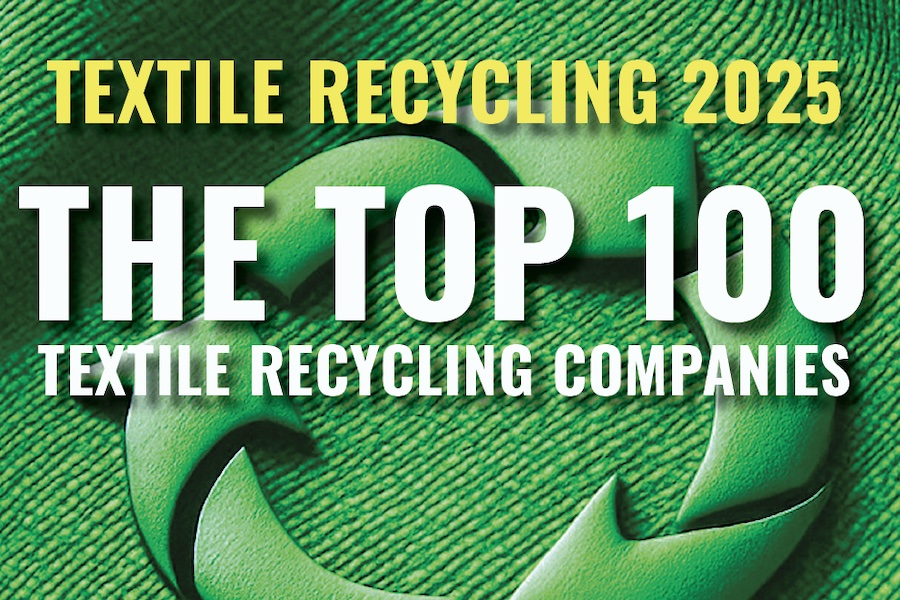
With a comprehensive 176-page special edition, textile.4U is dedicating its latest issue entirely to one of the most dynamic and influential topics in today’s textile industry: textile recycling. The new issue, published exclusively in high-quality print, presents the Top 100 textile recycling companies researched and selected by TexData – organizations that already play a key role in the transition to circular textiles or are expected to have a significant impact in the near future.


“With our Top 100 companies, we not only want to showcase the key players in the market but also give readers a clear and structured overview of where textile recycling stands in 2025,” says Oliver Schmidt, Editor-in-Chief of textile.4U. “Understanding the companies, their activities, and their current milestones provides readers with unique insights into what is already possible in textile recycling – and where the journey is heading from a technological perspective.”

Broad coverage across the entire textile value chain

The selection reflects the entire textile value chain: from technology providers for mechanical and chemical recycling to machinery manufacturers, collectors, sorters, and various service providers that build infrastructure and processes for circular textiles.

Many of the featured companies are currently planning or constructing industrial-scale production facilities. Together, their pilot plants already represent over one million tonnes of recycling capacity for textile waste.

The company profiles have in most cases been developed in close collaboration with the companies themselves, who reviewed and supplemented the publicly available information researched by textile.4U. This ensures a uniquely accurate and up-to-date insight into each organization’s role, technology, and progress in textile recycling.

Seven exclusive interviews with global industry experts

In addition to the company profiles, the special issue features seven exclusive expert interviews, offering diverse perspectives on the state and future of textile recycling:

  • Prof. Dr. Stefan Schlichter from the Textile and Recycling Atelier (TWA) shares his extensive expertise, discussing the establishment of the Recycling Atelier in Augsburg, the experiences gained, and his new role as spokesperson of CirTex – explaining how he aims to further advance textile recycling in Germany and across Europe.
  • Dr. Christian Schindler, Director General of the International Textile Manufacturers Federation (ITMF), discusses the global relevance of textile recycling: “Recycling will remain a key issue for the textile industry with growing relevance and possibly exponential development.” At the same time, he adds a note of realism: “The idea of eliminating oil entirely is unrealistic.” His analysis offers a balanced view of global opportunities and constraints.
  • Dirk van Vantyghem, Director General of Euratex, provides valuable insights into collaboration with the EU and explains how textile recycling is being advanced under the EU Textile Strategy. He highlights the often underestimated complexity of implementation and shares how concrete solutions are being developed – including his personal vision for a truly circular European textile industry.
  • Oswald Baldischwieler, Vice Presidentt Product Soltions at USTER Technologies, addresses one of the key issues in textile recycling – the measurable quality of recycled yarns and fabrics – and explains how this quality can and should be quantified using advanced testing technology.
  • Trützschler, a leading machinery manufacturer in mechanical textile recycling, already works with more than 20 customers worldwide on recycling projects. Dr. Bettina Temath, Head of Global Marketing, shares her practical experiences and introduces the company’s solution TRUECYCLED.
  • Andreas Merkel, Managing Director of Gebr. Otto Baumwollfeinzwirnerei GmbH & Co. KG, describes how the company successfully brought recycled yarns to market, the challenges it faced along the way, and its plans for expanding this product segment.
  • Finally, Emma Stjernlöf, Chief Communication and People Officer at SYRE, the rising star in chemical textile recycling and winner of the ITMF Startup Award 2024, discusses the company’s vision for a future where textile recycling becomes the new normal. She adds: “We expect a supply-demand gap in only a few years’ time, based on market research.”

Editorial background: facts, myths, and future directions

The issue also includes three in-depth editorial features that explore the selection and composition of the Top 100, the boom in textile recycling, and the ongoing transformation and extension of the textile value chain toward circularity.

These articles also challenge common myths and shed light on often-overlooked aspects of the textile recycling sector.

A book-length publication based on over 1,000 hours of research

Altogether, more than 1,000 hours of research, communication, and editorial work have gone into this publication – which is more of a book than a magazine.

Accordingly, it is available exclusively as a printed edition. The special issue can be ordered via www.texdata.com. The regular price is €179 plus shipping and taxes. An introductory price of €99 applies until October 31, 2025, the closing date of ITMA ASIA + CITME 2025. PayPal serves as the payment processor, and credit card payments are also accepted.

More Info:

https://www.texdata.com/en/textile-recycling-2025



More News from TEXDATA International

#ITM 2026

ITM 2026: The new geography of textile production

New production hubs are emerging across North Africa and Central Asia, while Türkiye is accelerating its transformation toward higher-value, technology-driven and more sustainable textile manufacturing.

#Research & Development

“Production is a product”

From technical textiles and AI-driven robotics to the limitations of textile circularity: Professor Dr Thomas Gries looks back on more than two decades of development at ITA Aachen. In the interview, he explains why production technology remains a decisive success factor, discusses international collaborations and innovation ecosystems, and shares his views on the transformation of production landscapes and the challenges facing an increasingly regulated industry.

#Knitting & Hosiery

“We need to move away from the price trap and return to a value-driven mindset.”

With its new Textile Innovation Center, KARL MAYER is sending a strong signal for innovation, collaboration, and the future of textile applications. In this interview, Karl Josef Mayer discusses new opportunities in warp knitting, the processing of staple fibres, recycling, the changing role of machinery manufacturers, and why the textile industry must once again focus more strongly on the value of textiles. by Oliver Schmidt

#Associations

“Innovation, resilience and international experience remain the great strengths of the Swiss textile machinery industry”

Geopolitical uncertainty, growing competitive pressure from China, new free trade agreements and the shift towards a circular economy are currently reshaping the global textile industry. In this interview, Cornelia Buchwalder discusses the current mood within the Swiss textile machinery sector, the industry’s distinctive innovative strength, new market opportunities in India and Asia, and the technological trends that could shape the upcoming trade fair cycle leading up to ITMA 2027.

More News on Recycling / Circular Economy

#Recycling / Circular Economy

RE&UP establishes Fiber Club consortium to scale Next-Gen material sourcing

Originally developed as an umbrella framework by innovation platform Fashion for Good, the RE&UP Fiber Club aims to accelerate the commercial adoption of circular Next-Gen materials across the global fashion ecosystem.

#Recycling / Circular Economy

HKRITA signs MoU with Jeanologia and Looptworks to establish the Green Machine Circular Textile Ecosystem

The Hong Kong Research Institute of Textiles and Apparel (HKRITA) yesterday officially signed a landmark Memorandum of Understanding (MoU) with two key global partners, Jeanologia and Looptworks, to establish the Green Machine Circular Textile Ecosystem – a first-of-its-kind collaboration to accelerate the large-scale recycling of blended textiles.

#Spinning

Object Carpet tests production of rPET BCF yarn on Neumag BCF line

In a joint project with Object Carpet GmbH, Denkendorf; the Institute for Textile Technology (ITA), Augsburg; and Next Generation Recyclingmaschinen GmbH (NGR), Feldkirchen, Austria, Barmag investigated the processing of recycled polyester for BCF yarn. The goal was to evaluate the fundamental suitability of 100% recycled carpet material for reuse in carpet yarn production to create a closed-loop system in carpet manufacturing. To date, commercial rPET BCF processes have been based solely on rPET from bottle pellets.

#Recycling / Circular Economy

Albany International reports progress with Cyclezyme on industrial textile recycling project

Albany International Corp. (NYSE:AIN) reports continued progress in the ongoing project with Cyclezyme AB, a leader in advanced enzyme-based plastic recycling, based in Sweden. The project exemplifies leading edge innovation in materials science, focusing on the development of enzyme-based recycling of industrial textiles primarily consisting of polyester and polyamide, where there is currently a significant lack of effective solutions for circular material flows. The objective of the project is to establish enzymatic processes for depolymerization and recycling of technical textiles and high-performance industrial materials.

Latest News

#Yarns

Yarn Expo Shenzhen 2026 closes doors, advancing sustainable and innovative sourcing in South China

Yarn Expo Shenzhen 2026 served as a strategically positioned mid-year sourcing platform for the Greater Bay Area, highlighting Shenzhen’s role in connecting regional demand, supply and innovation exchange across the textile value chain. During the three-day fair, over 20,000 visits were drawn from 74 countries and regions[1], as exhibitors and buyers engaged with new developments in greener, performance-led, and value-added yarn and fibre solutions. Held in conjunction with Intertextile Shenzhen Apparel Fabrics and PH Value, the fair underscored the benefits of closer synergy and new materials across yarn, fabric and apparel platforms for the South China market.

#Research & Development

2026 general meeting of the Friends and Supporters of RWTH Aachen at ITA

The Friends and Supporters of RWTH Aachen e. V. (proRWTH) looked back on a successful year of support at their 2026 general meeting. The meeting took place at Institut für Textiltechnik (ITA) of RWTH Aachen and was combined with a joint session of the Executive Board and the Administrative Board. Before the general meeting began, participants were given a guided tour of ITA, providing them with fascinating insights into current research and development topics in textile engineering.

#Natural Fibers

Cotton ConneXions Insight to Impact brings supply chain leaders together around cotton innovation

Cotton Incorporated’s Cotton ConneXions Insight to Impact brought together more than 300 industry leaders from 140 companies across 10 countries, including more than 45 top global brands and sourcing organizations, underscoring strong global interest in cotton-rich product development, sourcing and supply chain collaboration.

#Knitting & Hosiery

Footwear innovation enabled by warp knitting technology– insights from New Balance

The future of the athletic shoe is increasingly being shaped on warp knitting machines. For KARL MAYER, the footwear industry is one of the most important growth markets – and one of the sectors where innovative textiles can realize their full potential. In his keynote address at the opening of KARL MAYER’s TEXTILE INNOVATION CENTER in Obertshausen in April, Vishnu Prakash Muthusamy, Senior Textile and Materials Engineer at New Balance, explained the opportunities that warp knitting technology opens up for performance, sustainability, and faster development processes, and why textile manufacturers are transitioning from suppliers to development partners.

TOP