[pageLogInLogOut]
TRÜTZSCHLER SPINNING - FROM WASTE TO VALUE

#Spinning

Spinners know what they want
© 2021 Uster
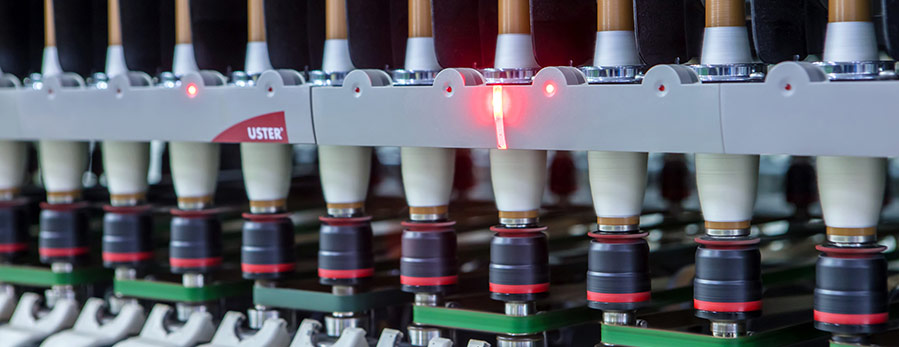
… and how to get it with Uster RSO 3D. For the first time, mills can now intelligently correlate ring quality data and winding quality data in a single system – for significant profitability increases. RSO 3D is the ‘third dimension’ of quality. A case study from practice shows how a mill made real gains, with the vital figures to prove it.

An ambitious spinner was aiming to reach the next level of quality management. For this customer, it was essential that quality, as well as profitability, had to be improved. The medium-sized spinning mill in India installed Uster-Muratec RSO 3D as part of an expansion project. The installation includes 30 compact ring spinning machines with Uster Sentinel, in combination with Muratec QPRO EX/FPRO EX featuring Spin Inspector and Uster Quantum yarn clearers. On these machines, the customer produces 100% combed cotton yarn, in counts Ne 26 and Ne 32.

Advantages in percentages

When the new installation was being started up, a direct comparison between RSO 3D and the standard installation was executed as a trial to demonstrate the difference.

The evidence showed that the spinner was able to reduce yarn faults by 10% and yarn alarms by 12% in both counts with RSO 3D. Quality blocks were reduced by a further 7% and finally clearer quality cuts by 8%.

Overall, this spinner was able to reduce the total yarn splices by 5%, producing about 5 kg more good yarn per machine per month.

© 2021 Uster
© 2021 Uster


Money talks, clearly

The mill’s results are impressive. Some small calculations convert the facts into numbers. Let’s start with energy savings. By reducing yarn joints on the winding machines, the customer needed less compressed air and thus less electricity for the machine compressor unit. These savings together amount to approximately 954 kWh per machine per month. Calculated at about 0.08 USD (6 INR) per kWh, this comes to 77 USD (5,724 INR) per machine per month. With 30 machines, this amounts to 27,720 USD (almost 2 million INR) the whole year.

On top of the financial savings, the mill also noted an increase in the level of ‘good’ material. The 5 kg reduction in waste means there is 5 kg more good yarn per machine every month which can be sold. With 30 machines, this totals 1800 kg more yarn per year. Based on a price of 3.77 USD (280 INR/kg), this achieves an increase in sales worth another 6,786 USD (500,000 INR).

Combining both these calculations, the overall gain for the spinner totals 2.5 million INR per year, equivalent to about 35,000 USD/year, apart from significant savings due to reduced clearer cuts.

Further advantages can also be expected in downstream processes. Fewer cuts mean the yarn has fewer potential weak points leading to less stoppages due to yarn breaks. This makes it possible to adapt subsequent process speeds, while the customer will also benefit from an improved fabric appearance.


Operators benefit too…

The working area for machine operators could be increased significantly – while reducing the stress factor. This is possible because Uster Sentinel notifies the operators from a distance about individual yarn breaks. The system uses signal lamps at the head of the machine, at the relevant section, and at the affected spinning position. So, the operator is logically guided to the next yarn break, instead of having to search laboriously for yarn breaks along all machine sides.

When an operator locates a yarn break, the type of break is indicated at the spinning position. Different signals categorize the problem as either Slip, Off Quality, Rogue or RSO 3D alarm. At this mill, operators are instructed to deal exclusively with yarn breaks, but not with the RSO 3D alarms. These are the responsibility of highly-trained technicians, because RSO 3D alarms indicate a faulty setting at the spinning position, and repairing them is both necessary and time-consuming. The RSO 3D alarms are displayed to the technicians by the Sentinel LEDs, and also on the Quantum control unit (CCU), as well as on the RSO 3D Quality Map.

As a result, the customer can deploy trained personnel in a very targeted and efficient manner. At the same time, the mill could increase spinning capacity and the working areas of the operators through path optimization.

Rapid payback

Individual quality data for each spindle position enables quality mapping across the ring spinning machine. This helps to identify outlier sides, sections or spindles, in addition to supporting maintenance decisions. Quality mapping also enables users to trace problems back to the individual roving machine and bobbin. Thanks to quality mapping, spinners can keep the entire ring spinning machine under control – and their profits as well.

RSO 3D proves its worth, for every cent invested, because of cost savings through reduced compressed air use and savings in energy. Payback comes earlier with the higher production efficiency based on saving cuts. It means the extra amount of good yarn sold is equal to what would have otherwise been wasted at the winding machine.

“The customer is convinced of Uster RSO 3D because of the increased spinning productivity and profitability, as well as facing the challenge of the lack of well-skilled staff by utilizing trained personnel in a very targeted and efficient manner,” says Amol Kekre, General Manager Sales & Marketing at Uster’s subsidiary in India.

Bigger profits come with increased quality standards, because of much smoother running at the winders. Claims are a thing of past and increased production efficiency assured for the future. The spinner’s downstream customers will also be delighted to increase production speed in their own processes – and to improve fabric appearance at the same time.
More News from Uster Technologies AG

#ITM 2026

Uster’s new Recycling Opening Index guides spinners to the perfect blend

Uster AFIS 6 now offers the key data for better decisions when blending recycled fibers. Process control is decisive in determining the quality and economic outcome. The new R Recycling Module of AFIS 6 introduces the Recycling Opening Index (ROI), so spinners can optimize their circularity credentials. It was officially launched at ITM 2026 in Istanbul, Türkiye.

#Spinning

Measure and control the fiber – optimize yarn quality

Producing consistent yarn quality is an everyday challenge – and a very difficult one. Detailed knowledge and understanding of the fiber raw material is absolutely critical to achieving the best possible quality in the yarn. To help spinners, Uster experts have put together guidelines for avoiding yarn irregularity claims, in a special edition of the Uster News Bulletin.

#ITMA Asia + CITME Singapore 2025

Uster presents novelties at ITMA Asia + CITME 2025

There’s news from Uster Technologies to be announced for the industry’s upcoming event in Singapore. The Uster 360Q universe is growing with new products, solutions and services. Innovation developments can also be recorded in the fields of man-made fiber testing and fabric inspection. Uster innovations address the industry’s trending topics as mill management and process control, optimization of delivered fabric quality and yield.

#Spinning

Uster Technologies marks 150 years of empowering quality excellence

Uster Technologies marks 150 years of excellence – a milestone that reflects continuous adaptation to customer needs and industry change. Over the decades, Uster has evolved from manufacturing quality testing instruments into a trusted partner shaping the future of textile production.

More News on Spinning

#Research & Development

GenuTrace client advisory: Is your cotton supply chain UFLPA ready?

U.S. Customs and Border Protection has released updated operational guidance (CBP Publication No. 5560-0526) expanding its forced labor enforcement framework. The guidance supersedes the original 2022 UFLPA Operational Guidance and now covers all forced labor enforcement authorities — UFLPA, CAATSA, and WROs/Findings — in a single unified document. For cotton importers, the enforcement posture has not softened. It has become more structured, more documented, and more demanding. Learn more about UFLPA.

#Spinning

"We will become a recycling powerhouse"

The textile industry is now in its fourth consecutive year of crisis, while automation, artificial intelligence and recycling are reshaping the rules of the game. In this interview, Rieter CEO Thomas Oetterli discusses the first signs of a market recovery, reflects on his first three years at the helm of the company, explains the integration of Barmag, outlines Rieter’s vision of the fully automated spinning mill and highlights the strategic importance of recycling. In doing so, he explains why the new Rieter Group aims to play a leading role in transforming the textile value chain into a circular economy.

#Spinning

Barmag and Hitech Automation enter into partnership for an auto-doff system for texturing machines

Barmag (Suzhou) Technology Co., Ltd. and Hitech Automation Solutions PVT LTD. of Surat, India, have agreed to an exclusive partnership to jointly market Hitech’s Doffmatic automation solution for Barmag’s proven manual eFK texturing machines. In many texturing facilities, manual doffing processes remain heavily operator-dependent – resulting in issues such as increased scrap, inconsistent quality, and limited productivity.

#Spinning

Nico Pedretti appointed as Managing Director Graf Group

As of June 1, 2026, Nico Pedretti has assumed the role of Managing Director Graf Group. With more than 20 years of international industrial experience and extensive expertise in Operations, Supply Chain Management, Finance and Controlling, he brings a broad range of leadership and business experience to support Graf’s continued success.

Latest News

#Carpets

DOMOTEX Hannover 2028 off to a strong start with expanded portfolio

Preparations for DOMOTEX 2028 are already gaining strong momentum. Following its successful repositioning as the Home of Flooring & Interior Finishing, around 100 international manufacturers have already secured their place during the initial registration phase.

#Knitting & Hosiery

STOLL: Agreement signed for the divestiture of selected assets

In early 2025, KARL MAYER announced its strategic decision to focus on its core business areas of WARP KNITTING, WARP PREPARATION, and TECHNICAL TEXTILES. As part of this move, the flat knitting machine business under the STOLL brand was discontinued and the production site in Reutlingen was closed in October 2025.

#Research & Development

TERNAfil wins first place at PitchMiUp Night 2026 in Minden

The RWTH spin-off TERNAfil has developed MAXCarbon, a new high-performance hybrid fibre that combines the mechanical performance of carbon with the temperature and corrosion resistance of ceramic materials. For this development, TERNAfil was awarded first prize at the PitchMiUp Night in Minden on 21 May 2026.

#Nonwovens

Lenzing Group highlights scalable, bio-based nonwovens solutions at leading global industry fairs

From CIDPEX in China to Techtextil in Frankfurt and INDEX in Geneva, the Lenzing Group showcases ready-for-market, bio-based nonwoven solutions and receives industry recognition for LENZING™ Nonwoven Technology.

TOP