[pageLogInLogOut]

#Spinning

Mesdan introduces Loop knotter type 093E

A breakthrough innovation for diaper manufacturers

Developed and manufactured by Mesdan, Italy, the Loop knotter type 093E is a special version of the well-known Loop knotter, specifically designed to join hygiene-grade spandex yarns used in the personal care industry.


The new model was developed in cooperation with leading spandex manufacturers and in close collaboration with producers of the tension devices used on diaper manufacturing creels. This coordinated approach ensures seamless integration into existing production environments and addresses the specific requirements of elastic yarn processing in hygiene applications.

Greater efficiency and reliability in diaper production

The hand-operated knotter brings enhanced efficiency and reliability to diaper manufacturing operations by eliminating manual knot tying. Operators no longer need to tie together the ends of spandex packages – a process prone to inconsistency and potential production interruptions.

With the type 093E, consistent and repeatable knots can be achieved, helping to reduce downtime and improve overall line stability. In high-speed hygiene production, where even short interruptions can affect output and product quality, such reliability plays a key role.

The main application of the 093E is the tail-to-top transfer on creels used in diaper production. The device can be easily moved, directly clamped to the creel structure and secured at preset positions thanks to dedicated brackets, offering flexibility and ease of handling in daily operations.

Part of Mesdan’s comprehensive knotting expertise

Despite the growing demand for knot-free joining technologies, Mesdan continues to manufacture a complete range of knotting devices in both manual and automatic versions, covering the three main knot configurations: Winders, Weavers and Fishermans.

Knotting devices remain the only safe and repeatable method for joining monofilaments, air-bonded yarns or other yarn types whose ends cannot be opened to allow fiber intermingling – a characteristic typical of spandex used in disposable hygiene products.

The Loop knotter type 093E is available through Mesdan’s official sales network, providing the personal care and disposable hygiene industry with a dedicated and application-focused solution.
More News from Mesdan S.p.A.

More News on Spinning

#Spinning

Heberlein reinforces its commitment to the Chinese market

Heberlein, globally recognised as a leading provider of air interlacing and air texturing jets for synthetic filament yarns, is consolidating its success in the Chinese market with its APh- and APe-series for DTY applications. Particularly in the field of Air Covering, Heberlein technologies combine excellent quality with significant savings in compressed-air consumption. A new service hub in Shengze City underlines the company’s long-term commitment in the Chinese market.

#Recycled Fibers

Driving circularity with Uster Recycled Fiber Matrix

The textile industry’s commitment to circularity continues to accelerate, and mechanical recycling is viewed as a targeted approach to cutting textile waste and its environmental impact. At the forefront of this drive, Uster has developed the Recycled Fiber Matrix, a two-dimensional assessment of mechanically recycled fibers to guide optimum processing and end-uses.

#Spinning

Greater efficiency for tomorrow’s textile industry

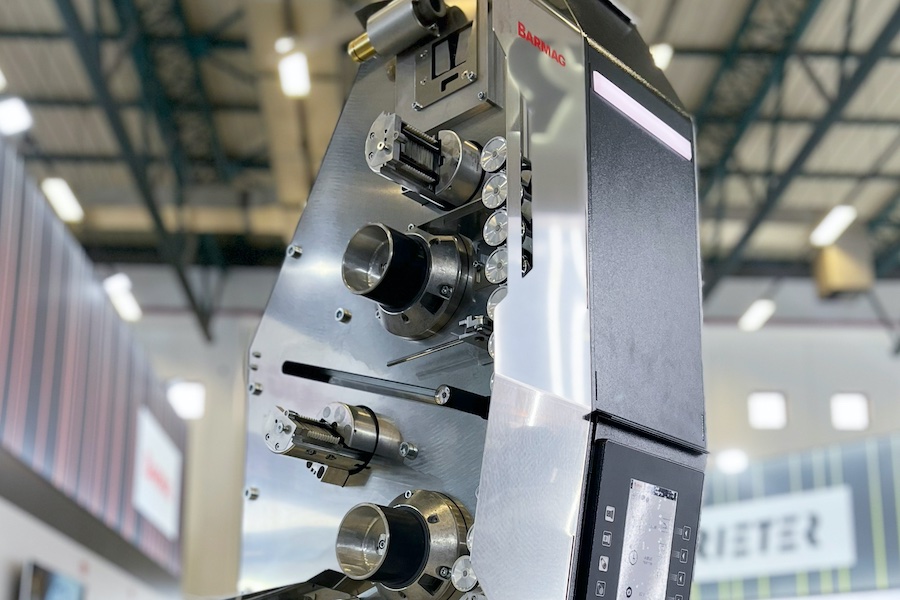
From September 24 to 27, 2026, Barmag, together with BB Engineering (BBE), will present innovative solutions for the efficient and sustainable production of synthetic yarns at the Egy Stitch & Tex Expo in Cairo, Egypt. Under the motto “A New Era. Powered by Innovation.,” experts from Barmag and BBE will present technologies spanning the entire textile value chain — from melt to yarn — at the ATAG Ltd. booth (Hall 1, Booth C1).

#Spinning

Rieter prepares leadership transition in Components & Technology

Roger Albrecht, Head of the “Components & Technology” Division, has decided to pursue a new opportunity outside the Rieter Group. Roger has worked for the Group for 11 years and has been instrumental in maintaining Rieter’s position as a technology leader in the short-staple business.

Latest News

#Textile chemistry

Archroma wins ICIS Innovation Award for sulfur dye breakthrough

Archroma, a global leader in specialty chemicals, has won a coveted 2026 ICIS Innovation Award for Best Product Innovation from a Large Company for FiberColors®. These high-performance sulfur dyes are synthesized from pre-consumer wool waste, reducing industry reliance on petroleum-based inputs while contributing to the circular economy by upcycling unwanted wool that farmers would otherwise pay to dispose of.

#Raw Materials

Redesigned World Cotton Day website offers tools, ideas and inspiration

With World Cotton Day just one month away, the International Cotton Advisory Committee (ICAC) has launched a completely redesigned www.WorldCottonDay.com, creating a new global home for everyone who wants to learn about, celebrate, and support cotton.

#Recycled Fibers

RE&UP’s Next-Gen Cotton fibers power Zalando private label t-shirt collection crafted from innovative recycled textiles

RE&UP Recycling Technologies’ Next-Gen Cotton powers a new collection from Zalando’s private labels, marking a step forward in bringing textile-to-textile recycled fibers into commercial fashion production. Launching on Zalando in August, the collection comprises five t-shirts across YOURTURN by Zalando and Even&Odd by Zalando, made from a circular-knit fabric blending 80% organic cotton with 20% RE&UP Next-Gen Cotton — textile-to-textile recycled fiber produced from textile waste. This is the first time RE&UP's recycled fibers feature in Zalando's private label assortment.

#Heimtextil 2027

Heimtextil Trends 27/28: ‘Home-Maxxing’ between performance and respite

Sleep better, recover faster, live more efficiently: the desire for optimisation has long since reached our homes. Under the title ‘Home-Maxxing – The Performance of Everyday Living’, Heimtextil Trends 27/28 show how our relationship with efficiency-driven thinking and technology is influencing the design of spaces and textiles. The more sleep, wellness, routines, materials and spaces are optimised, the stronger the desire for a home that does not demand even more of us.

TOP