[pageLogInLogOut]
TRÜTZSCHLER SPINNING - FROM WASTE TO VALUE

#Spinning

New TC 19i delivers outstanding results

Only a few months after its launch, the new intelligent Truetzschler card TC 19i has proven its performance in customer applications in key textile markets. TC 19i achieved up to 40% less yarn imperfections and new potentials for productivity increase for customers. At the same time, TC 19i demonstrated significant raw material savings of up to 2% at a consistent yarn quality level. Several hundreds of intelligent cards sold since January demonstrate that Truetzschler is answering some of the most pressing challenges for yarn manufacturers: Producing consistent quality and reducing cost of ownership.
  • Up to 40% less yarn imperfections
  • Up to 2% raw material savings
  • Several hundreds of intelligent cards sold since launch in January

Intelligent functions improve quality, productivity and raw material utilization

“With the new intelligent card, we can achieve consistently high quality and productivity with very little effort”, confirms MD Moshiur Rahman, General Manager at Badsha Textiles Ltd. in Bangladesh. Badsha Textiles Ltd. is a leading textile conglomerate and producer of a range of high-quality carded, ring and open-end yarns in state-of-the-art spinning mills. The company trusted Truetzschler to deliver on its promises regarding the performance of TC 19i – and has not regretted its decision yet. In a production of cotton ring yarn, for example, the TC 19i achieved a reduction of yarn imperfections of minus 35% at a production of 90 kg/h. MD Moshiur Rahman explains: “The gap between cylinder and flats is crucial to ensure quality. In conventional machines, the minimum gap which we could get was 3 thou (thousandth of an inch). The TC 19i makes it possible to get 1 thou.“ Keeping such narrow carding gaps, which are thinner than a piece of paper, is decisive to achieve maximum quality and productivity, especially in processing cotton. Moreover, this process has become fully automatic: “Before using TC 19i, skilled technicians had to optimize the gap after dismantling the machine. But now it is done using software efficiently and precisely. The advantage of quality adjustment in a running carding machine was quite unimaginable before. With TC 19i it can be done effortlessly“, says MD Moshiur Rahman.

At the same time, the new card allows raw material savings of up to 2% - and this by just one click on the card’s display. “Before we worked with TC 19i, my team spent quite some time on inspecting the card waste regularly and adjusting the knife settings” reports MD Moshiur Rahman. This is now a thing of the past: The TC 19i with WASTE CONTROL monitors the carding waste, gives recommendations and adjusts the knife automatically. 

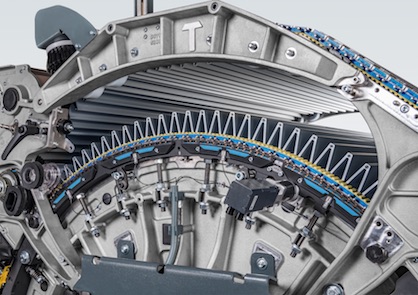
The carding gap between cylinder and flats: In processing cotton, keeping a precise and narrow carding gap is decisive to achieve maximum quality and productivity (c) 2020 Truetzschler


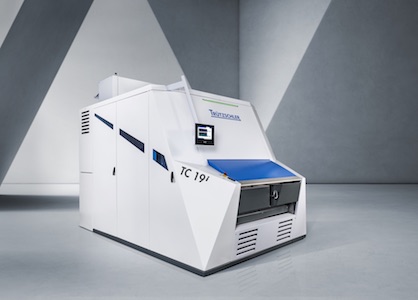
The intelligent Truetzschler Card TC 19i (c) 2020 Truetzschler

In other key textile markets, such as Turkey, Uzbekistan, and Mexico, the TC 19i demonstrated similar significant advantages in terms of quality, productivity, raw material savings and handling and energy efficiency. It showed up to 40% less yarn imperfections in carded ring yarn, and even more than 50% less yarn imperfections in combed ring yarn and rotor yarn manufacture – and this at high production levels between 75kg/h and 100 kg/h. 

“We observe that our customers create more value from their raw material with the TC 19i, and are able to increase productivity and quality flexibly” reports Markus Wurster, Global Sales Director at Truetzschler. “Moreover, the results are independent of technician, temperature, wire condition or production rate”. Only a few clicks on the display are necessary, and the intelligent card sets and keeps the ideal carding gap automatically and permanently. 
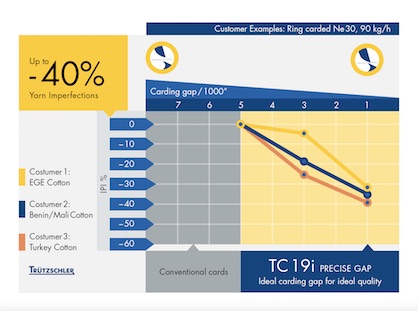
By narrowing the carding gap to 1/1000” – for comparison: 3/1000” is thinner than a piece of paper – yarn imperfection were reduced by up to minus 40% in these carded ring yarn productions (c) 2020 Truetzschler


Advanced sensor technology: T-GO gap optimizer

“At the heart of the intelligent card is the T-GO gap optimizer” explains Armin Leder, Director of Truetzschler’s global R&D department. “In combination with our T-CON sensor system it enables our card to know and adapt the real carding gap at all times during operation and under changing production conditions. No competitor card can achieve this. The TC 19i is the first intelligent card and an economic and ecologic solution for the demands of state-of-the-art spinning preparation.”
More News from Truetzschler GmbH & Co. KG

#ITM 2026

Trützschler’s Integrated Draw Frame IDF 3: Unlocking the full potential of short fiber processing

Spinning mills worldwide are looking for solutions that combine higher productivity, stable quality and shorter processes, especially when processing short fibers. Trützschler’s integrated draw frame IDF 3 has proven to be a powerful answer to these requirements. Evaluations from several customer trials in Türkiye under real production conditions highlight the strong performance of the IDF 3, particularly when combined with the next-generation card TC 30i.

#ITM 2026

Experience Trützschler’s leading fiber processing technologies at ITM 2026

From June 9 to 13, the Trützschler Group will present its latest machinery, service expertise and digital solutions at ITM 2026 in Istanbul, Türkiye. Visitors are invited to explore innovations across Spinning, Card Clothing, and Nonwovens at Hall 7, Booth 714A at the Tüyap Fair Convention and Congress Center. They can experience modern fiber processing with Trützschler!

#Spinning

Perfect quality through collaboration: Machinery from Trützschler, Toyota and Murata at Zirve Tekstil

In today’s textile industry, excellence is not achieved by chance – it’s the result of deliberate decisions, technical expertise, and the courage to go beyond conventional paths. The Turkish company Zirve Tekstil has done just that: by combining the best technologies from Trützschler, Toyota and Murata, they’ve created a production setup that delivers outstanding yarn quality – recognized worldwide.

#Spinning

Details matter: How Trützschler cylinder wires boost efficiency in Pakistan’s spinning sector

Pakistan’s textile industry, especially its spinning sector, is the backbone of the national economy and a vibrant hub of innovation. Today’s spinning mills face growing demands for efficiency, quality, and sustainability. From the serene northern valleys to the vibrant port city of Karachi in the south, mills like Suraj Cotton Mills, Liberty, and Nishat Chunian are turning to advanced solutions.

More News on Spinning

#Research & Development

GenuTrace client advisory: Is your cotton supply chain UFLPA ready?

U.S. Customs and Border Protection has released updated operational guidance (CBP Publication No. 5560-0526) expanding its forced labor enforcement framework. The guidance supersedes the original 2022 UFLPA Operational Guidance and now covers all forced labor enforcement authorities — UFLPA, CAATSA, and WROs/Findings — in a single unified document. For cotton importers, the enforcement posture has not softened. It has become more structured, more documented, and more demanding. Learn more about UFLPA.

#Spinning

"We will become a recycling powerhouse"

The textile industry is now in its fourth consecutive year of crisis, while automation, artificial intelligence and recycling are reshaping the rules of the game. In this interview, Rieter CEO Thomas Oetterli discusses the first signs of a market recovery, reflects on his first three years at the helm of the company, explains the integration of Barmag, outlines Rieter’s vision of the fully automated spinning mill and highlights the strategic importance of recycling. In doing so, he explains why the new Rieter Group aims to play a leading role in transforming the textile value chain into a circular economy.

#Spinning

Barmag and Hitech Automation enter into partnership for an auto-doff system for texturing machines

Barmag (Suzhou) Technology Co., Ltd. and Hitech Automation Solutions PVT LTD. of Surat, India, have agreed to an exclusive partnership to jointly market Hitech’s Doffmatic automation solution for Barmag’s proven manual eFK texturing machines. In many texturing facilities, manual doffing processes remain heavily operator-dependent – resulting in issues such as increased scrap, inconsistent quality, and limited productivity.

#ITM 2026

Uster’s new Recycling Opening Index guides spinners to the perfect blend

Uster AFIS 6 now offers the key data for better decisions when blending recycled fibers. Process control is decisive in determining the quality and economic outcome. The new R Recycling Module of AFIS 6 introduces the Recycling Opening Index (ROI), so spinners can optimize their circularity credentials. It was officially launched at ITM 2026 in Istanbul, Türkiye.

Latest News

#Carpets

DOMOTEX Hannover 2028 off to a strong start with expanded portfolio

Preparations for DOMOTEX 2028 are already gaining strong momentum. Following its successful repositioning as the Home of Flooring & Interior Finishing, around 100 international manufacturers have already secured their place during the initial registration phase.

#Knitting & Hosiery

STOLL: Agreement signed for the divestiture of selected assets

In early 2025, KARL MAYER announced its strategic decision to focus on its core business areas of WARP KNITTING, WARP PREPARATION, and TECHNICAL TEXTILES. As part of this move, the flat knitting machine business under the STOLL brand was discontinued and the production site in Reutlingen was closed in October 2025.

#Research & Development

TERNAfil wins first place at PitchMiUp Night 2026 in Minden

The RWTH spin-off TERNAfil has developed MAXCarbon, a new high-performance hybrid fibre that combines the mechanical performance of carbon with the temperature and corrosion resistance of ceramic materials. For this development, TERNAfil was awarded first prize at the PitchMiUp Night in Minden on 21 May 2026.

#Nonwovens

Lenzing Group highlights scalable, bio-based nonwovens solutions at leading global industry fairs

From CIDPEX in China to Techtextil in Frankfurt and INDEX in Geneva, the Lenzing Group showcases ready-for-market, bio-based nonwoven solutions and receives industry recognition for LENZING™ Nonwoven Technology.

TOP