[pageLogInLogOut]

#Spinning

USTER® TESTER 6 offers two new features

Major advances with USTER® TESTER 6: two new features – and total mill optimization through the Quality Management Platform (c) 2019 Uster
It’s the acknowledged global standard in testing, at the heart of the laboratory in every quality-conscious textile mill. And USTER® TESTER 6 – the latest edition of the legendary Uster Technologies instrument – still keeps on improving, with innovative solutions to keep pace with latest industry trends.

Two examples illustrate this progress: the facility for measuring conductive yarn through the Frequent Occurrences (FO) feature of USTER® TESTER 6. And the high-speed assessment of twist and twist variation as part of a single yarn testing routine.

USTER® TESTER 6 hosts USTER® QUALITY EXPERT, the ultimate digital solution for integrated data-based improvements throughout the spinning mill, connecting and interpreting information from a range of different instruments in the unique Quality Management Platform. For the first time, spinners have access to all the possibilities for total mill optimization.

Sivakumar Narayanan, Executive Vice President Marketing & Business Development says: “We are committed to innovating products, solutions and services which strengthen business sustainability for customers. The new features demonstrate this well. Working with USTER gives customers the peace of mind that can only come from strong partnerships, as well as adding extra impetus to our technological development efforts."

“USTER® TESTER 6 was launched in 2015 and has already been sold in 37 countries. As part of USTER’s continuous improvement strategy, we have collected personal feedback from every USTER® TESTER 6 customer around the world. This, combined with field reports from our service engineers, led to the latest developments of USTER® TESTER 6.”

Frequent Occurrences: Quality evaluation for conductive yarns

Conductive yarns have become more important in the past decade in fast-growing markets such as protective wear, fitness clothing, and healthcare.

Manufacturers of protective clothing in particular need to deal with public institutions and tenders. In this competitive environment, the supplier’s reputation is crucial – and it depends largely on consistent quality to avoid costly claims.
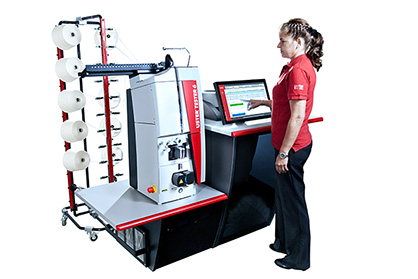
Until now, it has not been possible to measure the quality of conductive yarns – a real issue for spinners in this field. USTER stepped up efforts to include measurement of conductive yarn in USTER® TESTER 6. Sensor OM is now used to measure Frequent Occurrences (FO) in these yarns. It analyses neps, thin and thick places, yarn evenness, diameter, density and shape – all vital quality parameters for conductive yarns.
USTER® TESTER 6 (c) 2019 Uster


Twist and twist variation – in a single test routine

The manual and often subjective measurement of twist has been regarded by spinners as a task to be avoided if possible. But the twist level in a yarn is a critical quality parameter that affects both the look and performance of the finished product, as well as the productivity level, so spinners would benefit from integrating twist in their normal testing routine.

Now, this important parameter can be measured as a simple by-product of yarn testing for 100% cotton ring and compact yarn – giving producers information about all relevant parameters as part of one laboratory procedure. USTER® TESTER 6 is the only yarn testing instrument on the market with the option to obtain Twist and Twist variation (Tu) data during yarn testing, at a speed of 800 m/min. This information enables spinning mills to react quickly to identify performance gaps such as low-speed spindles.

Developed by experts in the technology department of USTER, these innovations extend the capabilities of USTER® TESTER 6 still further.
More News from Uster Technologies AG

#ITM 2026

Uster’s new Recycling Opening Index guides spinners to the perfect blend

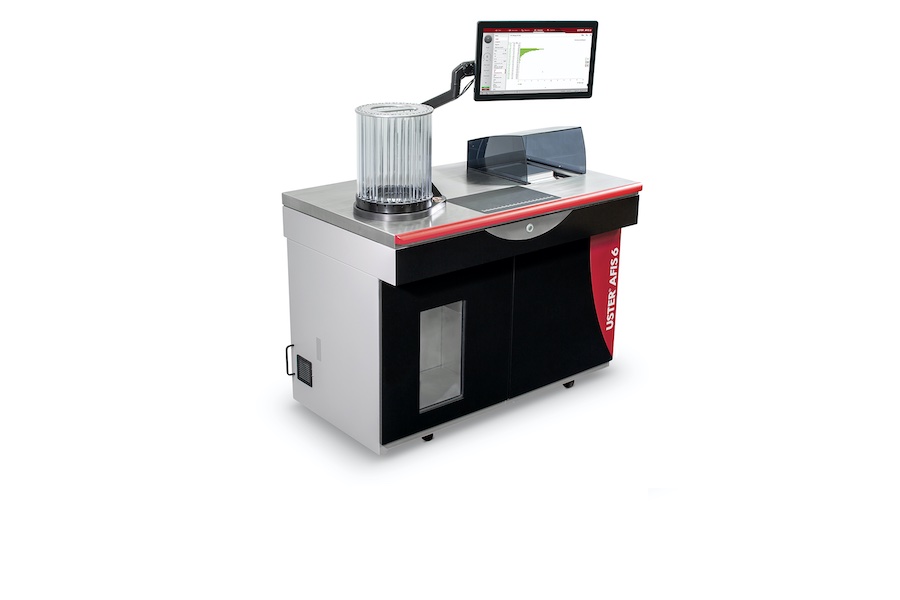
Uster AFIS 6 now offers the key data for better decisions when blending recycled fibers. Process control is decisive in determining the quality and economic outcome. The new R Recycling Module of AFIS 6 introduces the Recycling Opening Index (ROI), so spinners can optimize their circularity credentials. It was officially launched at ITM 2026 in Istanbul, Türkiye.

#Spinning

Measure and control the fiber – optimize yarn quality

Producing consistent yarn quality is an everyday challenge – and a very difficult one. Detailed knowledge and understanding of the fiber raw material is absolutely critical to achieving the best possible quality in the yarn. To help spinners, Uster experts have put together guidelines for avoiding yarn irregularity claims, in a special edition of the Uster News Bulletin.

#ITMA Asia + CITME Singapore 2025

Uster presents novelties at ITMA Asia + CITME 2025

There’s news from Uster Technologies to be announced for the industry’s upcoming event in Singapore. The Uster 360Q universe is growing with new products, solutions and services. Innovation developments can also be recorded in the fields of man-made fiber testing and fabric inspection. Uster innovations address the industry’s trending topics as mill management and process control, optimization of delivered fabric quality and yield.

#Spinning

Uster Technologies marks 150 years of empowering quality excellence

Uster Technologies marks 150 years of excellence – a milestone that reflects continuous adaptation to customer needs and industry change. Over the decades, Uster has evolved from manufacturing quality testing instruments into a trusted partner shaping the future of textile production.

More News on Spinning

#Spinning

Ibrahim Fibres and Trützschler: A strong partnership enters its next phase with the TC 30Si

For more than two decades, Ibrahim Fibres and Trützschler have grown side by side, driven by a shared ambition to continuously improve spinning performance, strengthen technology leadership and set new benchmarks in the textile industry. Today, Ibrahim Fibres is a leading yarn and polyester staple fiber manufacturer in Pakistan. The company operates the largest number of Trützschler cards in the country, with more than 200 machines running across its mills in Faisalabad, and plays an important role in one of Asia’s largest textile industries.

#Spinning

Object Carpet tests production of rPET BCF yarn on Neumag BCF line

In a joint project with Object Carpet GmbH, Denkendorf; the Institute for Textile Technology (ITA), Augsburg; and Next Generation Recyclingmaschinen GmbH (NGR), Feldkirchen, Austria, Barmag investigated the processing of recycled polyester for BCF yarn. The goal was to evaluate the fundamental suitability of 100% recycled carpet material for reuse in carpet yarn production to create a closed-loop system in carpet manufacturing. To date, commercial rPET BCF processes have been based solely on rPET from bottle pellets.

#Spinning

New spinning package with two-step filtration for recycled yarns and more

At the ITM in Istanbul, BB Engineering unveiled its new, patented ValuePack spinning package for the first time, which features a two-stage filtration system. This is particularly beneficial for re-cycling processes. Until now, spinning packs have used either metal powder (“sand”) or filter candles as filter media. Both options are suitable for differ-ent applications, and each has its own specific advantages and dis-advantages.

#Research & Development

GenuTrace client advisory: Is your cotton supply chain UFLPA ready?

U.S. Customs and Border Protection has released updated operational guidance (CBP Publication No. 5560-0526) expanding its forced labor enforcement framework. The guidance supersedes the original 2022 UFLPA Operational Guidance and now covers all forced labor enforcement authorities — UFLPA, CAATSA, and WROs/Findings — in a single unified document. For cotton importers, the enforcement posture has not softened. It has become more structured, more documented, and more demanding. Learn more about UFLPA.

Latest News

#Research & Development

ALADIN paves the way for circular and demand-driven textile production in Europe

Textile production can be organized sustainably by utilizing short supply chains and preventing overproduction. This can already be achieved today by intelligently connecting and efficiently utilizing existing infrastructure. At the same time, production becomes circular when innovative technologies and materials are used that enable high-quality recycling. The ALADIN research project, launched in May 2026 and co-funded with five million euros under the EU Horizon Europe program, is creating the conditions for this.

#Nonwovens

Katharina Obergruber appointed to the Management Board of Sandler AG

The Supervisory Board of Sandler AG has appointed Katharina Obergruber to the company’s Management Board. Effective September 1, 2026, the Board will consist of Philipp Ebbinghaus (CEO), Dr. Ulrich Hornfeck (currently CCO, future COO), and Katharina Obergruber (CCO). Katharina Obergruber, currently Chief Sales Officer Hygiene and member of the Management Team of Sandler AG, will assume responsibility for all sales activities as Chief Commercial Officer. She will assume this role from Dr. Ulrich Hornfeck, who will focus primarily on production and supply chain topics.

#Recycling / Circular Economy

Ence and ShareTex begin initial testing of the ATENEA innovation project to promote textile recycling in Spain

Ence and ShareTex are making progress on the Atenea R&D project, which aims to develop a complete value chain for textile recycling in Spain. Specifically, the goal of the ATENEA project—which is funded by the Center for Technological Development and Innovation (CDTI)—is to connect all the necessary stages for the recovery of textile waste, from collection and management, through recycling and transformation into new raw materials, to their incorporation into new textile products.

#Recycling / Circular Economy

DePoly Inaugurates its Showcase Plant in Monthey Switzerland

What if used plastic bottles, PET packaging material and polyester textiles could become raw materials just as high performing as virgin resources? That is the ambition of DePoly, a circular materials company based in Sion, Switzerland which inaugurated its Showcase Plant in Monthey on July 6th & 7th. The first depolymerization facility of its kind and scale in Switzerland, this industrial Showcase Plant represents a major milestone in the company's growth and its journey toward commercialization.

TOP