[pageLogInLogOut]

#Sustainability

Sustainable fashion: How are the leaders in fast fashion doing?
(c) 2020 Lectra
Brands are prepared for the new health protection rules and have reopened their stores. But aside from the direct impact of the COVID-19 epidemic, is the fashion market ready to respond to customers’ desire to act by changing their spendinghabits? Basedon analyses by Retviews, a recently acquiredstartup, Lectrahas produced a survey of sustainable fashion among the leading fast fashion brands. The main findings are explained here.

Post-COVID-19 survey

  • 10% of their offer is eco-responsible.
  • Sustainable cotton is a priorityfor retailers for the coming years.
  • Sustainable garments cheaper than standard garments.

The COVID-19 crisis has given many people the desire to live more meaningfully and to act more responsibly. The crisis period could be seen as the catalyst that forces the fashion industry to change the way it designs, produces and distributes its products. Since, for consumers, buying is a way of expressing a commitment and affirming their values, brands have an incentive to change their offer in preparationfor the future, by taking a more eco-responsible, authentic and transparent approach.

While these factors were apparent before the pandemic, they have now become the key to interacting with consumers wanting a more responsible offer. The era of the consumer activist, long heralded without actually becoming a reality, is now here, and brands must adapt in response.

Sustainable collections still a very small minority

The  proportion  of  sustainable  fashion  in  collections  varies  considerably  from  one  retailer  to  the  next.  For example, eco-friendly collections constitute only a small portion of the ranges offered by leading retailers Zara and H&M, which signedthe Fashion Pact during the G7 Summit in Biarritz.

Zara’s  Join  Life  collection  represents  14%  of  its  range,  whereas  C&A’s  #Wearthechange  represents  nearly 30%  of  its  total  collection.  The  Conscious  collection  at  H&M,  which  tops  the Fashion  Transparency  Index, created by Fashion Revolution, accounts for less than 10% of its total range. 
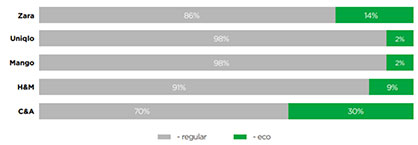
Eco vs regular collection, Retviews 2019-2020 (c) 2020 Lectra


Composition of products in eco-friendly collections

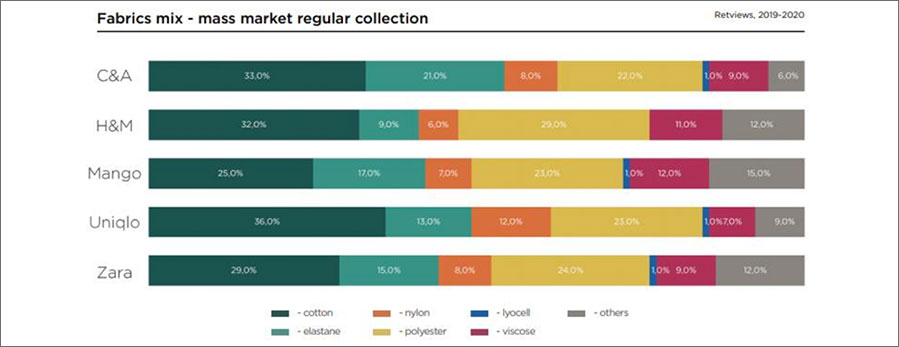
C&A, H&M and Inditex (Zara) are among the top four users of organic cotton. All the brands analyzed in the Retviews survey present their cotton as sustainable and consider it a priority for 2020 and beyond.


There  is  little  difference  between  the  fabrics  mostcommonly  usedin  the  mass  and  premium markets.  The same  is  true  for  eco-friendly  compared  to  standard  collections.  Cotton,  synthetic  fabrics  such  as  polyester, elastane and also viscose are the most widely offered and used fabrics. 

Are sustainable fabrics more expensive?

The assumption that sustainable and/or organic garments are more expensive is a misconception, according to  the  results  of  the  survey.  H&M’s  exclusive  sustainable  collection,  Conscious,  is  a  good  example.  The average price of a dress in the standard collection is €39.90, whereas in the Join Life collection it is €31.70.

Average price dresses, Retviews woman dresses 2019-2020 (c) 2020 Lectra


The opportunities offered by sustainability are significant. It’s an issue attracting much greater interest from Generation Z, and retailers have listened to and taken on board these concerns. 90% of consumers say they are aware of the situation and are prepared to change their behavior to combat climate change*. This shows their  real  inclination  to  invest  in  eco-responsible  products.  In  view  of this  change,  brands  have  a  social responsibility to inform their customers, to be transparent about their progress in this area, and to share some of  the  challenges  they  face,  in  order  to  educate  their  communities.  There  are  currently  no  international regulations for apparel defining what can be described as sustainable. This means that there is still a long way to  go  before  the  standardization  of  sustainable  fashion  is  achieved.  ”explains  Quentin  Richelle,  Chief Marketing Officer, Retviews.

*European study on sustainable consumption by Oney-Februry2020


More News from Lectra Deutschland GmbH

#Industry 4.0 / Digitalization

Mango joins TextileGenesis pioneering traceability solution, a Lectra company, for a transparent value chain

Mango, one of the leading international fashion groups, has joined TextileGenesis, the pioneering traceability solution for the fashion and textile industries, to trace their natural and animal fibers, synthetics, man-made cellulosic fibers and leather. TextileGenesis, a Lectra company, offers a complete and secure cutting-edge technology with its six-dimensional (6D) offering and unique “fiber forwards” approach. Mango, has long been committed to maintaining a fully transparent supply chain, and TextileGenesis will reinforce this commitment.

#Textiles & Apparel / Garment

New Retviews study by Lectra: the luxury market in 2025, between margin protection strategies and new iconic pieces

After more than a decade of uninterrupted growth, the luxury fashion market is now experiencing a more pronounced slowdown. Global luxury goods sales have fallen from €369 billion in 2023 to €364 billion in 2024 (according to Bain & Co.), exposing the vulnerabilities of a model long supported by aggressive price increases.

#Recycling / Circular Economy

Recover and TextileGenesis collaborate to verify supply chain integrity of recycled materials

RecoverTM, a global producer of recycled cotton and cotton-blend fibers, has commenced a traceability collaboration with TextileGenesis, a Lectra company, to digitally track its recycled waste materials across the entire textile value chain.

#Industry 4.0 / Digitalization

Lectra launches the Observatory of innovation and transformation in the fashion, furniture and automotive markets

As a leader in technology solutions accelerating the transition of fashion, furniture and automotive companies to Industry 4.0, Lectra announces the launch of its Observatory to mark its 50th anniversary. The Observatory will focus on innovations and changes in the fashion, furniture and automotive markets, to help these sectors stay informed and adapt to new opportunities. The Lectra Observatory’s first white paper on the advent of Industry 4.0 is already available online.

More News on Sustainability

#Textile chemistry

Jeanologia urges industry to accelerate PP Spray phase-out following ZDHC Watchlist update

Potassium permanganate has officially entered the Chemical Watchlist of the ZDHC Foundation, signaling increased scrutiny and potential phase-out of one of the most hazardous chemicals still used in denim finishing. The inclusion confirms an industry shift that Jeanologia anticipated more than a decade ago.

#Textiles & Apparel / Garment

Global Standard strengthens presence in Southeast Asia at VIATT 2026

Global Standard will participate in the Vietnam International Trade Fair for Apparel, Textiles and Textile Technologies (VIATT) 2026, organized by Messe Frankfurt, the first textile trade show in the APAC region this year. Global Standard will host a booth and Felica Shi will lead a seminar on Global Organic Textile Standard (GOTS). The trade fair will take place from February 26 to 28, 2026, in Ho Chi Minh City, Vietnam.

#Sustainability

Ying McGuire becomes new CEO of Cascale

Cascale today announced the appointment of Ying McGuire as Chief Executive Officer, effective June 1, 2026.

#Sustainability

VAUDE eliminates PFAS from all products

PFAS (per- and polyfluoroalkyl substances) are now detectable worldwide – in drinking water, soil and the human body. These so-called “forever chemicals” are considered hazardous to health and potentially carcinogenic, as they do not break down and remain in the environment permanently. Despite these risks, PFAS are still used in a wide range of products. More than 15 years ago, VAUDE made a strategic decision to gradually eliminate PFAS from all product categories.

Latest News

#Research & Development

Fabolose: Fabricating vegan and circular leather alternatives from bio-tech-derived cellulose

Fabulose is an EU funded project coordinated by the German Institutes of Textile and Fiber Research (DITF). Its consortium consists of leading research institutes, biotech innovators, and industry stakeholders who aim to create high-performance, biobased and recyclable leather-like fabrics, using efficient biotech production routes for bacterial cellulose, cyanophycin and bacterial pigments

#Textiles & Apparel / Garment

Connecting the ASEAN textile sector: sustainability, trends, and technology take centre stage at this week’s VIATT 2026

Opening this week Thursday, the Vietnam International Trade Fair for Apparel, Textiles, and Textile Technologies (VIATT) is set to welcome visitors from ASEAN’s dynamic textile market and beyond. From 26 to 28 February, VIATT 2026 – the fair’s third editions – will reinforce its strategic proposition with an integrated showcase of the three core sectors of the entire textile value chain. Beyond new sourcing opportunities in Apparel Fabrics & Fashion, Home & Contract Textiles, and Technical Textiles & Technologies, the fair will present an expanded fringe programme.

#Spinning

Measure and control the fiber – optimize yarn quality

Producing consistent yarn quality is an everyday challenge – and a very difficult one. Detailed knowledge and understanding of the fiber raw material is absolutely critical to achieving the best possible quality in the yarn. To help spinners, Uster experts have put together guidelines for avoiding yarn irregularity claims, in a special edition of the Uster News Bulletin.

#Software

Coats Digital appoints Himanshu Mehrotra as Managing Director to lead next phase of cloud and AI-driven innovation

Coats Digital is delighted to announce the appointment of Himanshu Mehrotra as Managing Director to lead the company’s strategic direction, innovation agenda, and global growth as it accelerates the development of its cloud-native, AI-powered software solutions for the global apparel and footwear supply chain.

TOP