[pageLogInLogOut]

#Research & Development

SABIC celebrates 10th Anniversary of its Technology Center in Shanghai with first Innovation Day

SABIC, a global leader in diversified chemicals, yesterday celebrated the 10th anniversary of the SABIC Technology Center in Shanghai (STC Shanghai) by holding the site’s first-ever Innovation Day.

SABIC Chairman Khalid Hashim Al-Dabbagh and SABIC CEO Abdulrahman Al-Fageeh celebrated this remarkable milestone with his excellency Abdulrahman Bin Ahmed Hamdan Al-Harbi, Ambassador of the Kingdom of Saudi Arabia to China; Zhu Zhisong, Member of Standing Committee of CPC Shanghai, Secretary of CPC Pudong New Area Committee; Peng Song, Executive Deputy Director of Shanghai Science and Technology Innovation Promotion Office; Wu Qiang, Deputy Governor of Shanghai Pudong New Area, along with SABIC executive committee, customers, and business partners. 

© 2023 Sabic
© 2023 Sabic


“Multinational corporations would diligently work with others across different industries and in different countries to build up a portfolio of innovative solutions that can turn challenges into opportunities,” said Al-Fageeh. “One of the most active fronts in our campaign for innovation is right here, at the STC Shanghai. SABIC looks forward to strengthening its in-country relationships and remains firmly committed to fostering mutually beneficial economic growth in and through China.”

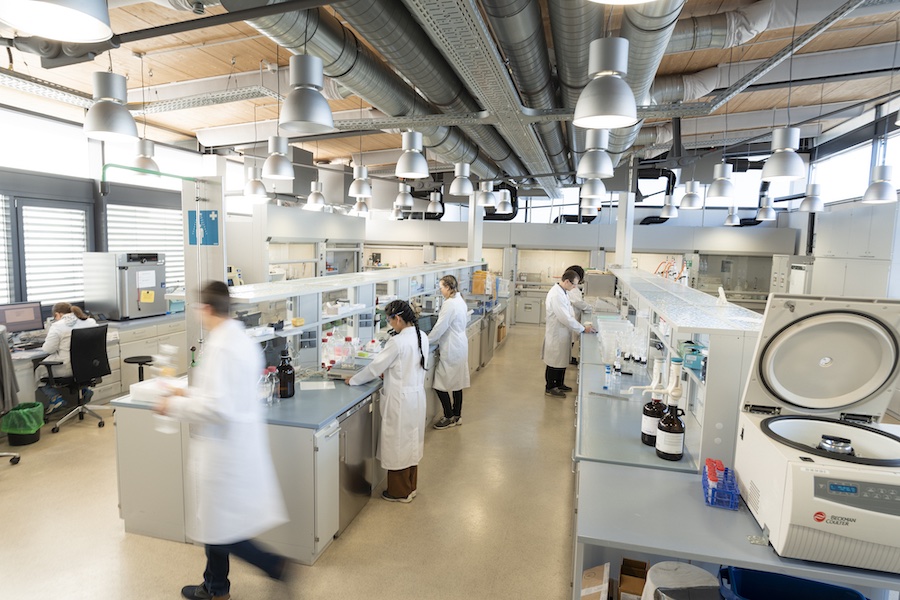
Established in 2013 as one of the key regional hubs and 19 global technology centers, STC Shanghai is a key part of SABIC’s global innovation network. Today, the center has 20 laboratories with three focus areas including Analytical Science, EMT (extrusion, molding & testing) and Application Technology & Industry Solutions. Over 500 employees work at the center, including more than 170 scientists, who focus on helping customers address challenges across focused segments such as automotive, building and construction, packaging, electrical and electronics, healthcare, personal hygiene and energy transition. Leveraging value-chain collaboration and partnerships with renowned universities and research institutes in China, STC Shanghai also helps drive in-depth integration between industry and academia to further support China’s high-level, innovation-driven development.


In addition to being a key source of collaborative innovation, STC Shanghai has also played an important role in SABIC’s engagement with the local community. In 2017, SABIC launched its River Conservation Program, drawing on STC Shanghai’s expertise to help improve the local community’s natural ecosystem. Over the past decade, SABIC has held several Open-to-Public (OTP) Days and ‘Lights of Our Future’ activities at the center. These events, which were made possible by SABIC local employees volunteering over 9,000 hours to provide public education services on sustainability topics, reached a total of 11,840 students from 42 local schools in Shanghai.

© 2023 Sabic
© 2023 Sabic


Innovation is the foundation on which SABIC has built its success and the core driving force of its development in China for almost 40 years. It is through innovation that SABIC has successfully delivered rapid growth and expanded its network in China to include not only the STC Shanghai but also two joint ventures and three compounding plants with operations in 17 cities. Through its ongoing focus on market-facing innovation marked by the 10th anniversary of the STC Shanghai, SABIC remains firmly committed to expanding its presence in China, contributing to the country’s high-quality development, and supporting the strategic alignment between Saudi Arabia’s Vision 2030 and China’s Belt and Road Initiative.

© 2023 Sabic
© 2023 Sabic


More News from SABIC

More News on Research & Development

#Research & Development

The region of renewable raw materials: Central German Alliance for Bioplastics

The development of sustainable plastic solutions is rapidly gaining importance in light of global environ- mental pollution, dwindling fossil resources and ambitious climate protection targets. As part of the re- gional alliance RUBIO, which brings together 18 partners from central Germany and the Berlin-Branden- burg area, the bio-based and biodegradable plastic polybutylene succinate (PBS) was comprehensively investigated, starting with the raw material, through the manufacturing process, to industrial application.

#Nonwoven machines

Cooperation in the field of meltblown laboratory technology

The Nonwoven Institute (NWI) at North Carolina State University and Oerlikon Nonwoven will be collaborating in the field of meltblown laboratory technology in the future. This was announced by Professor Raoul Farer, Executive Deputy Director of the NWI and Professor at the Wilson College of Textiles at North Carolina State University, and Dr. Ingo Mählmann, Sales Director Nonwoven at Oerlikon Neumag, during this year's ITMA Asia and CITME in Singapore.

#Recycling / Circular Economy

European research project addresses textile waste through integrated recycling technologies

A major European research initiative coordinated by Fraunhofer UMSICHT has been launched to develop integrated solutions for textile waste recycling. The AUTOLOOP project aims to create a comprehensive system that could process 1.24 million tonnes of textile waste annually by 2050, whilst potentially creating over 130,000 green jobs across the EU. This project aims to develop, test and integrate automated sorting, tracing, and closed-loop recycling technologies for polyester-based textiles (NRT), addressing the pressing challenge of textile waste management.

#Research & Development

Feasibility study shows potential to convert textile waste into PHB bioplastic

Textile waste could serve as a valuable source of raw materials for sustainable plastics in the future, according to the joint TexPHB feasibility study conducted by the Fraunhofer Institute for Applied Polymer Research IAP, Beneficial Design Institute GmbH and matterr GmbH. The study will be presented to the public for the first time at a network meeting on 25 November 2025 at the State Chancellery in Potsdam.

Latest News

#Recycling / Circular Economy

Advanced Recycling Conference 2025 fuels innovation across key waste streams

The Advanced Recycling Conference (ARC) 2025 brought together nearly 220 experts from 28 countries to spotlight pioneering advancements and foster industry collaboration in recycling across diverse waste streams including plastics, textiles, automotive and other materials.

#Dyeing, Drying, Finishing

Navis TubeTex announces U.S. partnership with Icomatex

Navis TubeTex, a global leader in advanced dyeing and finishing machinery solutions, is pleased to announce a new partnership with Icomatex (www.icomatex.com), a respected European manufacturer of high-quality stenters and textile finishing equipment. Under this agreement, Navis TubeTex will exclusively represent the Icomatex stenter line in the United States.

#Recycling / Circular Economy

ADVANSA launches ADVA®tex: A new step toward textile-to-textile recycling

ADVANSA has introduced ADVA®tex, a new filling fibre made entirely from recycled pre-consumer textile waste, positioning the material as a significant step forward in textile-to-textile (T2T) recycling. The fibre is designed for use in duvets, pillows, mattresses, and furniture applications and is available in three versions.

#Knitting & Hosiery

KARL MAYER celebrates 35 years of EL pattern drive

KARL MAYER is celebrating an anniversary this year: on 30 November 1990, the first warp knitting machine with electronic guide bar control, the KS 4 EL, was delivered – another milestone for patterning. As early as 1980, the SU gearbox with the MRS42SU had initiated the transition from mechanical chains to digital data.

TOP