[pageLogInLogOut]

#Research & Development

Stylish sensors to wear
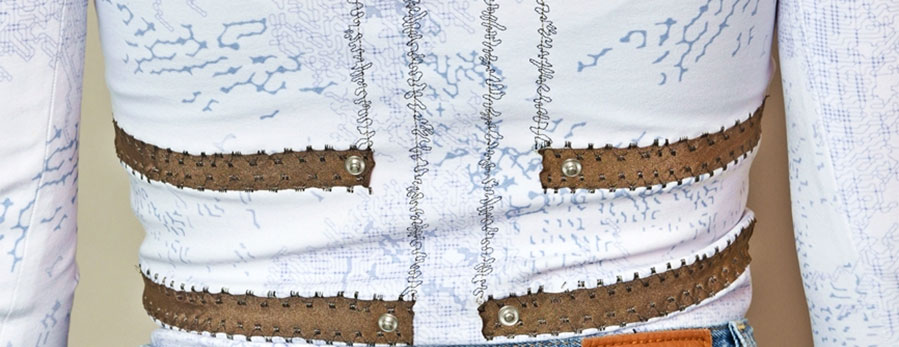
A shirt that monitors breathing: Designer Laura Deschl developed the monitoring system to wear together with Empa. Image: Empa
With sensors that measure health parameters and can be worn on the body, we do let technology get very close to us. A collaboration between Empa and designer Laura Deschl, sponsored by the Textile and Design Alliance (TaDA) of Eastern Switzerland, shows that medical monitoring of respiratory activity, for example, can also be very stylish – as a shirt.

Wearables for healthcare

The desire for a healthy lifestyle has triggered a trend towards self-tracking. Vital signs should be available at all times, for example to consistently measure training effects. At the same time, among the continuously growing group of people over 65, the desire to maintain performance into old age is stronger than ever. Preventive, health-maintaining measures must be monitored if they are to achieve the desired results. The search for measurement systems that reliably determine the corresponding health parameters is in full swing. In addition to the leisure sector, medicine needs suitable and reliable measurement systems that enable efficient and effective care for an increasing number of people in hospital and at home. After all, the increase in lifestyle diseases such as diabetes, cardiovascular problems or respiratory diseases is putting a strain on the healthcare system.

Designer at work: Laura Deschl at the production of the Sensor Shirt. Image: Ladina Bischof / TaDA


Beautiful and precise

Researchers led by Simon Annaheim from Empa's Biomimetic Membranes and Textiles laboratory in St. Gallen are therefore developing sensors for monitoring health status, for example for a diagnostic belt based on flexible sensors with electrically conductive or light-conducting fibers. However, other, less technical properties can be decisive for the acceptance of continuous medical monitoring by patients. For example, the sensors must be comfortable to wear and easy to handle – and ideally also look good.

This aspect is addressed by a cooperation between the Textile and Design Alliance, or TaDA for short, in eastern Switzerland and Empa. The project showed how textile sensors can be integrated into garments. In addition to technical reliability and a high level of comfort, another focus was on the design of the garments. The interdisciplinary TaDA designer Laura Deschl worked electrically conductive fibers into a shirt that change their resistance depending on how much they are stretched. This allows the shirt to monitor how much the subjects' chest and abdomen rise and fall while they breathe, allowing conclusions to be drawn about breathing activity. Continuous monitoring of respiratory activity is of particular interest for patients during the recovery phase after surgery and for patients who are being treated with painkillers. Such a shirt could also be helpful for patients with breathing problems such as sleep apnea or asthma. Moreover, Deschl embroidered electrically conductive fibers from Empa into the shirt, which are needed to connect to the measuring device and were visually integrated into the shirt's design pattern.


A network for the textile industry, culture and research

The Textile and Design Alliance is a pilot program of the cultural promotion of the cantons of Appenzell Ausserrhoden, St.Gallen and Thurgau to promote cooperation between creative artists from all over the world and the textile industry. Through international calls for proposals, cultural workers from all disciplines are invited to spend three months working in the textile industry in eastern Switzerland. The TaDA network comprises 13 cooperation partners – textile companies, cultural, research and educational institutions – and thus offers the creative artists direct access to highly specialized know-how and technical means of production in order to work, research and experiment on their textile projects on site. This artistic creativity is in turn made available to the partners as innovative potential.

During the project, Laura Deschl was supported by Schoeller Textil AG (raw material), Lobra (transfer printing) and the Saurer Museum (conductive embroidery) in the realization of the prototype. In addition, she received expert guidance regarding print quality from Martin Leuthold. Ideas for a continuation of the project are already available; they aim at a smart patient clothing that can detect and measure the most important physiological parameters without additional sensor technology.

"TaDA Spinnerei" on November 25, 2022

The "TaDA Spinnerei" is an annual event where the results from the TaDA Residency are presented to a broad public. On the one hand, TaDA Residents present their projects, which they developed together with partner companies. What is unusual about this is that it is always interdisciplinary. And the partner companies report on their experiences during their collaboration with TaDA. At the same time, TaDA also sets new topics – always from an ecological and social angle. This year, the possibilities and framework conditions of sustainable production will be fanned out – here, too, the diversity of perspectives is intended to reveal new approaches.
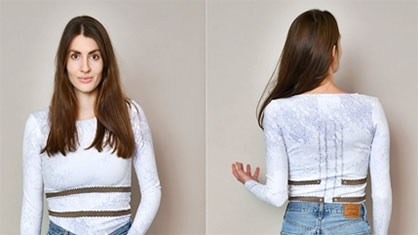

T-shirt with breathing sensors: The textile sensors are incorporated into the garment. Image: Empa


More News from TEXDATA International

#Recycling / Circular Economy

textile.4U publishes special edition “Top 100 Textile Recycling Companies 2025”

With a comprehensive 176-page special edition, textile.4U is dedicating its latest issue entirely to one of the most dynamic and influential topics in today’s textile industry: textile recycling. The new issue, published exclusively in high-quality print, presents the Top 100 textile recycling companies researched and selected by TexData – organizations that already play a key role in the transition to circular textiles or are expected to have a significant impact in the near future.

#Recycling / Circular Economy

Responsible Textile Recovery Act of 2024 signed by Governor

Senator Josh Newman (D-Fullerton) is proud to announce that Senate Bill 707 (SB 707), the Responsible Textile Recovery Act of 2024, has been signed into law by the Governor of California, Gavin Newsom. This groundbreaking legislation establishes the country’s first Extended Producer Responsibility (EPR) textile recycling program, marking a significant step forward in the state’s efforts to combat waste and promote sustainability.

#Textiles & Apparel / Garment

Modtissimo promotes sustainability with 28 coordinates in the Green Circle

Modtissimo is proving more and more to be a textile and clothing show that delivers the latest innovations in the area of sustainability, with the iTechStyle Green Circle being the main showcase for companies' creations. In this 60+4 edition, taking place on 12 and 13 September, 28 coordinates will be exhibited in a section organised by CITEVE and curated by Paulo Gomes.

#Europe

The EU and Egypt team up to mobilise private sector investments at Investment Conference and sign a Memorandum of Understanding underpinning €1 billion in macro-financial assistance for Egypt

At the EU-Egypt Investment Conference, co-organised by the EU and the Government of Egypt on 29-30 June, the EU and Egypt are teaming up to intensify private sector investments in Egypt. They are also signing a Memorandum of Understanding (MoU) for the disbursement to Egypt of up to €1 billion in Macro-Financial Assistance.

More News on Research & Development

#Research & Development

Fraunhofer CCPE presents the “Monomaterial Design Set” – Innovative solutions for circular product design

Composite materials made from different types of plastic often extend the lifetime of products but make recycling more difficult in the circular economy. That is why Fraunhofer CCPE has developed the “Monomaterial Design Set”. This new approach helps to reduce the variety of plastics used in durable products and offers circular solutions for designers and product developers.

#Research & Development

How innovations drive BASF’s success

“Innovation has always been part of BASF’s DNA. Especially in these volatile times, it is crucial to leverage our innovative strength to develop competitive solutions that differentiate us as a company in our markets and give us a competitive edge,” said Dr. Stephan Kothrade, Member of the Board of Executive Directors of BASF and Chief Technology Officer, at the company’s Research Press Briefing held today. To achieve this, BASF implemented its “Winning Ways” strategy about a year ago with the clear goal of becoming the preferred chemical company to enable its customers’ green transformation.

#Research & Development

Small tolerances, big impact and a recyclable alternative to elastane

ITA Master's student Janne Warnecke investigated tension differences over the fabric width in the weaving process and thereby contributed to quality assurance; ITA Bachelor's student Jasmin Roos found a basis for the development of recyclable yarns and textiles. For these developments, they were awarded the Walter Reiners Foundation's Promotion and Sustainability Prizes on 27 November. Peter D. Dornier, Chairman of the Walter Reiners Foundation, presented the awards at the Aachen-Dresden-Denkendorf International Textile Conference (ADD-ITC) in Aachen, Germany.

#Associations

Young researchers recognised for cutting-edge work in recycling, fibre technology and textile mechanics

At the Aachen-Dresden-Denkendorf International Textile Conference held in Aachen at the end of November, Peter D. Dornier, Chairman of the Walter Reiners Foundation of the VDMA, honoured five successful young engineers. Promotion and sustainability prizes were awarded in the categories bachelor/project theses and diploma/master theses. Academic theses that develop solutions for resource-saving products and technologies, for example, are eligible for the sustainability awards.

Latest News

#Spinning

First PA66 spinning plant with EvoQuench successfully commissioned

With the successful commissioning of a multi-digit PA66 spinning line for microfiber yarns, Chinese textile company Shandong Nanshan Fashion Technology Co., Ltd. has added yarn production to its textile value chain.

#Knitting & Hosiery

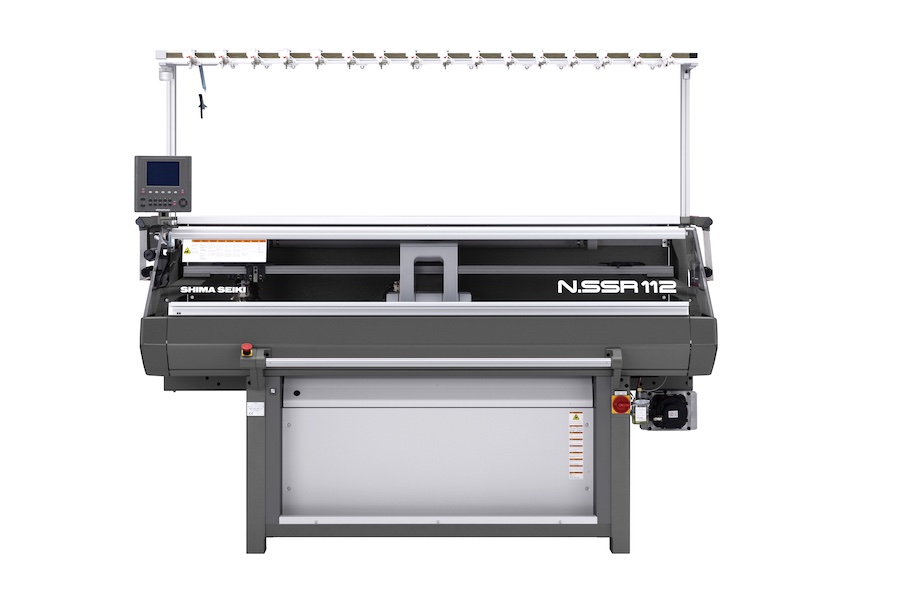
SHIMA SEIKI returns to ShanghaiTex

Leading flat knitting solutions provider SHIMA SEIKI MFG., LTD. of Wakayama, Japan, together with its Hong Kong and Chinese market subsidiary SHIMA SEIKI (HONG KONG) LTD., will exhibit at the ShanghaiTex 2025 exhibition (Booth No.: Hall N3, Booth A20) held in Shanghai, China this month. This marks the return of SHIMA SEIKI to ShanghaiTex after a 14-year hiatus, its last exhibit at the show having been in 2011.

#Man-Made Fibers

arena introduces renewable LYCRA® EcoMade fiber in its latest swimwear collection

Italian swimwear specialist arena has unveiled a new collection that brings sustainability and performance even closer together. Launched on December 4, the line features swimsuits made from recycled nylon and renewable LYCRA® EcoMade fiber — the first time the bio-based spandex has been used commercially in swimwear.

#Spinning

Saurer Technologies Twisting Solutions at ICFE 2026

Saurer Technologies Twisting Solutions, a global leader in textile machinery innovation, will be present at the International Carpet and Flooring Expo ICFE 2026. Join us January 6–9 at the Istanbul Expo Center, Türkiye, as industry leaders, manufacturers, and innovators gather to explore the latest breakthroughs in carpet and flooring technology. Let’s meet at the new established global Center of the Carpet Sector in hall 3, booth 300!

TOP