[pageLogInLogOut]

#Research & Development

FibreCoat and DBF Deutsche Basalt Faser win overall prize of the “IQ Innovationspreis Mitteldeutschland“

“IQ Innovationspreis Mitteldeutschland“, overall winner (from left to right) FibreCoat GmbH from Aachen, ITA graduate Dr Robert Brüll, Deutsche Basalt Fiber GmbH from Sangerhausen, Georgi Gogo-ladze, photo credit: Tom Schulze
FibreCoat GmbH from Aachen, Germany, together with DBF Deutsche Basalt GmbH, developed a completely new type of fibre material to shield electromagnetic radiation from digital end devices, medical technology or e-car batteries cheaply and effectively. The joint project was awarded the overall prize of the 17th “IQ Innovationspreises Mitteldeutschland“ on 24 June in an online event broadcast live from Leipzig.

The two innovative companies DBF Deutsche Basalt GmbH and FibreCoat GmbH from East and West combine the two materials basalt and aluminium to protect against electromagnetic radiation. In doing so, they coat basalt with aluminium and, through this novel combination, create an inexpensive, sustainable and quickly produced alternative for a market worth billions.

The overall prize of the “IQ Innovationspreises Mitteldeutschland“ is endowed with €15,000 and was sponsored by the Halle-Dessau, Leipzig and East Thuringia Chambers of Industry and Commerce.
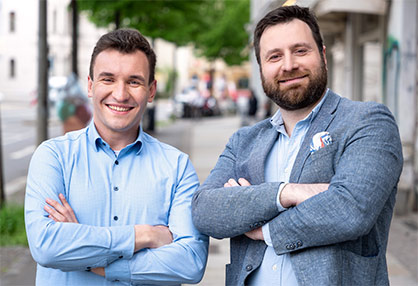
“IQ Innovationspreis Mitteldeutschland“, overall winner (from left to right) FibreCoat GmbH from Aachen, ITA graduate Dr Robert Brüll, Deutsche Basalt Fiber GmbH from Sangerhausen, Georgi Gogoladze © photo credit: Tom Schulze


FibreCoat GmbH from Aachen is a spin-off of the Institut für Textiltechnik (ITA) of RWTH Aachen University; the managing directors Dr Robert Brüll and Alexander Lüking and Richard Haas have completed their doctorates at the ITA or are in the process of preparing their doctorates. Georgi Gogoladze, Managing Director of Deutsche Basaltfaser GmbH, also studied at RWTH Aachen University. The two managing directors Brüll and Gogoladze know each other from their student days.

Background

Electromagnetic radiation from smartphones, hospital diagnostics and electric car batteries must be shielded so that they do not interfere with each other. To prevent mutual interference, they have so far been covered with metal fibre fabrics, a very time- and energy-consuming and thus expensive procedure. The new material from Basalt Faser GmbH and FibreCoat GmbH prevents this with a fibre core made of melted, thinly drawn basalt, which is coated with aluminium and bundled into the so-called AluCoat yarn.


This yarn remains just as conductive and shielding, but is lighter, stronger, cheaper and more sustainable than previous alternatives. In addition, there are further advantages:

  • The number of process steps required is reduced from ten to one.
  • 1,500 metres of yarn are produced per minute instead of the previous five metres.
  • The energy required is only 10 per cent of the previous amount.
  • The result is a price that is twenty times lower.

The textile made of AluCoat fibres is versatile and flexible: as wallpaper it can shield 5G radiation in offices or medical rooms or encase batteries and thus ensure the smooth functioning of electric cars. AluCoat is already being used in some companies. A European fibre centre in Sangerhausen is being planned for mass production. During the award ceremony, other cluster winners and winners of the local IQ competitions in Halle (Saale), Leipzig and Magdeburg were announced.

With the “IQ Innovationspreis Mitteldeutschland“, the “Europäische Metropolregion Mitteldeutschland“ promotes novel marketable products, processes and services in five industry-specific clusters. Further information: “IQ Innovationspreis Mitteldeutschland“.

https://iq-mitteldeutschland.de/

More News from Institut für Textiltechnik of RWTH Aachen University (ITA)

#Research & Development

Exchange data between textile companies openly, securely and cost-effectively without a central platform – ITA makes it possible

The Institut für Textiltechnik (ITA) of RWTH Aachen University has launched a new demonstrator for an open and secure data space in the textile industry at the Digital Innovation Centre Europe (DICE). For the first time, the demonstrator shows directly and clearly how companies can share their data securely with each other without the need for a central platform. Data exchange is based on shared, freely usable technical foundations.

#Research & Development

Sustainable athletic wear made from bio-based Polyethylene

Conventional sports textiles made from petroleum-based synthetic fibres are to be replaced in the future by sustainable, bio-based, cooling textiles. Polyethylene, previously used mainly in the packaging industry, is thus qualified for use in textiles and, as a bio-based drop-in solution, offers a cost-effective, sustainable alternative for the future.

#Research & Development

India, ITA and innovation – enhanced cooperation in research, implementation and bilateral projects such as hydrogen mobility

The Indian Consul General, Dr Shuchita Kishore, visited the Institut für Textiltechnik (ITA) of RWTH Aachen University on 15 December to inspect the joint project between the ITA, the Indian Institute of Technology (IIT) Bombay and industrial partners from India and Germany and to tour the ITA.

#Research & Development

Small tolerances, big impact and a recyclable alternative to elastane

ITA Master's student Janne Warnecke investigated tension differences over the fabric width in the weaving process and thereby contributed to quality assurance; ITA Bachelor's student Jasmin Roos found a basis for the development of recyclable yarns and textiles. For these developments, they were awarded the Walter Reiners Foundation's Promotion and Sustainability Prizes on 27 November. Peter D. Dornier, Chairman of the Walter Reiners Foundation, presented the awards at the Aachen-Dresden-Denkendorf International Textile Conference (ADD-ITC) in Aachen, Germany.

More News on Research & Development

#Research & Development

Bio-based fibers with good flame retardancy

Fibers made from bio-based plastics reduce dependence on fossil raw materials and promote the circular economy. The covalent bonding of flame-retardant additives can open the way for these fibers to enter the mass market.

#Research & Development

Innovation center for textile circular economy inaugurated

Just over eight months after the foundation stone was laid, the new Innovation Center for Textile Circular Economy was officially inaugurated today at TITK Rudolstadt. Thuringia's Minister President Mario Voigt, TITK Director Benjamin Redlingshöfer, and other guests of honor cut the ribbon to the modern building complex and viewed the premises, which are now ready for occupancy. The “DICE – Demonstration and Innovation Center for Textile Circular Economy” is TITK's largest single investment to date. The Free State of Thuringia supported the total cost of €11.5 million with €8 million in GRW and FTI funding.

#Research & Development

Sustainable design of Geosynthetics and roof underlayments made from recyclates

Is it possible to recover plastic recyclates from previously unused waste streams in order to produce high-quality fibers and films? How can bio-based polymer fibers be manufactured so as to allow adjustable biodegradability? These are the questions being addressed by researchers from the Fraunhofer Cluster of Excellence Circular Plastics Economy CCPE in the Zirk-Tex project.

#Research & Development

More safety and comfort for protective clothing thanks to auxetic fabrics

When everyday materials are pulled, they stretch or elongate in the direction of the pull and become narrower in cross-section. We can also observe this property in two-dimensional textiles. Auxetic structures behave differently here. They have the striking property of not changing under tensile stress or even increasing their width or thickness. These properties are advantageous, for example, in protective textiles or textile filter media. The DITF are researching auxetic fabrics for various applications.

Latest News

#Technical Textiles

Cinte Techtextil China 2026: redefining business encounters for trending sub-sectors and cutting-edge technologies

The essence of a good trade fair is to create chance encounters to deliver tangible business value to its participants. Driven to stay ahead, Cinte Techtextil China is constantly seeking fresh strategies to keep the industry attuned to emerging trends, pinpointing high-potential segments for technical textiles and nonwovens. With a new zone and upgraded fringe events introduced, the last edition saw an impressive 17% increase in visiting numbers[1], and this year’s fair is set to leverage that success from 1 to 3 September at the Shanghai New International Expo Centre.

#Spinning

Rieter completes acquisition of Barmag

Rieter has successfully completed the acquisition of Barmag as of February 2, 2026. This strategically important acquisition makes Rieter the world’s leading system provider for natural and synthetic fibers.

#Digital Printing

Epson launches SureColor G9000: high-production Direct-To-Film printer delivering greater productivity and reliability

Epson today announces the launch of the SureColor G9000, a new high-production Direct-To-Film (DTFilm) printer designed to meet growing global demand for flexible and efficient textile transfer printing. Expanding Epson’s DTFilm line-up alongside the SC-G6000, the SC-G9000 introduces enhanced speed, reliability and ease of maintenance for commercial garment decorators and textile producers.

#Nonwoven machines

Three ANDRITZ spunlace lines start operating at Alar Silk Road New Materials in China

Alar Silk Road New Materials and ANDRITZ have successfully commissioned three spunlace lines in crosslapped configuration at Alar’s facility in Aral City, Xinjiang, China.

TOP