[pageLogInLogOut]

#Recycling / Circular Economy

Eastman collaborates with Debrand to recycle apparel waste from top brands

Advancing textile-to-textile recycling solutions through collaborative innovation
Eastman, a specialty materials company and producer of Naia™ cellulosic fibers, has formed a strategic collaboration with Debrand, a prominent, next-life logistics company specializing in finding sustainable solutions to apparel waste for some of the world’s top apparel and footwear brands.

Teaming up with Debrand for collection of the waste, Eastman is using its cutting-edge molecular recycling technology to recycle 5,000 pounds of pre- and post-consumer apparel waste. The process breaks down apparel waste to its molecular building blocks and uses the certified recycled material to create Naia™ Renew fibers — circular fibers made from 60% sustainably sourced wood pulp and 40% recycled waste material via Global Recycled Standard-certified mass balance.

Employee holds shredded apparel  © 2024 Debrand
Employee holds shredded apparel © 2024 Debrand

“We are committed to advancing sustainable solutions for the fashion industry,” said Claudia de Witte, Eastman’s textiles sustainability leader. “Partnering with Debrand allows us to drive progress on our Naia™ sustainability goals, particularly to mainstream circularity by creating sustainable solutions for textiles that have reached end of life and turning them into valuable resources for new Naia™ Renew fibers. This collaboration underscores our commitment to work closely with key collectors and sorters to drive the necessary infrastructure changes for advancing sustainability in the fashion industry.”

Eastman and Debrand are showcasing the transformative potential of molecular recycling technology to address the textile waste crisis. By providing more circular solutions for apparel waste, this partnership sets a new standard for sustainable practices in the fashion industry. Prior to its collaboration with Eastman, Debrand secured a strategic investment from Waste Management, the leading provider of comprehensive waste management in North America, to deliver circular solutions across the U.S. and Canada.

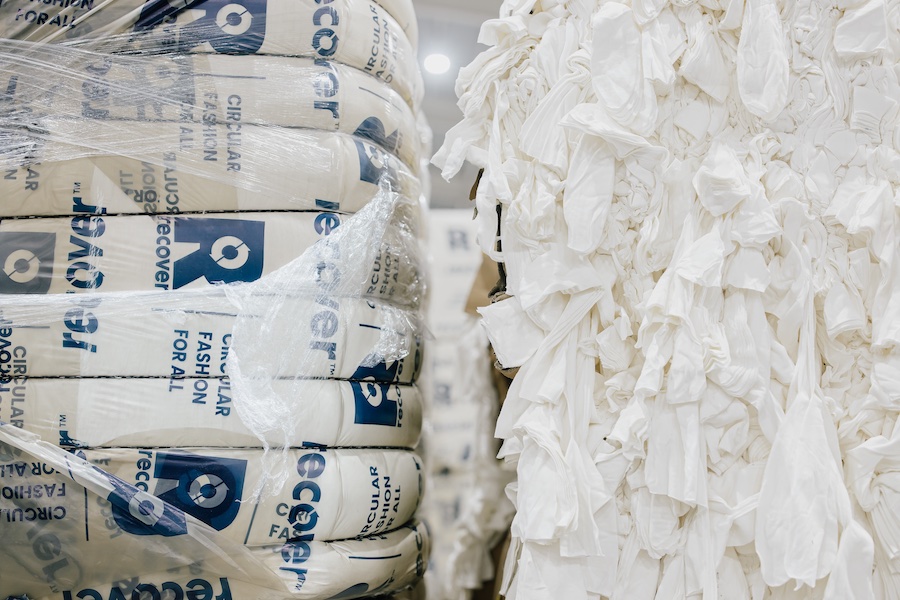
Apparel waste bales for shipping © 2024 Debrand


“We are excited to collaborate with Eastman on this innovative pilot project and create building blocks toward valuable systems of sustainability,” said Lina G. Londono, vice president of sustainability at Debrand. “We took on this project with an intentional and iterative approach that would reach meaningful milestones. This project was designed to offer scalability and accessibility for other brands that would want to participate in the future.”

Eastman continues to partner with strategic brands and organizations to drive innovation and enhance the infrastructure for a circular economy in the textiles industry. Recently, Eastman teamed up with Patagonia to recycle 8,000 pounds of its unusable apparel, demonstrating Eastman’s commitment to close the loop on textiles.

Apparel waste processing © 2024 Debrand


More News from Eastman

#Recycled Fibers

Eastman Naia™ highlights circularity and responsible sourcing at Textile Exchange 2026

Scaling sustainable practices across businesses, supply chains and landscapes is one of the defining challenges facing the textile industry. At the 2026 Textile Exchange Conference, held October 12–16 in Vancouver under the theme “The Implementation Era,” Eastman Naia™ showcased how its commitments to circularity, responsible sourcing and forest conservation translate into practical action.

#Recycled Fibers

Eastman Naia™ brings versatility to Kingpins Amsterdam

Denim continues to evolve, responding to changing consumer expectations for comfort, adaptability and functionality across different styles, occasions and seasons. At Kingpins Amsterdam, taking place October 14–15, Eastman Naia™ highlights how the versatility of Naia™ Renew staple fiber can help manufacturers address different denim needs through thoughtful fiber blending, while preserving the distinctive character of denim.

#Recycled Fibers

Naia™ from Eastman strengthens western hemisphere textile connections at Apparel Sourcing Show Guatemala

As brands and retailers explore more diversified and responsive sourcing networks, the Naia™ brand from Eastman is strengthening its engagement with the textile and apparel value chain across the western hemisphere. From August 18–20, the company will participate for the first time in Apparel Sourcing Show Guatemala, a regional meeting point for apparel sourcing, manufacturing and nearshoring.

#Man-Made Fibers

Eastman Naia™ brings the SEEDS theme to life at PREFACE LA

Eastman Naia™ is participating in PREFACE LA, taking place July 29–30, to present applications of its filament yarn and staple fiber across fashion and denim.

More News on Recycling / Circular Economy

#Recycled Fibers

Recover and SUPIMA partner to develop recycled Pima cotton fibers and yarns

Recover and SUPIMA have partnered to turn waste from SUPIMA cotton production into a new line of recycled fibers and yarns. The collaboration will explore how recycled American-grown Pima cotton can be used in a wider range of yarns and garments for the premium market.

#Recycling / Circular Economy

ReSpin founder Åsa Strandberg receives Innovation Champion of the Year 2026 award

Åsa Strandberg, founder and CEO of Swedish textile recycling company ReSpin AB, has been named Innovation Champion of the Year 2026. The award recognises her development of RespinJenny, a patented technology designed to recycle textile waste into new, high-quality fibres without using water, chemicals or additional virgin raw materials. The distinction was presented by the Olle Oscarsson Foundation and Axera Inkubator at Guldgalan in Sweden.

#Recycling / Circular Economy

Circulose resumes recycling of discarded cotton textiles and appoints interim CEO

Circulose today announced its restart of commercial-scale production plant at Ortviken in Sundsvall, Sweden, marking a significant step in scaling next-generation materials for the global fashion industry. The Ortviken plant is the world’s first commercial-scale chemical textile recycling facility. Its restart demonstrates that the fashion industry is seeking ways to scale proven solutions that move beyond pilots and into commercial production.

#Recycled Fibers

Reju expands textile-to-textile recycling network with six international fabric manufacturers

Reju, a textile-to-textile regeneration company, is expanding its industrial network through collaborations with six fabric manufacturers in Europe and the Americas. The initiative aims to accelerate the integration of regenerated polyester into textile manufacturing and support the development of finished fabrics for commercial applications.

Latest News

#Associations

Christoph René Holler to succeed Uwe Mazura as managing director of textil+mode

Christoph René Holler will take over as managing director of textil+mode, the German textile and fashion industry confederation, on 1 January 2027. He succeeds Uwe Mazura, who has led the association for 13 years and will remain in charge of collective bargaining policy through the next round of negotiations before retiring.

#Heimtextil 2027

Heimtextil and The Florentin showcase the role of textiles in hotel design

Heimtextil has partnered with Frankfurt hotel The Florentin by Althoff Collection for its new Interior.Architecture.Hospitality campaign. The collaboration will give architects, interior designers and other contract-sector professionals a closer look at how textiles were used in the hotel. The two studios behind the project will discuss their work at Heimtextil on 14 January 2027 in Hall 4.1.

#EU Textile Strategy

EU Commission proposes advanced materials agenda with targets for 2035

The European Commission has proposed an Advanced Materials for Europe agenda to accelerate the development, production and adoption of safer and more sustainable advanced materials. The proposal sets three benchmarks for 2035 and calls for closer coordination among EU member states to help move new materials from the laboratory into industrial production.

#Research & Development

Empa develops liquid-core fibre for insecticide-treated mosquito nets

Empa researchers have developed a liquid-core fibre for mosquito nets that can incorporate insecticides unsuitable for conventional melt spinning. The fibre gradually releases the active ingredient through a polymer sheath. The team developed and tested the yarn over three years in the Innosuisse project MalCoFil with Swiss industry partners Vestergaard and Monosuisse.

TOP