[pageLogInLogOut]

#Recycling / Circular Economy

Textile ETP wraps up T-REX's Policy Roundtable
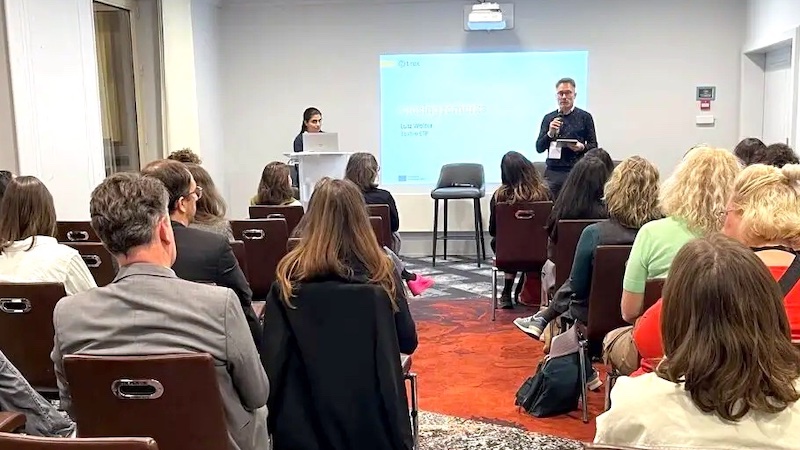
The T-REX project’s policy roundtable in Brussels on November 12 was a pivotal gathering of experts and leaders committed to advancing Europe’s sustainability efforts. Concluding the event, Secretary General Lutz Walter reflected on the discussions and emphasized the core themes that resonated throughout the day.
Lutz Walter speaking at the T-REX project’s policy roundtable © 2024 Textile ETP


A key theme in Lutz Walter's concluding remarks was recognising Europe’s exceptional creative and innovative talent, highlighting the importance of placing design at the centre of sustainability strategies. However, progress requires more than just ideas. Lutz Walter stressed the need for fostering the right framework conditions that allow creativity to thrive. This includes supportive policies, investment in sustainable practices, and strategic partnerships across the supply chain. 

Collaboration, he noted, is the backbone of sustainable development. Only through close cooperation among designers, manufacturers, policymakers, and other stakeholders can Europe achieve lasting advancements.

The roundtable’s discussions also highlighted the role of regional initiatives in advancing the European sustainability agenda. Local projects often serve as testbeds for scalable innovations, responding to community needs while contributing to the broader mission. A recurring point was the importance of robust data. The roundtable underscored that without accurate data, it is difficult to make well-informed decisions or create impactful policies. Enhanced data collection and analysis empower decision-makers with clear insights, helping to chart a strategic path towards sustainability.

The T-REX project, an ECOSYSTEX member project, brings together 13 major players from across the entire value chain to create a harmonised EU blueprint and business opportunities for closed loop sorting, and recycling of household textile waste. Transforming end-of-use textiles, from waste, into a desired feedstock, and a commodity for new business models that can be adopted at scale. Learn more here.

https://trexproject.eu/


More News from Textile ETP

#Recycling / Circular Economy

From local actions to industrial innovations: SOLSTICE shares mid-project results

Since its launch in May 2024, the SOLSTICE project is accelerating the transition from linear models to circular regional ecosystems in the textile industry, focusing on four key territories: Grenoble-Alpes Métropole (France), Berlin (Germany), Prato (Italy), and Catalonia (Spain). By mid-project, SOLSTICE has already revealed both regional disparities and promising solutions to strengthen textile repair, reuse, and recycling infrastructure.

#EU Textile Strategy

Textile ETP at the European Commission's event on the Textiles Ecosystem Transition Pathway

On 4 June 2024, the Textile ETP Secretary General Lutz Walter participated in the European Commission’s Directorate-General for Internal Market, Industry, Entrepreneurship & SMEs (DG GROW) stakeholder event for the Textiles Ecosystem Transition Pathway.

#Textiles & Apparel / Garment

Shaping new horizons for the textile sector: 18th Textile ETP Conference 2024

The 18th Textile ETP Annual Conference in Mechelen brought together industry leaders, experts, and innovators for two dynamic days of discussions and insights, focusing on sustainability, innovation, funding, and the future of the textile sector.

#Recycling / Circular Economy

Textile ETP and partners launch new textile recycling and upcycling innovation project PESCO-UP

Launched today, the PESCO-UP project focuses on transforming mixed polyester/cotton waste into high-quality and clean materials for the next use cycle, aligning with the EU's 2025 textile waste mandatory collection.

More News on Recycling / Circular Economy

#Recycling / Circular Economy

Europe needs tipping point to scale textile-to-textile recycling, BCG and ReHubs say

A new report from Boston Consulting Group (BCG) and ReHubs, titled “Advancing Textile Circularity – Europe’s textile waste challenge: Scaling Textile-to-Textile requires enabling mechanisms”, highlights the urgent need for systemic action to tackle Europe’s growing textile waste and scale a circular textile economy.

#Recycling / Circular Economy

AI Circular Economy Conference 2026 fuels innovation at the intersection of AI and Circular Economy

The AI Circular Economy Conference 2026, organised by nova-Institute, brought together 116 participants from 15 countries in Cologne and online to explore the transformation of the chemical and materials industry supported and accelerated by artificial intelligence. During the two-day event, leading experts from industry, research, start-ups and the investment community discussed how AI can maximise the potential of renewable carbon creating efficient circular value chains. The conference featured 24 presentations and multiple panel discussions, highlighting the growing convergence of digital technologies and circular material systems. It demonstrated how artificial intelligence is progressing from the experimental stage to real industrial implementation within the circular economy.

#Recycled_Fibers

Circ deepens access to recycled fibers with Xinxiang Bailu Chemical Fiber Co., Ltd. partnership agreement

Circ®, a global leader in textile‑to‑textile recycling, today announced a new partnership agreement with Xinxiang Bailu Chemical Fiber Co., a Canopy Dark Green Shirt producer and one of the world’s leading producers of viscose filament. The agreement marks a significant step in Circ’s continued expansion in China and strengthens its position within the country’s rapidly evolving circular textile ecosystem; further supporting Circ’s ability to supply recycled fibers near existing fashion supply chains.

#Recycled_Fibers

Worn Again Technologies unveils the Accelerator

Worn Again Technologies unveils the Accelerator, the next major step towards commercialising its pioneering Textile-to-Fibre recycling process and proving the technical and economic feasibility of polycotton recycling.

Latest News

#Textile chemistry

A flagship for chemical production: BASF inaugurates world-scale Verbund site in China

BASF today (March 26, 2026) celebrated the official inauguration of its newly built, world-scale Verbund site in Zhanjiang, Guangdong Province in southern China. Covering an area of around four square kilometers, it is more than a major BASF project in the chemical growth market of China. “Zhanjiang shows what the future of chemistry looks like: efficient, digital and sustainable by design. The site showcases a smart integrated Verbund structure on an industrial scale,” said Dr. Markus Kamieth, CEO of BASF, at the ceremony attended by representatives from government, customers, business partners and employees.

#Nonwovens

VEOCEL™ Lyocell production expands to Asia – Launching a new chapter for nonwovens in the region

VEOCEL™, Lenzing's flagship specialty nonwovens brand, expands production at its Thai plant in Prachinburi. This is the first-ever production of its nonwoven-grade lyocell fibers in Asia. Built in 2022 with a 100,000-ton annual production capacity, the facility - previously focused on fibers for textile applications - now can directly meet the demand for VEOCEL™’s biodegradable¹, wood-based lyocell fibers for nonwovens products. These fibers are an essential ingredient for high-quality nonwovens products, ranging from baby wipes to facial sheet masks and everyday personal hygiene items.

#Research & Development

Hof University develops sustainable textile coating for the fashion of tomorrow from mushrooms

Clothing is often treated as disposable: T-shirts for events, general merchandise, or short-term campaigns frequently end up in the trash after only a few uses. This is particularly problematic given that their production still largely relies on fossil-based materials. This is precisely where a new research project at Hof University of Applied Sciences comes in.

#Raw Materials

Fashion for Good mobilises industry to adopt mass balance attribution and accelerate decarbonisation

Fashion for Good launches today the Mass Balance Demonstrator project, a collaborative industry initiative to implement and scale the mass balance attribution (MBA) chain-of-custody model for biomass-attributed PET in textile applications. The project represents a concrete step toward accelerating brand-driven decarbonisation across the apparel value chain.

TOP