[pageLogInLogOut]

#Raw Materials

Aid by Trade Foundation, International Cotton Advisory Committee and bizpando start cooperation
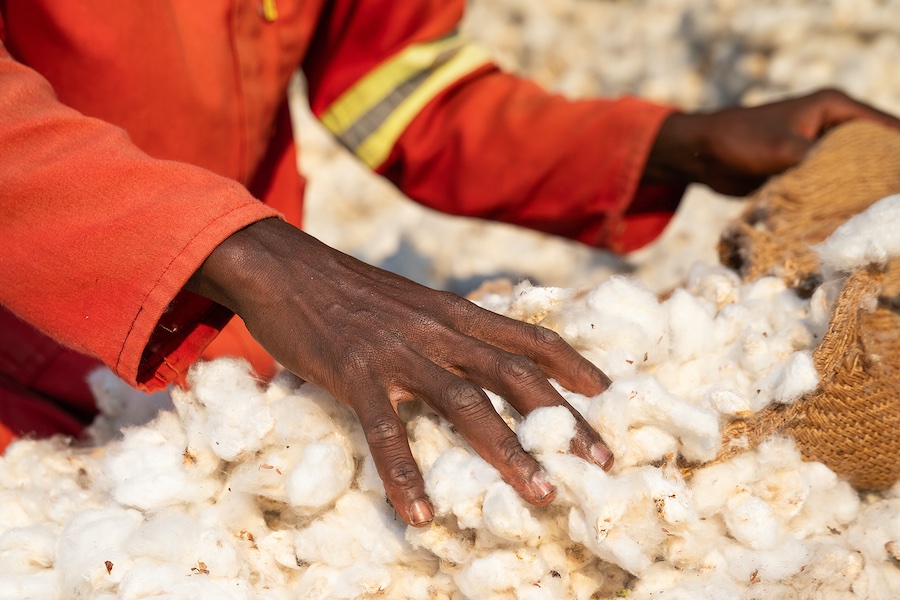
bizpando AG, operator of a compliance platform, has joined forces with the Aid by Trade Foundation (AbTF) and the International Cotton Advisory Committee (ICAC) to launch a project to promote carbon credits in cotton production. The aim is to empower African smallholder farmers through effective agricultural techniques and digital solutions to improve soil quality, sequester CO? and create additional sources of income.
Harvested CmiA cotton in hands of a ginnery worker © 2025  Credit: Isabela Pacini AbTF
Harvested CmiA cotton in hands of a ginnery worker © 2025 Credit: Isabela Pacini AbTF


Sustainability and economic benefits for smallholder farmers

By using sustainable agricultural strategies such as the use of biochar, minimal tillage and the cultivation of cover crops, up to 5.75 tonnes of CO? per hectare per year can be sequestered in the soil. This potential not only offers important opportunities for climate protection but also brings considerable economic benefits for producers.

As part of the newly concluded cooperation between AbTF, ICAC and bizpando, African farmers who grow cotton in accordance with the Cotton made in Africa (CmiA) standard benefit from additional income from the sale of carbon credits. At the same time, their costs are lowered as the use of pesticides and fertilisers can be reduced. In addition, improved soil quality and the water-retaining properties of biochar lead to higher agricultural yields. Tina Stridde, Managing Director of the Aid by Trade Foundation, emphasises: "Our work is grounded in the principles of climate-smart agriculture, which not only protects the environment and conserves resources but also enhances the productivity of cotton producers. Beyond the licensing income generated from Cotton made in Africa-verified cotton, collaborations like this foster sustainable opportunities for smallholder farmers in Africa."

Climate protection through carbon credits

The use of biochar can make a decisive contribution to climate protection and soil fertility. Keshav Kranthi, Chief Scientist at ICAC, explains: "Biochar improves soil structure, stores water and nutrients and promotes microbial growth. It is a sustainable solution that has a positive impact on both the environment and the profitability of agriculture." Eric Trachtenberg, Executive Director ICAC adds: "With simple techniques, cotton farmers can improve the quality of their soil and at the same time sequester carbon in the soil for more than 100 years. We support them in this endeavour."

Technological implementation by bizpando

bizpando plays a central role in the digital implementation of this project. A GPS-supported measurement system is being developed to map the areas under cultivation of smallholder farmers in such a way that double counting of areas can be ruled out. The platform will also enable digital recording to validate cotton production to reliably verify the origin and quantity of carbon credits. The bizpando platform will be used to issue the necessary certificates for the carbon credits, market them directly and ensure that proceeds are paid out directly to the farmers. "Our project combines digital solutions for climate protection with social responsibility. Using simple methods and complex digital background processes, we help farmers to operate more sustainably while significantly increasing their income. This allows us to reduce administrative costs and maximise the farmers‘ benefit from the cooperation," explains Jasper Bhaumick, CEO of bizpando AG.

Next steps

Over the next few months, the partners plan to expand the bizpando platform technically to include digital solutions for land surveying and payment methods, acquire certifications and prepare local measures such as training and further collaboration with stakeholders. The first carbon credits are to be generated by 2026 at the latest, and local activities have already been initiated.


More News from Aid by Trade Foundation (AbTF)

#Natural Fibers

Aid by Trade Foundation publishes 2024 annual report: Growing impact for environment and people

The Aid by Trade Foundation (AbTF) is on a growth track. Despite a challenging global economy, AbTF increased its income by six percent from 2023 to 2024, reaching a total of EUR 8.6 million. This revenue has been invested in comprehensive measures for the sustainable production of cotton and cashmere as well as for expanded measures to ensure transparency in global value chains. In addition to gaining new partners in 2024—including big names like Mango, Nordstrom, and CWS Workwear—AbTF was able to expand its global stakeholder network active in the production of raw materials or textiles.

#Raw Materials

Aid by Trade Foundation receives Honorary Award of the German Africa Foundation 2025

On the evening of 25 June, the Hamburg-based Aid by Trade Foundation (AbTF) received the Honorary Award of the German Africa Foundation 2025. Prof. Dr Michael Otto, the foundation’s founder and a prominent entrepreneur, accepted the award at a ceremony held at the German Bundestag. The Parliamentary State Secretary to the Federal Minister for Economic Cooperation and Development (BMZ), Dr Bärbel Kofler, presented the award in the presence of guests from politics, business and civil society as well as representatives of African embassies.

#Sustainability

Aid by Trade Foundation turns 20, invests half a million Euros in new biodiversity fund

To effectively promote nature conservation and biodiversity, the Aid by Trade Foundation (AbTF) announced at the second Hamburg Sustainability Conference (HSC) that it would be investing 500,000 euros in the ‘AbTF Biodiversity Fund’ to mark the foundation's 20th anniversary. Since it was established in 2005 by the entrepreneur Prof. Dr Michael Otto, AbTF has been committed to transforming the textile and fashion industries.

#Raw Materials

Laly Lichtenfeld joins AbTF Board of Trustees

The Aid by Trade Foundation is pleased to welcome Laly Lichtenfeld, an internationally renowned leader in community-driven nature conservation, to its board of trustees. After years of researching community-driven conservation, including as a Fulbright Scholar in 1996, she co-founded African People & Wildlife in 2005 with the aim of promoting peaceful coexistence between rural communities and wildlife such as lions and elephants.

More News on Raw Materials

#Natural Fibers

38th International Cotton Conference Bremen launches registration and unveils key topics

Participants can now register online for the 38th International Cotton Conference Bremen, which will be held on 25-27 March 2026 at the Haus der Bürgerschaft parliament building on market square. All visitors can look forward to a high-calibre conference programme, numerous additional meetings and a valuable exchange of knowledge and information. The comprehensive range of topics covering the entire value chain will provide practical expertise, address current developments, answer key industry questions, and provide new impetus for the future.

#Natural Fibers

ICAC to collaborate with Uzbekistan and Bizpando on regenerative agriculture

The Government of Uzbekistan has allocated 55,000 hectares of land to implement a regenerative agriculture program for cotton as part of a collaborative project with the International Cotton Advisory Committee (ICAC) and Bizpando, a company with a a blockchain-based internet platform designed to ensure supply chain compliance.

#Natural Fibers

World Cotton Trade declined 4.1% in 2024/25, according to ICAC's 2025 World Cotton Trade Report

Washington, DC — The International Cotton Advisory Committee (ICAC) has released the 2025 World Cotton Trade Report, which covers trade developments in raw cotton since 1980. An annual publication, it provides analysis of world trade by region; import/export projections by country; matrices of trade flows; and seasonal estimates of export commitments to date.

#Natural Fibers

BCI warns against ‘dangerous dilution’ of EU corporate directives

The approval of the European Commission’s Omnibus I proposal by the European Parliament’s Committee on Legal Affairs, accepting controversial changes to key sustainability directives is of great concern. These changes, namely to the Corporate Sustainability Reporting Directive (CSRD) and the Corporate Sustainability Due Diligence Directive (CSDDD), threaten to significantly dilute business reporting and due diligence obligations.

Latest News

#Recycling / Circular Economy

Advanced Recycling Conference 2025 fuels innovation across key waste streams

The Advanced Recycling Conference (ARC) 2025 brought together nearly 220 experts from 28 countries to spotlight pioneering advancements and foster industry collaboration in recycling across diverse waste streams including plastics, textiles, automotive and other materials.

#Dyeing, Drying, Finishing

Navis TubeTex announces U.S. partnership with Icomatex

Navis TubeTex, a global leader in advanced dyeing and finishing machinery solutions, is pleased to announce a new partnership with Icomatex (www.icomatex.com), a respected European manufacturer of high-quality stenters and textile finishing equipment. Under this agreement, Navis TubeTex will exclusively represent the Icomatex stenter line in the United States.

#Recycling / Circular Economy

ADVANSA launches ADVA®tex: A new step toward textile-to-textile recycling

ADVANSA has introduced ADVA®tex, a new filling fibre made entirely from recycled pre-consumer textile waste, positioning the material as a significant step forward in textile-to-textile (T2T) recycling. The fibre is designed for use in duvets, pillows, mattresses, and furniture applications and is available in three versions.

#Knitting & Hosiery

KARL MAYER celebrates 35 years of EL pattern drive

KARL MAYER is celebrating an anniversary this year: on 30 November 1990, the first warp knitting machine with electronic guide bar control, the KS 4 EL, was delivered – another milestone for patterning. As early as 1980, the SU gearbox with the MRS42SU had initiated the transition from mechanical chains to digital data.

TOP