[pageLogInLogOut]

#Raw Materials

Executive cotton update March 2023

The persistently strong labor market continues to defy the expected effects of the Federal Reserve’s increases in interest rates. The economy added a high number of jobs again last month, and the unemployment rate remains at a historically low level. With unemployment low, employers face more competition for qualified candidates, and that can put upward pressure on wages. Wages are a cost to employers that can be passed along to consumers. For that reason, wage growth has been associated with inflation, and it may be a data point being tracked for the Federal Reserve’s policy decisions.

U.S. Macroeconomic Indicators & the Cotton Supply Chain

Rising wages can also support growth in consumer spending. Along with savings accumulated with the stimulus released after the pandemic, recent increases in income likely contributed to the strength in consumer spending in recent years. Consumer spending on clothing has been relatively flat since the first quarter of 2021. Still, it remains at a level nearly 25% higher than it was in 2019 (over the longer term, the average rate of growth in consumer spending on apparel is around two percent, so current spending levels are likely higher with the pandemic and stimulus than they would have been under more normal conditions).

Nonetheless, rates of growth for wages have not been keeping up with overall inflation since June 2021. This has had several implications for consumers. One is that savings rates have plummeted. After the financial crisis and before COVID, savings rates fluctuated between five and ten percent. In the aftermath of COVID, and with stimulus payments, saving rates climbed to record levels, forming one peak of over 33% in April 2020 and another of over 25% in March 2021. Since then, the savings rate has moved sharply lower. Savings rates have been below five percent since the start of the 2022 calendar year, and there have been months when the savings rate was less than three percent.

Consumers may still be holding on to savings accumulated during the pandemic, but with wage growth slower than inflation, those savings are being drawn down to support spending. Further evidence of this comes from data from Federal Reserve regarding credit card debt. After declining -11.2% in 2020, the volume of revolving debt tracked by the central bank, which is primarily for credit cards, increased by 15.5% in 2022 (growth was 6.9% in 2021, and it was near 4.5% in 2018 and 2019). In recent earnings reports, several of the largest U.S. retailers voiced concern about the trajectory of consumer spending given stubborn inflation and rising interest rates. However, was not a shortage of forecasts released over the past year that suggested the U.S. would already be in a recession, and a sharp contraction has yet to surface. Uncertainty persists about whether a more severe downturn may be coming. In one corner, there is the resilient labor market. In the other corner, there is stubborn inflation and rising interest rates.


Employment

The U.S. economy is estimated to added +311,000 jobs in February. Revisions to figures for previous months were negative, with the value for December falling -21,000 to +239,000 and the value for January falling -13,000 to +504,000. The current twelve-month average is +362,000 jobs per month.

The unemployment rate increased from 3.4% to 3.6% between January and February and remains very low by historical standards. Part of the reason for the increase in the unemployment rate in February was the entry of 419,000 workers into the economy. The labor force participation rate (percentage of the population wanting to work) has been moving higher and is approaching levels before COVID (the ratio was near 62.7% before COVID, it fell as low as 60.1% with the onset of the pandemic and was 62.5% in February).

Wage growth has slowed. Average hourly wages have been trending downward since March 2022, when they reached a postoutbreak peak of 5.9% growth year-over-year. All the readings since October have been below five percent, with values for the latest two months (January and February) near 4.5%.

Consumer Confidence & Spending

The Conference Board’s Index of Consumer Confidence decreased for the second consecutive month in February. The current value is 102.9. In December, the value was 109.0, which was the second-highest value posted in 2022. After the first quarter, values in 2021 ranged between 110 and 130.

Overall consumer spending increased 1.1% month-over-month in January and was up 2.4% year-over-year. This was the strongest rate of month-over-month growth in total spending since March 2021. Spending on garments was up 3.0% month-over-month and was up 3.2% year-over-year

Consumer Prices & Import Data

Retail prices for apparel increased 1.0% month-over-month in January. Year-over-year, the CPI for clothing was up 3.7%. Average import costs per square-meter equivalent (SME) of cotton-dominant apparel were $4.18 in seasonally-adjusted terms in January. This is well-above levels before the pandemic (averaged $3.36/SME in 2018 and $3.45/SM in 2019) and significantly higher than the post-COVID low marked in March 2021 ($2.99/SME).

View the full report and chart:

https://www.cottonworks.com/wp-content/uploads/2023/03/Executive-Cotton-Update-March-2023.pdf



More News from TEXDATA International

#Texprocess 2026

Texprocess 2026: Automation, digitalisation and AI redefine textile processing

Making investment decisions in textile processing has become significantly more demanding. Increasing energy costs, a shortage of skilled labour and ongoing geopolitical uncertainties are compelling companies to focus on technologies that deliver clear gains in efficiency and process reliability. This applies equally to apparel manufacturing and to the processing of technical textiles and high-performance materials. As a result, modernisation initiatives are assessed more carefully – even as the need to upgrade production systems continues to intensify.

#Techtextil 2026

Techtextil 2026: Between innovation pressure & market reality

From 21 to 24 April 2026, Techtextil in Frankfurt am Main will once again become the central meeting point for the international technical textiles and nonwovens industry. Running in parallel, Texprocess will focus on the industrial implementation of textile processing technologies as the leading platform in this field. Together, the two trade fairs form a closely integrated presentation and working platform along the entire textile value chain – from material development to finished applications.

#Techtextil 2026

Between geopolitical pressure and industrial resilience

In this interview, Dr. Janpeter Horn (VDMA) discusses the current challenges facing textile machinery manufacturers, shaped by geopolitical tensions, regulatory developments and subdued investment. He also outlines why innovation strength, integrated solutions and strategic positioning remain key to global competitiveness.

#Texprocess 2026

Between investment restraint and modernization pressure

Texprocess 2026 takes place in a complex market environment shaped by uncertainty and innovation pressure. In this interview, Elgar Straub (VDMA) explains why the trade fair is particularly relevant this year and which technologies are driving efficiency and competitiveness.

More News on Raw Materials

#Raw Materials

China projected to increase cotton production, yields, and imports in 2026/27

World cotton production in the 2026/27 season is projected at 25.9 million tonnes, exceeding global consumption of 25.2 million tonnes, according to the May 2026 issue of Cotton This Month. That means both production and consumption are expected to remain close to current season levels, while global cotton trade is projected to decline by 2.7% to approximately 9.6-9.7 million tonnes.

#Raw Materials

ICAC launches Carbon Credits Initiative to deliver new income streams to cotton farmers

The International Cotton Advisory Committee (ICAC) has announced a new initiative designed to unlock additional income streams for cotton farmers through participation in carbon credit markets, linking sustainable production practices directly to financial returns.

#Raw Materials

ECCO introduces first shoe featuring innovative protein-based fibre

ECCO, in partnership with Spinnova, announces the launch of the limited edition ECCO BIOM® 720, a first-of-its-kind shoe utilising an often overlooked leather by-product, transformed into a protein-based fibre. The fibres are produced using patented technology that advances material innovation while reducing waste and supporting full resource use across the leather and textile industry.

#Raw Materials

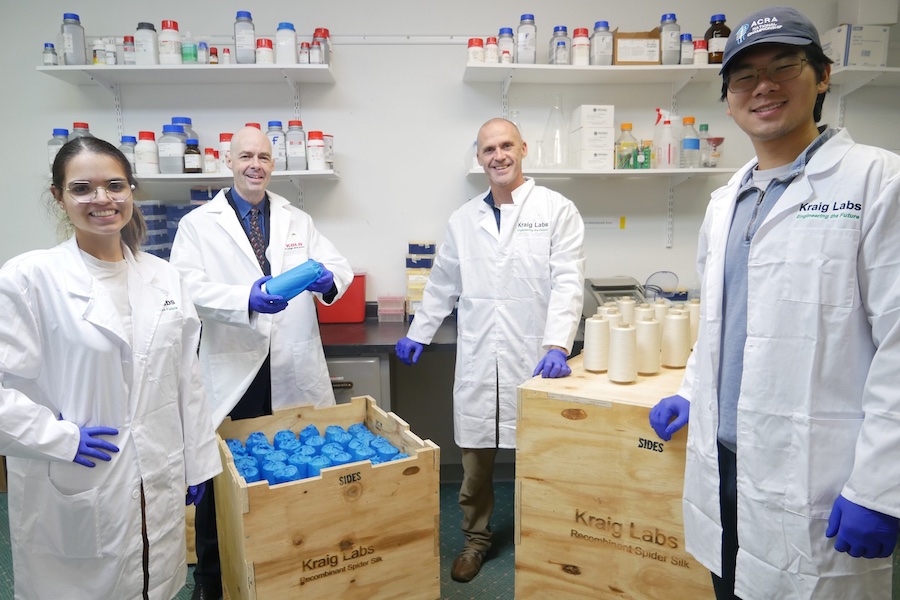
Kraig Biocraft Laboratories reports major progress converting record-setting spider silk cocoon production into reeled silk

Kraig Biocraft Laboratories, Inc. (OTCQB: KBLB) (“the Company”, “Kraig Labs”, or “Kraig’s”), a world leader in spider silk technology*, today announced significant progress in the processing of its recently produced recombinant spider silk cocoons into reeled silk.

Latest News

#Digital Printing

Kornit Digital launches Konnections 365

Kornit Digital (NASDAQ: KRNT) (“Kornit” or the “Company”), a global pioneer in sustainable, on-demand digital fashion and textile production today announced the launch of Konnections 365 - a year-round movement designed for the people moving the apparel, print, and retail industries forward. The strategy is built on the overwhelming success of Konnections 2026 held in Hollywood, Florida, featuring more than 500 customers, partners, and collaborators who together are driving the future of apparel and textiles.

#Techtextil 2026

Techtextil 2026: KARL MAYER impresses as an innovative sector partner

KARL MAYER looks back with satisfaction on its participation in Techtextil 2026. From April 21 to 24, the international industry leader used the trade show in Frankfurt to meet with numerous key customers at its booth and, at the same time, establish many new contacts. Most visitors came from Germany, followed by major markets such as Poland, the United Kingdom, Turkey, France, and Portugal.

#Associations

BTMA backs global growth while investing in future UK leaders

As one of a number of new initiatives launched this year, the British Textile Machinery Association (BTMA) is launching the UK-India Textile Machinery Coalition. The UK-India Free Trade Agreement, signed in July 2025, has implications that extend across sourcing, competitiveness and long-term trade dynamics, believes BTMA CEO Jason Kent.

#Sustainability

Number of GOTS-certified facilities grow 15% globally as demand for credible sustainability standards continues to strengthen

Global Organic Textile Standard (GOTS) certification continued to grow in 2025, with nearly 18,000 certified facilities worldwide, despite ongoing geopolitical uncertainty and rapidly evolving regulatory requirements across global textile supply chains.

TOP