[pageLogInLogOut]

#Raw Materials

The new ICAC Data Portal: The difference between text and context

With today’s public release of its new Data Portal, the ICAC has seized a leadership position in the exciting new field of ‘data storytelling’: the ability to effectively communicate insights from a dataset using narratives and visualisation. In the words of ICAC Data Scientist and architect of the Data Portal, Matthew Looney, 'It’s about telling a compelling story using numbers — a way to convert simple text into context, so to speak'.

1. Putting basic, yet still very robust, data storytelling capabilities into the hands of the global cotton and textile community. All users who visit the Data Portal will be able to view the global, regional and national cotton balance sheet form 1940 to present. In fact, the Data Portal is connected, in real-time, to ICAC databases, so when we make updates to the data they will be instantly reflected in the Data Portal. This makes the ICAC the premier resource for real-time information on global, regional and national statistics. In addition to viewing the data, users will be able to download the data to their local machine. The Data Portal also contains information on cotton lint (HS 5201) imports and exports. In the ’Tools’ section of the Data Portal, users can view a Cotton Season Calendar to get a sense of who is planting and/or harvesting cotton around the globe at any given time throughout the year. Under the ’Tools’ tab, users will able be able to convert cotton bales to metric tonnes, which is useful because different countries have different bale sizes. And finally, there is a tab that allows users to compare the ICAC’s cotton balance sheet to the USDA’s cotton balance sheet — a useful exercise to get two different perspectives on the global cotton situation.

2. Adding significant new value to ICAC Member governments. Some of the most powerful functionality found in the Data Portal is reserved for use by ICAC Members only. It’s one of several steps the organisation has taken over the last five years to provide even greater value for Members; others include the development of the Four Simple Steps to Sustainable High Yields programme, Virtual Reality Cotton Training and the voice-based Soil and Cotton Plant Health app that was created to help illiterate small holder farmers.

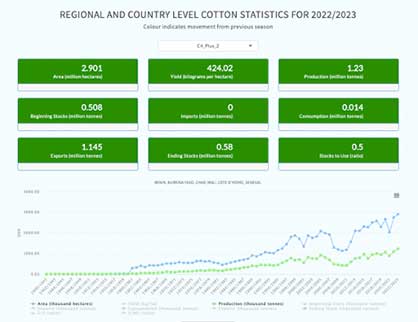
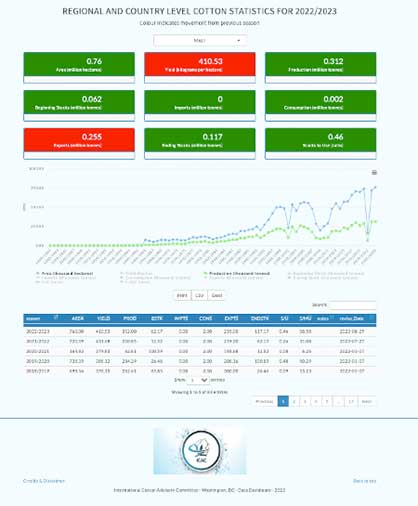
As an example of the Data Portal’s capabilities, let’s assume a user wants to view regional statistics about the C4+2 cotton-producing countries in Africa (Benin, Burkina Faso, Chad, Mali, Cote D'Ivoire, Senegal). A quick glance at the image below reveals that this region is doing well in the 2022/23 season, as all major variables are green (thus indicating an increase from the previous season). In fact, if these numbers hold, the C4+2 countries are on pace for the largest production in their history.
© 2022 ICAC
© 2022 ICAC


However, when we look at the graph view of the data at the bottom of the image, we notice an anomaly in the 2020/21 season. Using the dashboard, we can perform a small amount of investigative work and drill down into each of the C4+2 countries to have a closer look. We would find that Mail had a particular tragic 2020/21 crop year, and that is the reason for the depressed numbers in the C4+2 during that time period.
© 2022 ICAC
© 2022 ICAC


This simple example illustrates the ability to view data at the regional level. Users can drill down into the data at the country level and instantly have a plot available to quickly understand the trends in the data. They also can download the data in Excel (csv) format so they can further manipulate it depending on the specific use case.

‘The dashboard that is being showcased today is the foundation upon which the ICAC will build’, Mr Looney said. ‘In time, we will migrate our publications into interactive and dynamic reports, giving users the ability to dig deeper into the data to help understand the analysis. This is a massive change from the way the ICAC had been operating the statistics programme. With formal databases, interactive dashboards and dynamic reports, we are excited to provide the same excellent analysis using the most advanced data science technology’.

‘Not only has this Data Portal ensured that the ICAC is now at the cutting edge of data provision, it also has an added advantage of allowing ICAC Members to interact directly with the data we hold’, said ICAC Executive Director Kai Hughes. ‘It really is a fantastic achievement and developed in-house by Data Scientist Matthew Looney in just a few months’.

To try out the new ICAC Data Portal, please click:

https://tinyurl.com/mvp7yfpb.



More News from TEXDATA International

#Texprocess 2026

Texprocess 2026: Automation, digitalisation and AI reshape textile processing

Investment decisions in textile processing have become increasingly complex. Rising energy prices, labour shortages and geopolitical uncertainties are forcing companies to prioritise technologies that deliver measurable improvements in efficiency and process stability. This applies not only to apparel production, but also to the processing of technical textiles and high-performance materials. Modernisation projects are therefore being evaluated more selectively – but the pressure to upgrade production systems continues to grow. Texprocess 2026 reflects this tension between cautious investment behaviour and increasing technological demand.

#Techtextil 2026

Textile Chemicals & Dyes: Innovation in Textile Chemistry moves into focus at Techtextil 2026

From PFAS-free finishes and water-saving dyeing technologies to advanced coatings and recycling-compatible formulations, innovation in textile chemistry is accelerating across the industry. Reflecting this development, Techtextil 2026 introduces Textile Chemicals & Dyes as a dedicated product segment, highlighting the growing role of chemical solutions in shaping the next generation of technical textiles.

#Recycling / Circular Economy

textile.4U publishes special edition “Top 100 Textile Recycling Companies 2025”

With a comprehensive 176-page special edition, textile.4U is dedicating its latest issue entirely to one of the most dynamic and influential topics in today’s textile industry: textile recycling. The new issue, published exclusively in high-quality print, presents the Top 100 textile recycling companies researched and selected by TexData – organizations that already play a key role in the transition to circular textiles or are expected to have a significant impact in the near future.

#Recycling / Circular Economy

Responsible Textile Recovery Act of 2024 signed by Governor

Senator Josh Newman (D-Fullerton) is proud to announce that Senate Bill 707 (SB 707), the Responsible Textile Recovery Act of 2024, has been signed into law by the Governor of California, Gavin Newsom. This groundbreaking legislation establishes the country’s first Extended Producer Responsibility (EPR) textile recycling program, marking a significant step forward in the state’s efforts to combat waste and promote sustainability.

More News on Raw Materials

#Raw Materials

A Powerful Opening: Global thought leaders launch the International Cotton Conference Bremen

The International Cotton Conference Bremen will open on 25 March 2026 in the Parliament building of the Free Hanseatic City of Bremen with a keynote session of exceptional calibre. Distinguished international experts will set the stage for the conference by offering incisive perspectives on the most pressing challenges and the defining trends shaping the future of the global cotton trade. Their insights will span a broad spectrum — from geopolitically driven disruptions affecting global supply chains to the opportunities emerging from innovation-led agriculture capable of supporting a growing world population. Together, these opening keynotes will frame the dialogue of the conference, highlighting both the complexity of today’s market environment and the pathways toward a resilient and forward-looking cotton sector.

#Raw Materials

Lenzing Group positions bio‑based materials as a strategic asset for Europe’s economic security

The Lenzing Group, a leading supplier of regenerated cellulose fibers for the textile and nonwovens industries, hosted a high‑level roundtable in Brussels to discuss how bio‑based materials can strengthen Europe’s economic security and support the shift toward a fossil‑free future. Organized in cooperation with Euractiv, the event brought together representatives of the European Commission, the UK Mission to the EU, academia, civil society, and industry.

#Natural Fibers

Beyond Cotton: Natural Fibres in the Spotlight at the Bremen Cotton Conference - Branded by DNFI

Climate targets, fragile supply chains, and rising regulatory requirements are fundamentally changing the perspective of the textile industry - the focus is increasingly shifting toward the base material. Not only cotton, but natural fibres are gaining significant importance: they stand out not only because of their outstanding functional properties, but also because they make a valuable contribution to the bioeconomy and responsible product development.

#Raw Materials

International Women’s Day: Cotton made in Africa strengthens equality for women through targeted investments

On the occasion of International Women’s Day—which will be observed on 8 March under the motto “Rights. Justice. Action. For ALL Women and Girls”—the Aid by Trade Foundation (AbTF), which is responsible for Cotton made in Africa® (CmiA), underlines its long-standing and ongoing commitment to the equality of women in African cotton production areas.

Latest News

#Techtextil 2026

Gebr. Otto highlights versatility at Techtextil with regional supply chains, yarn innovations and new hygiene segment

At this year’s Techtextil, Gebr. Otto places its versatility at the center of its presentation. In addition to spinning, twisting and dyeing – traditionally focused on fine cotton – textile processors will also find a competent development partner for technical specialty solutions. The Dietenheim-based spinning mill has now built up a decade of experience in the production of technical yarns, particularly from aramids. A new hygiene segment has also been established, where yarns for medical and hygiene products are currently being produced. In the future, this department could also develop textile products for the food sector. Gebr. Otto will once again be present at the BW-i joint stand, booth D81, hall 12.1. What is wound onto the spool is determined by the customer: Gebr. Otto develops according to specific customer requirements and transforms its own ideas into yarn innovations.

#Europe

Commission presents proposal for EU Inc. - unlocking the full potential of the Single Market for Europe's entrepreneurs

Today, the European Commission presented its proposal for EU Inc., a new single set of corporate rules, building the cornerstone and starting point for the EU's 28th regime. EU Inc. is an optional, digital-by-default European corporate framework. It will make it easier for businesses to start, operate and grow across the EU – incentivising them to stay in Europe, and encourage those who once looked elsewhere to return.

#Man-Made Fibers

OnceMore® from Södra brings end-to-end traceability for circular Man-made Cellulosic Fibers (MMCF) using TextileGenesis

OnceMore® from Södra, the world’s first large-scale process for recycling blended fabrics into high‐quality dissolving pulp, will begin using TextileGenesis, a Lectra company, to strengthen traceability from raw material to retail across the value chain. OnceMore® produces dissolving pulp made from blended textile waste and wood sourced from responsibly managed Swedish forests. By integrating TextileGenesis, OnceMore® supports the growing need for verified data and secure, transparent tracking throughout increasingly complex supply chain.

#Sustainability

Experts publish APAC policy priorities

Cascale today announced the publication of its APAC Policy Priorities Paper, developed by the Asia-Pacific (APAC) Policy Member Expert Team (MET) to identify key regional sustainability challenges and provide practical, aligned recommendations for policymakers and industry stakeholders across Asia-Pacific.

TOP