[pageLogInLogOut]

#Raw Materials

Applied DNA and Stratum Reservoir (Isotech) sign memorandum of understanding to leverage isotopic analysis for enhanced DNA-based cotton authenticity and provenance

Applied DNA Sciences, Inc. (NASDAQ: APDN) (Applied DNA or the “Company”), a leader in Polymerase Chain Reaction (PCR)-based DNA manufacturing and nucleic acid-based technologies, and Stratum Reservoir (Isotech), LLC (“Isotech”), a division of Stratum Reservoir and a leader in laboratory stable isotope analysis, a technique used for fingerprinting naturally occurring organic compounds such as cotton, today announced that they have entered into a Memorandum of Understanding (MoU).

Under the terms of the MoU, Applied DNA will deploy Isotech’s isotopic analysis (IA) as a confirmatory assay for cotton genotyping, the process through which cotton DNA is utilized to determine cotton fiber and fabric origin forensically. The MoU is expected to be followed by a definitive agreement between the companies. 

The signing of the MoU follows the joint presentation of initial data by the companies at an American Apparel and Footwear Association event that describes a methodology and findings for the successful determination of Egyptian cotton fiber, yarn and fabric origin using cotton genomics with affirmation by IA. The complementary use of IA to Applied DNA’s CertainT® platform for textile traceability yields a continuity of forensic data across the entirety of a natural fiber-based value chain – from source to finished goods – to ensure adherence to social (avoidance of products made with forced or slave labor) and environmental practices (sustainable, organic) aligned with regulatory and consumer expectations. Per the MoU, the companies will support business development opportunities for cotton traceability. They will also continue to build and compile a global database of cotton, yarn, and fabric samples from known sources to broaden the application and utility of IA.


MeiLin Wan, vice president of Textile Sales at Applied DNA, stated, “The use of IA complements our CertainT platform to deliver what we believe is a best-in-class, multi-layered approach to supply chain traceability and assurance across the entirety of natural fiber-based value chains. With CertainT, once origin is established, we deliver certainty that we believe is immutable and forensic from source-to-shelf. The power of DNA is now augmented with IA.”

“Stable isotope analysis is a powerful tool that we have historically used in the oil and gas industry,” said Steven Pelphrey, Director of Stratum Reservoir (Isotech), LLC. “Through our collaboration with Applied DNA, we can now more broadly apply our proven technology and techniques to the textile industry. This both enhances Applied DNA’s CertainT platform with an additional layer of geographic provenance and delivers an unmatched solution to the marketplace.”



More News from TEXDATA International

#Texprocess 2026

Texprocess 2026: Automation, digitalisation and AI redefine textile processing

Making investment decisions in textile processing has become significantly more demanding. Increasing energy costs, a shortage of skilled labour and ongoing geopolitical uncertainties are compelling companies to focus on technologies that deliver clear gains in efficiency and process reliability. This applies equally to apparel manufacturing and to the processing of technical textiles and high-performance materials. As a result, modernisation initiatives are assessed more carefully – even as the need to upgrade production systems continues to intensify.

#Techtextil 2026

Techtextil 2026: Between innovation pressure & market reality

From 21 to 24 April 2026, Techtextil in Frankfurt am Main will once again become the central meeting point for the international technical textiles and nonwovens industry. Running in parallel, Texprocess will focus on the industrial implementation of textile processing technologies as the leading platform in this field. Together, the two trade fairs form a closely integrated presentation and working platform along the entire textile value chain – from material development to finished applications.

#Techtextil 2026

Between geopolitical pressure and industrial resilience

In this interview, Dr. Janpeter Horn (VDMA) discusses the current challenges facing textile machinery manufacturers, shaped by geopolitical tensions, regulatory developments and subdued investment. He also outlines why innovation strength, integrated solutions and strategic positioning remain key to global competitiveness.

#Texprocess 2026

Between investment restraint and modernization pressure

Texprocess 2026 takes place in a complex market environment shaped by uncertainty and innovation pressure. In this interview, Elgar Straub (VDMA) explains why the trade fair is particularly relevant this year and which technologies are driving efficiency and competitiveness.

More News on Raw Materials

#Raw Materials

China projected to increase cotton production, yields, and imports in 2026/27

World cotton production in the 2026/27 season is projected at 25.9 million tonnes, exceeding global consumption of 25.2 million tonnes, according to the May 2026 issue of Cotton This Month. That means both production and consumption are expected to remain close to current season levels, while global cotton trade is projected to decline by 2.7% to approximately 9.6-9.7 million tonnes.

#Raw Materials

ICAC launches Carbon Credits Initiative to deliver new income streams to cotton farmers

The International Cotton Advisory Committee (ICAC) has announced a new initiative designed to unlock additional income streams for cotton farmers through participation in carbon credit markets, linking sustainable production practices directly to financial returns.

#Raw Materials

ECCO introduces first shoe featuring innovative protein-based fibre

ECCO, in partnership with Spinnova, announces the launch of the limited edition ECCO BIOM® 720, a first-of-its-kind shoe utilising an often overlooked leather by-product, transformed into a protein-based fibre. The fibres are produced using patented technology that advances material innovation while reducing waste and supporting full resource use across the leather and textile industry.

#Raw Materials

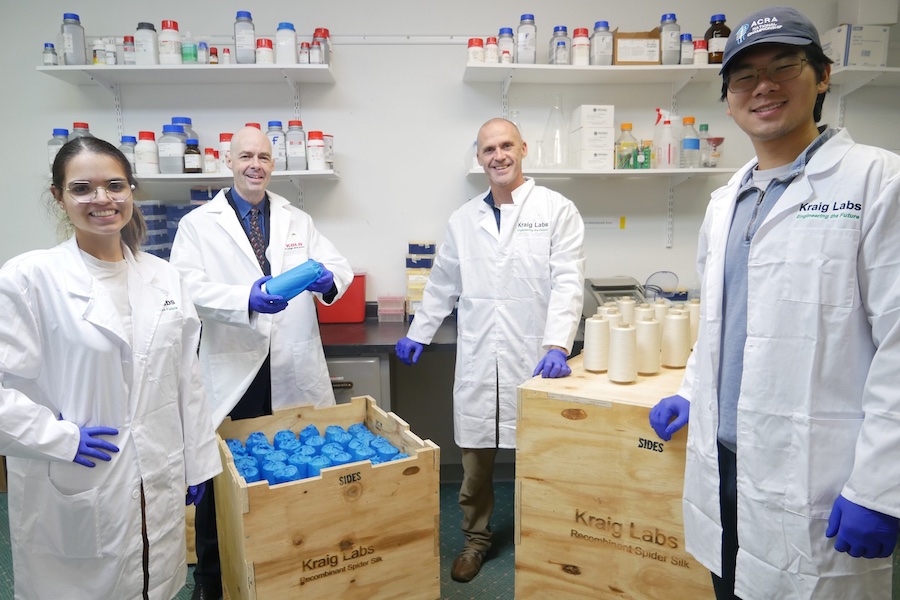
Kraig Biocraft Laboratories reports major progress converting record-setting spider silk cocoon production into reeled silk

Kraig Biocraft Laboratories, Inc. (OTCQB: KBLB) (“the Company”, “Kraig Labs”, or “Kraig’s”), a world leader in spider silk technology*, today announced significant progress in the processing of its recently produced recombinant spider silk cocoons into reeled silk.

Latest News

#ITM 2026

ITM 2026: KARL MAYER presents new perspectives

KARL MAYER will once again showcase itself as a strong partner to the Turkish textile industry at ITM in Istanbul from June 9 to 13. At Booth 303 A in Hall 3 of the Tüyap Fair Convention and Congress Center, the industry leader will exhibit solutions for warp knitting, warp preparation, and technical textiles – tailored to a challenging economic environment.

#Spinning

Specialist in fine counts: New type 2777 ceramic oiler

With the new Type 2777 ceramic oiler, Barmag has added a solution for fine titers and microfilaments to its portfolio of original parts.

#INDEX 2026

STFI highlights textile circular economy and alternative fibres at INDEX™ 2026

From 19 to 22 May 2026, INDEX will invite visitors to Lake Geneva for the world's leading nonwovens trade fair. The Centre of Excellence in Nonwovens at the Sächsisches Textilforschung- sinstitut e.V. (STFI) will be in attendance to present the latest developments in nonwovens research. In the field of the textile circular economy, the STFI will present acoustically effective nonwovens made from chemical recycling residues. The range also includes innovations aimed at replacing conventional raw materials, such as the biobased and biodegradable polymer polybutylene succinate (PBS) and Kendyr as an alternative to cotton.

#Associations

Italian textile machinery sector faces weak start to 2026 despite domestic growth

In the first quarter of 2026, order intake for Italian textile machinery manufacturers recorded a decrease of 5% compared to the same period in 2025, reflecting a still challenging start to the year. The decline affected foreign markets (-7%), while the domestic market showed growth (+21%).

TOP