[pageLogInLogOut]

#Raw Materials

2.7 million cotton farmers grow nearly a quarter of global cotton more sustainably

Today, the Better Cotton Initiative (BCI) shared in our 2020 Annual Report that Better Cotton – cotton produced in line with the initiative’s Better Cotton Principles and Criteria by licensed BCI Farmers – now accounts for 23% of global cotton production, with BCI’s nearly 70 Implementing Partners rapidly adapting their practices to evolving circumstances during the Covid-19 pandemic to deliver training and support to 2.7 million farmers* in 23 countries.

Together with our partners, BCI has made great progress from when the first bale of Better Cotton was produced in Pakistan just over a decade ago, but there is still much more to do. The global challenges of climate change, biodiversity loss, resource scarcity and social inequality are more pressing than ever. BCI is committed to supporting cotton communities and applying lessons learnt to deepen our impact as we move into the next decade.

2020 Year in Review— BCI remained committed to improving livelihoods and supporting cotton farming communities throughout the pandemic, transforming the way we work and raising funds to support the majority smallholder farmers in lower income countries. Strengthening our capacity to promote decent work and prevent forced labour, we revisited our approach to addressing decent work challenges with the help of a task force, culminating in a Decent Work Strategy. BCI also closed the first phase of our Gender Strategy, measuring and piloting women’s empowerment projects in South Africa and India, while advancing the gender conversation within the Cotton Community. Through the Delta Project, BCI helped lead the way in strengthening efforts of multiple sustainability initiatives to address social and environmental challenges in agriculture, protect workers’ rights and improve farmers’ livelihoods with the creation of a shared approach to measuring and communicating sustainability progress.

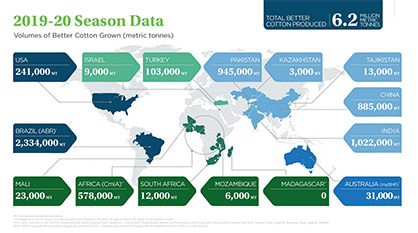
The BCI Journey— In 2016, BCI began our journey towards Better Cotton being recognised as a mainstream sustainable commodity by 2020. In the 2019-2020 season, BCI Retailer and Brand Members sourced 1.7 million metric tonnes of Better Cotton, a 13% increase on 2019 sourcing volumes and a record for the industry. In 2020, BCI also welcomed more than 400 new members across five membership categories. By the end of the year, BCI’s membership base had exceeded 2,100 members, spanning 60 countries and accounting for a 14% increase on 2019.  As BCI moves forward, creating and measuring meaningful impact will be an increasing focus of our work, as we continue to reach more farming communities. More on this will be shared later in the year.


Access the BCI 2020 Annual Report to find more detail on BCI’s performance to 2020 and how BCI’s stakeholders are determined to deliver real impact for cotton farming communities here:

https://bettercotton.org/about-bci/bci-reports/


“Our 2030 strategy is testament to our determination to help cotton farming communities build climate resilience, conserve natural resources and promote decent work, strengthening our sector while supporting the global push to achieve the UN’s 2030 Sustainable Development Goals. We want to deliver real impact for cotton farming communities. That’s why the work we have undertaken with our stakeholders in 2020 to refine our strategic approach and align our climate efforts with science-based targets is so important.”

– Alan McClay, CEO, Better Cotton Initiative

“In the 2019-20 cotton season, we strengthened our capacity building approach, dedicating more resources to helping farmers adopt sustainable practices and finding new ways of building lasting relationships with our partners as well as developing new partnerships with technical experts. This provided a robust foundation from which to respond rapidly to the Covid-19 pandemic in 2020.”

– Jyoti Narain Kapoor, India Country Director, Better Cotton Initiative
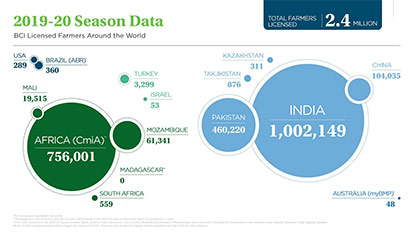


* This figure refers to ‘participating farmers’. There are 2.4 million farmers licensed to grow Better Cotton, 2.7 million participating farmers receiving BCI’s training and support to grow cotton more sustainably, and 3.8 million farmers reached by BCI’s programmes including Farmers+. More information is available here:

https://bettercotton.org/blog/understanding-our-reach-a-qa-with-eliane-augareils-and-kendra-park-pasztor-on-farmers-and-what-it-means-for-bci/



More News from TEXDATA International

#Techtextil 2026

Performance Apparels: Functional textiles drive innovation at Techtextil 2026

From high-performance fibres and advanced membranes to smart textiles and sustainable material concepts – functional apparel is becoming one of the most dynamic innovation fields in technical textiles. At Techtextil 2026, exhibitors demonstrate how new materials, finishing technologies and digital functions are shaping the next generation of protective, workwear and outdoor systems.

#Texprocess 2026

Texprocess 2026: Automation, digitalisation and AI reshape textile processing

Investment decisions in textile processing have become increasingly complex. Rising energy prices, labour shortages and geopolitical uncertainties are forcing companies to prioritise technologies that deliver measurable improvements in efficiency and process stability. This applies not only to apparel production, but also to the processing of technical textiles and high-performance materials. Modernisation projects are therefore being evaluated more selectively – but the pressure to upgrade production systems continues to grow. Texprocess 2026 reflects this tension between cautious investment behaviour and increasing technological demand.

#Techtextil 2026

Textile Chemicals & Dyes: Innovation in Textile Chemistry moves into focus at Techtextil 2026

From PFAS-free finishes and water-saving dyeing technologies to advanced coatings and recycling-compatible formulations, innovation in textile chemistry is accelerating across the industry. Reflecting this development, Techtextil 2026 introduces Textile Chemicals & Dyes as a dedicated product segment, highlighting the growing role of chemical solutions in shaping the next generation of technical textiles.

#Recycling / Circular Economy

textile.4U publishes special edition “Top 100 Textile Recycling Companies 2025”

With a comprehensive 176-page special edition, textile.4U is dedicating its latest issue entirely to one of the most dynamic and influential topics in today’s textile industry: textile recycling. The new issue, published exclusively in high-quality print, presents the Top 100 textile recycling companies researched and selected by TexData – organizations that already play a key role in the transition to circular textiles or are expected to have a significant impact in the near future.

More News on Raw Materials

#Raw Materials

Better Cotton Initiative strengthens regenerative focus in standard update

The Better Cotton Initiative (BCI) has strengthened the regenerative focus of its field-level standard with the launch of a new version of its Principles & Criteria (P&C), which marks the next step in the organisation’s journey to becoming a regenerative standards system.

#Raw Materials

Global production expected to decline in 2026/27 as policy shifts and weak demand reshape trade

Early projections for the 2026/27 season indicate that global cotton lint production will decline by 4% to 24.9 million tonnes, while world consumption is expected to remain stable at approximately 25 million tonnes, according to the April 2026 issue of Cotton This Month.

#Raw Materials

Textile Exchange publishes cotton Life Cycle Assessment study to strengthen impact data

Textile Exchange has published the first in a series of seven Life Cycle Assessment (LCA) studies designed to improve the quality and robustness of environmental impact data for raw material production across the fashion, textile, and apparel industry. The first LCA study focuses on cotton and addresses critical data gaps and methodology variability through new high-quality data across key producing countries. The study includes organic, regenerative, recycled, and country averages for conventional cotton production systems, providing a clearer picture of the associated environmental impact.

#Raw Materials

Fashion for Good mobilises industry to adopt mass balance attribution and accelerate decarbonisation

Fashion for Good launches today the Mass Balance Demonstrator project, a collaborative industry initiative to implement and scale the mass balance attribution (MBA) chain-of-custody model for biomass-attributed PET in textile applications. The project represents a concrete step toward accelerating brand-driven decarbonisation across the apparel value chain.

Latest News

#Man-Made Fibers

Selenis and Kintra Fibers partner to scale 100% bio-based synthetic fiber technology

Selenis, a leading global specialty polyester manufacturer, today announced a strategic manufacturing partnership with materials science company Kintra Fibers to scale Kintra’s patented fiber-grade PBS resin - a 100% bio-based and biodegradable material designed for textile applications.

#Functional Fabrics

PERFORMANCE DAYS proves its relevance as the industry’s key meeting point

Held on March 18–19, 2026, PERFORMANCE DAYS once again confirmed its position as a leading international platform for functional textiles. A total of 3.366 trade visitors and around 560 exhibitors gathered in Munich, with the event already kicking off successfully on DAY 0, which received highly positive feedback for its interactive format. Despite challenging conditions caused by the public transport strike in Munich, the event saw strong attendance and a consistently high level of activity across both exhibition days.

#Recycling / Circular Economy

Reju secures €135 Million in Dutch NIKI Funding for industrial-scale textile-to-textile regeneration hub at Chemelot Industrial Park, the Netherlands

Reju™, the progressive textile-to-textile regeneration company, has been awarded €135 million in funding under the Netherlands’ Nationale Investeringsregeling Klimaatprojecten Industrie (NIKI) program. The funding will support Reju’s planned industrial-scale Regeneration Hub at Chemelot Industrial Park in Sittard-Geleen, covering both the investment phase and ongoing operations, and represents a critical milestone on the path toward final investment decision.

#Techtextil 2026

TTL showcases nonwoven and needlefelt solutions at Techtextil 2026

Technische Textilien Lörrach GmbH & Co. KG (TTL), part of the Yanpai Group, will present its latest nonwoven and needlefelt solutions for industrial applications at Techtextil 2026 in Frankfurt.

TOP