[pageLogInLogOut]

#Raw Materials

The environmental footprint of Cotton Made in Africa’s cotton
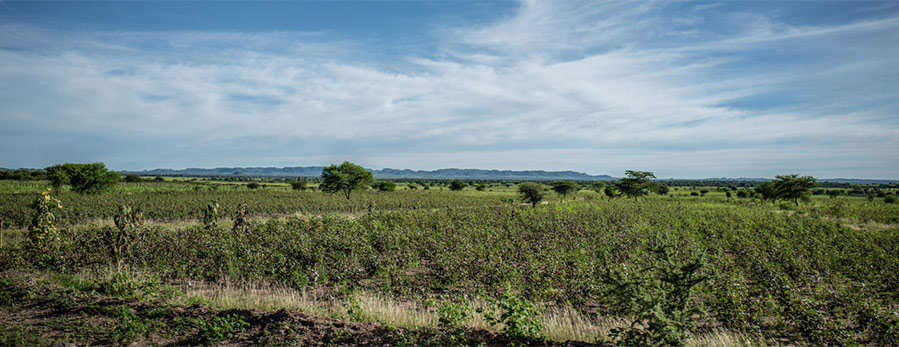
© 2021 Cotton Africa
In 2020, the Aid by Trade Foundation commissioned a scientific study on the environmental footprint left by cotton verified under the Cotton made in Africa (CmiA) standard. In terms of water consumption and climate change, CmiA cotton does better than most, primarily because it is cultivated by small-scale farmers who rely on rain-fed agriculture only and apply considerably less fertiliser than farmers in other cotton-growing regions. This study also includes the first biodiversity impact assessment for cotton production in the cultivation regions.

The environmental footprint of the Cotton made in Africa (CmiA) initiative’s cotton is excellent. This is the conclusion at which the second life cycle assessment (LCA) arrived, having investigated the impact of cotton farming on climate change, eutrophication, acidification, blue water consumption, and biodiversity. In the course of the assessment, CmiA-verified cotton companies from Côte d’Ivoire, Cameroon, and Zambia completed questionnaires on their practices, and data was collected on factors like average farm size, crop yields, and fertiliser application rates.

Low Greenhouse Gas Emissions and Minimal Water Consumption

CmiA cotton contributes less to climate change than the global average, with only 1.24 tonnes of CO2 equivalents being released per tonne of harvested CmiA cotton fibres versus the significantly higher global benchmark¹ of 1.43 tonnes. This is largely because CmiA farmers use relatively little fertiliser and cultivate their cotton under rain-fed conditions only. In addition to protecting surface and ground water, rain-fed agriculture saves energy, since there is no need to power the water pumps otherwise required for irrigation.

Although CmiA cotton’s acidification potential is slightly higher than the global average, it is difficult to compare the two values because the global values are calculated without taking into consideration field clearance, i.e. preparing fields by burning crop residue. When this variable is excluded from the CmiA calculations as well, the acidification value for CmiA cotton falls significantly below global average.

This lower figure can be traced back to CmiA cotton’s below-average field emissions. Created by fertilisers, soil erosion, and nitrogen released from crop residue, field emissions are the other major factor in acidification. This difference in acidification potential is likely due to CmiA small-scale farmers in Africa using significantly less urea as fertiliser than is common in major cotton producing countries like India or China. In terms of its environmental footprint, CmiA cotton can certainly hold its own on the world stage.

Reduced Burning and Tillage

In terms of eutrophication, i.e. the introduction of excessive levels of macronutrients into ecosystems, CmiA cotton scores worse than the global average. This is primarily because many other cotton-growing regions see little precipitation, driving down the global LCA average for leaching levels.

There is still room for improvement regarding field clearance, which causes especially high emissions as farmers burn last season’s cotton plants before sowing new ones, thereby releasing greenhouse gases and intensifying soil acidification. CmiA cotton’s environmental footprint can be further improved by composting crop residue and returning it to the soil as humus instead of burning it.

It would also be beneficial for more small-scale farmers to move towards no-till farming. The widespread practice of ploughing the soil results in nutrients like nitrate and phosphorous leaching out of the fertile topsoil at a greater rate, thereby compromising the quality of both the groundwater and the soil and ultimately leading to poorer harvests.


How Cotton Production Impacts Biodiversity

In this year’s LCA, the CmiA initiative supplemented the usual criteria with a new key parameter: the impact of cotton farming on biodiversity. Since this is the first time that this impact category is being investigated as part of an LCA for cotton, it will not be possible to rank CmiA cotton in terms of biodiversity until other players in the cotton production sector publish comparative values.

The results of this assessment are considered to be representative of CmiA cotton as a whole because more than half of all CmiA cotton is produced in the three countries under study (Côte d’Ivoire, Cameroon, and Zambia). Because the previous LCA – produced in 2014 by the prestigious Sphera institute, which also conducted this study – surveyed only one cotton company from each of Zambia and Côte d’Ivoire, the results of the two studies are not directly comparable.

¹The global average values mentioned refer to the data published in “The life cycle inventory & life cycle assessment of cotton fiber & fabric” (Cotton Inc, 2017)



More News from TEXDATA International

#Recycling / Circular Economy

textile.4U publishes special edition “Top 100 Textile Recycling Companies 2025”

With a comprehensive 176-page special edition, textile.4U is dedicating its latest issue entirely to one of the most dynamic and influential topics in today’s textile industry: textile recycling. The new issue, published exclusively in high-quality print, presents the Top 100 textile recycling companies researched and selected by TexData – organizations that already play a key role in the transition to circular textiles or are expected to have a significant impact in the near future.

#Recycling / Circular Economy

Responsible Textile Recovery Act of 2024 signed by Governor

Senator Josh Newman (D-Fullerton) is proud to announce that Senate Bill 707 (SB 707), the Responsible Textile Recovery Act of 2024, has been signed into law by the Governor of California, Gavin Newsom. This groundbreaking legislation establishes the country’s first Extended Producer Responsibility (EPR) textile recycling program, marking a significant step forward in the state’s efforts to combat waste and promote sustainability.

#Textiles & Apparel / Garment

Modtissimo promotes sustainability with 28 coordinates in the Green Circle

Modtissimo is proving more and more to be a textile and clothing show that delivers the latest innovations in the area of sustainability, with the iTechStyle Green Circle being the main showcase for companies' creations. In this 60+4 edition, taking place on 12 and 13 September, 28 coordinates will be exhibited in a section organised by CITEVE and curated by Paulo Gomes.

#Europe

The EU and Egypt team up to mobilise private sector investments at Investment Conference and sign a Memorandum of Understanding underpinning €1 billion in macro-financial assistance for Egypt

At the EU-Egypt Investment Conference, co-organised by the EU and the Government of Egypt on 29-30 June, the EU and Egypt are teaming up to intensify private sector investments in Egypt. They are also signing a Memorandum of Understanding (MoU) for the disbursement to Egypt of up to €1 billion in Macro-Financial Assistance.

More News on Raw Materials

#Raw Materials

Cotton production continues to exceed consumption, some growers shift away from cotton

World cotton lint production in the 2025/26 season is currently estimated at 26 million tonnes, continuing to exceed world consumption, which is estimated at 25.2 million tonnes, according to the February 2026 edition of Cotton This Month. Global production is estimated to be 1% higher than the previous season, while consumption is estimated to be 0.4% higher, resulting in a continued supply surplus in the world cotton market.

#Raw Materials

Better Cotton Initiative opens enrollment in the US with promising opportunities for producers

Producer enrollment for the US Program of the Better Cotton Initiative (BCI) is open until May 15 for the 2026-2027 season. With over 2,600 members spanning the cotton supply chain and more than 11,000 users of its Better Cotton Platform (BCP) as of 2025, BCI’s standard is implemented in 15 countries and covers one fifth of global cotton production.

#Natural Fibers

Modern testing methods for raw cotton

The 38th International Cotton Conference Bremen will take place from 25 to 27 March 2026 at the Bremen Parliament. This conference has traditionally stood for in-depth expertise and international exchange. The program will focus on technical innovations, market trends, and regulatory frameworks across the entire value chain – from agriculture to the circular economy. With high-profile speakers, the conference is regarded as the key meeting point for the global cotton industry. Today’s focus: Cotton quality and testing methods.

#Natural Fibers

38th International Cotton Conference Bremen: Let´s Talk about Cotton!

The 38th International Cotton Conference Bremen, to be held on 25-27 March 2026 in Bremen’s parliament building on market square, once again sends a powerful signal for professional excellence and international dialogue. The focus is on the latest market trends and technical innovations throughout the entire value chain – from agriculture and quality assurance to processing and the circular economy. With its high-calibre speakers, the conference remains an indispensable forum for anyone involved in shaping the cotton industry scientifically, technically, or economically.

Latest News

#Dyeing, Drying, Finishing

Orthopac RVMC-20 plus: German Engineering for Smarter Weft Straightening

In times of rising cost pressure and growing quality demands, textile producers worldwide are searching for solutions that combine precision, efficiency, and sustainability. With its latest innovation, the Orthopac RVMC-20 plus, Mahlo once again demonstrates the strength of German engineering: improving proven technology to meet today’s challenges.

#Knitting & Hosiery

KARL MAYER and Lenzing partner to advance warp knitting with scalable cellulose fiber solutions

The Lenzing Group, a leading supplier of regenerated cellulosic fibers for the textile and nonwovens industries, together with KARL MAYER, the global market leader in warp knitting machines and warp preparation systems, debut a joint innovation project during Premiere Vision, Paris.

#Textile chemistry

RUDOLF gets the exclusive global distribution rights for Sanitized® textile technologies

With effect from today, RUDOLF officially assumes exclusive global distribution rights for Sanitized® textile technologies from SANITIZED AG. This is the next milestone in the strategic collaboration announced in 2025, with the partnership between the two companies now fully implemented and expanded worldwide.

#Europe

ICAC to support European Commission on pending PEF legislation

The International Cotton Advisory Committee (ICAC) is proud to announce that it has been included as a member of the European Commission’s Technical Advisory Board (TAB) on the Product Environmental Footprint methodology. The Commission developed the Product Environmental Footprint (PEF) to assess and communicate the life cycle environmental performance of products and organizations.

TOP