[pageLogInLogOut]

#Man-Made Fibers

Textile Exchange publishes comprehensive polyester LCA study
© 2026 Textile Exchange
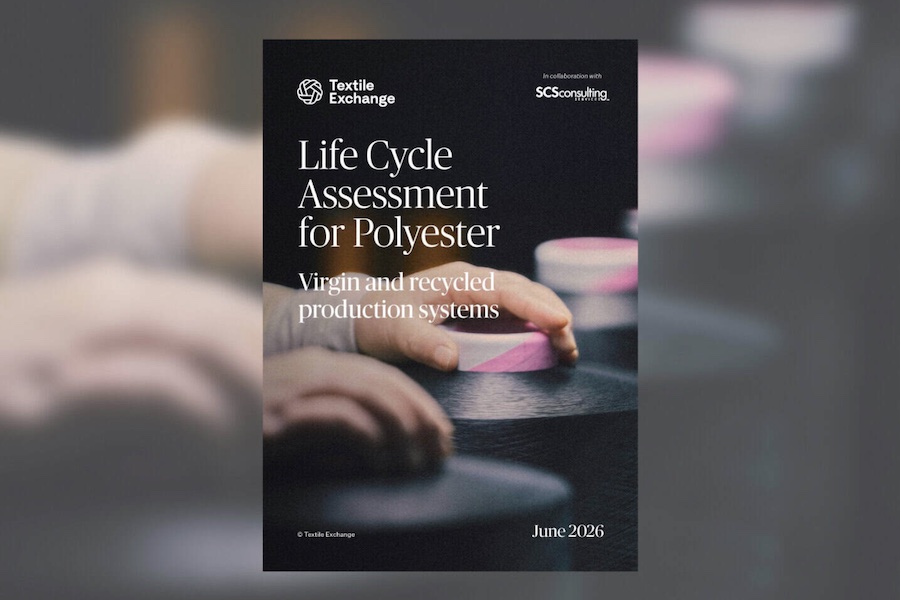
Textile Exchange has released a new Life Cycle Assessment (LCA) study on polyester, providing detailed data on the environmental impacts of both virgin and recycled polyester production. The study aims to strengthen understanding across the fashion, textile and apparel industries and support more informed decision-making regarding polyester sourcing and production.

According to Textile Exchange, the study identifies key environmental hotspots across different polyester production routes and includes new data on both thermomechanical and chemical recycling technologies. It also provides what is believed to be the first publicly available data on the environmental impacts of virgin polyethylene terephthalate (PET) production in Southeast Asia, a region that accounts for more than half of global virgin PET production.

The assessment focuses on virgin polyester production in Southeast Asia and recycled polyester production in China, Europe and the United States. Like all Textile Exchange LCA studies, it follows a cradle-to-gate approach, covering impacts from resource extraction through fiber formation. In addition, the study incorporates a broader “LCA+” methodology, including an assessment of human rights impacts associated with polyester production.

One of the central findings is that the environmental performance of polyester depends heavily on the production technology used. Key impact hotspots identified include the production of virgin fossil-based feedstocks, waste collection and sorting for recycled polyester, energy consumption and transportation.

To support industry-wide environmental modelling and progress tracking, the data from the study will be integrated into several major sustainability databases, including the Higg Materials Sustainability Index (MSI), Ecoinvent and the Quantis World Apparel and Footwear Life Cycle Assessment Database (WALDB). Textile Exchange notes that the data is primarily intended as proxy data for situations where source-specific LCA data is unavailable.

The polyester study is the second publication in Textile Exchange’s ongoing series of fiber-specific LCA studies. Earlier this year, the organization published its cotton LCA study, with additional assessments scheduled for release throughout 2026 and 2027.

To ensure scientific rigor and impartiality, the study was conducted in accordance with ISO standards, led by specialized LCA consultants, reviewed by independent expert panels and developed in consultation with a broad range of industry stakeholders.

Textile Exchange emphasizes that, as with all LCA data, results should be interpreted carefully and within their intended context. The organization advises against direct comparisons between different studies, regions or production systems, as methodological choices, assumptions and system boundaries can significantly influence outcomes.

Explore the full LCA study:

https://textileexchange.org/knowledge-center/reports/polyester-life-cycle-assessment/?utm_source=polyesterlca_email&utm_medium=email&utm_campaign=polyesterLCA&utm_term=null&utm_content=general



More News from Textile Exchange

#Sustainability

Textile Exchange unveils agenda for 2026 conference in Vancouver

Textile Exchange has released the agenda for its 2026 Conference, which will take place from October 12–16 in Vancouver, Canada. Under the theme “The Implementation Era,” the event will focus on translating sustainability commitments into practical action and scaling solutions across businesses, supply systems, and landscapes.

#Raw Materials

Textile Exchange publishes cotton Life Cycle Assessment study to strengthen impact data

Textile Exchange has published the first in a series of seven Life Cycle Assessment (LCA) studies designed to improve the quality and robustness of environmental impact data for raw material production across the fashion, textile, and apparel industry. The first LCA study focuses on cotton and addresses critical data gaps and methodology variability through new high-quality data across key producing countries. The study includes organic, regenerative, recycled, and country averages for conventional cotton production systems, providing a clearer picture of the associated environmental impact.

#Sustainability

Textile Exchange unveils commitment-based pathway for members to accelerate responsible raw material production

Textile Exchange has unveiled further details about its new membership structure, designed to guide the fashion, textile, and apparel industry in a collective course of action toward preferred production systems for raw materials and fibers.

#Yarns

Textile Exchange publishes the final criteria for its new Materials Matter Standard, marking a pivotal shift in connecting certification to impact

Textile Exchange has published the final criteria for its Materials Matter Standard—a major milestone in the organization’s multi-year transition toward a unified, impact-driven standards system for raw material production and primary processing. 

More News on Man-Made Fibers

#Yarn & Fiber

R-Evenge chooses Q-NOVA® yarn by Fulgar for its line of technical socks dedicated to wellness

Q-NOVA®, Fulgar’s sustainable polyamide 6.6 yarn, has been selected by R-Evenge for the development of its collection of technical socks dedicated to wellness, fitness, and water-based activities.

#Raw Materials

AMSilk and Ajinomoto Foods Europe expand partnership to enable industrial-scale production of silk proteins

AMSilk GmbH (“AMSilk”), a global leader leader in biotech produced silk materials, today announced a significant expansion of its partnership with Ajinomoto Foods Europe (AFE), marking a key step in scaling the industrial production of its silk proteins. Building on the collaboration first established in 2023, the two companies have now entered into a long-term manufacturing and supply agreement, enabling the transition from industrial validation to dedicated, large-scale production.

#Spinning

Ibrahim Fibres and Trützschler: A strong partnership enters its next phase with the TC 30Si

For more than two decades, Ibrahim Fibres and Trützschler have grown side by side, driven by a shared ambition to continuously improve spinning performance, strengthen technology leadership and set new benchmarks in the textile industry. Today, Ibrahim Fibres is a leading yarn and polyester staple fiber manufacturer in Pakistan. The company operates the largest number of Trützschler cards in the country, with more than 200 machines running across its mills in Faisalabad, and plays an important role in one of Asia’s largest textile industries.

#Man-Made Fibers

IMG Group, parent of Evertis and Selenis, launches Everbio Innovation Hub backed by €15 million in financing from C2 Capital Partners

IMG Group launched the Everbio Innovation Hub, backed by €15 million in financing from C2 Capital Partners. Located at the Group’s industrial site in Portalegre, Portugal, the Everbio Innovation Hub brings together the capabilities of Evertis (PET-based packaging films), Selenis (specialty copolyester resins), Renascis (advanced multilayer recycling) and Renewis (renewable energy) to develop, test and mature the next generation of recycled and bio-based polymer materials and technologies.

Latest News

#Recycled Fibers

Recover™ and Ünteks Group partner to scale recycled cotton in knitwear

Recover(TM), a global producer of low‐impact, high‐quality recycled cotton fiber, announces a new partnership with Ünteks Group, a vertically integrated textile manufacturer based in Turkey. The collaboration focuses on the development of circular knit fabrics and garments, combining Recover’s recycled cotton fiber with Ünteks Group’s integrated capabilities across knitting, dyeing, printing, and garment production.

#Spinning

STEELTOP®: A new benchmark in flat tops for spinning preparation

Modern carding generations achieve higher production performance, placing significantly greater stress on flat tops. Higher cylinder speeds and increased fiber density, combined with tighter carding gaps, create more demanding operating conditions. At the same time, poorer raw material quality and the increased use of recycled materials further intensify these challenges. With STEELTOP®, Trützschler introduces a new full steel flat top series developed for these demanding modern carding processes.

#Textile processing

YKK develops concept EXCELLA® zipper tape using nonwoven fabric partially derived from used clothing

YKK Corporation has developed a concept version of its premium EXCELLA® zipper series made from nonwoven fabric sheets created by fiberizing used clothing and other textile materials. Based on a proposal by fashion designer Yuima Nakazato, this item was created as a result of collaboration between Nakazato, Seiko Epson Corporation and YKK. The concept zipper was incorporated as a material component for pieces in the newest YUIMA NAKAZATO Couture Collection, “INFERNO,” which was unveiled in Paris, France on July 8, 2026.

#Textiles & Apparel / Garment

Texworld Apparel Sourcing Paris highlights evolving global sourcing landscape

From 31 August to 2 September 2026, Texworld Apparel Sourcing Paris will bring together more than 1,000 international exhibitors at Paris-Le Bourget Exhibition Centre. This edition reflects the new global balance of textile and apparel sourcing, highlighting a strong diversity of sourcing countries — some unexpected.

TOP