[pageLogInLogOut]
THE BEAUTY OF DETAIL GROZ-BECKERT

#Knitting & Hosiery

Mayer & Cie. extends top dog status in Turkey

Detailed view of a MBF 3.2. The machine producing three-thread fleece stands for comfortable home office wear and has seen a further increase in popularity. © 2020 Mayer & Cie
In pandemic year 2020 circular knitting machine manufacturer Mayer & Cie. (MCT) has further improved its leading position in Turkey. So the country continues to be one of the company’s strongest and most consistent sales markets. Even in difficult years, the manufacturer and its longstanding Turkish representative Mayer Mümessillik have achieved positive results. The reasons for this year’s success, as Mayer & Cie. sees it, are the transfer of production to locations close to Europe, Turkey’s state-of-the- art machinery and the increase in demand for comfortable clothing that is suitable as home office wear.

Above average market share, further on the increase

Turkish market is a growth market despite corona setback

“Compared to 2019, we anticipate a growth in the Turkish market even though the corona situation was a serious setback in the second quarter of 2020,” says Stefan Bühler, Mayer & Cie.’s regional sales manager for Turkey.

Mayer & Cie. got off to a strong start on the Bosporus in the first quarter of 2020 with additional positive effects until mid-March. This was due to a desire for production locations close to Europe. In the second quarter, during the lockdown, demand largely ground to a halt. Government measures helped to cushion the downturn. Says Ahmet M. Ög?retmen, general manager of MCT’s Turkish sales partner Mayer Mümessillik: “In the second quarter, GDP was down by about 10 percent, so we got off lightly.” 
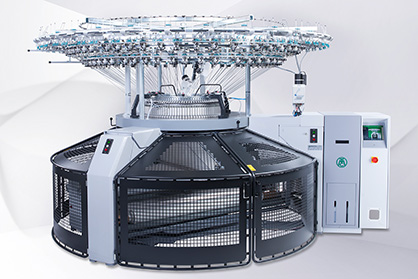
Relanit 3.2 HS: In Turkey, the machine is synonymous with single jersey fabric. © 2020 Mayer & Cie


Since July 2020, orders for Mayer & Cie. circular knitting machines have bounced back again. Ahmet M. Ög?retmen sees an interplay of reasons for this recovery. The main reason, he says, is the low exchange rate of the Turkish lira, which has boosted exports of ready-made textiles. The Turkish daily Hürriyet reports, with reference to the Turkish state news agency, 11 percent year-on-year growth in August 2020. The most important export markets, the newspaper says, are Germany, the UK and Spain. Between them, they account for around half of exports totalling € 1.27 billion.* “This demand must be fulfilled,” Ög?retmen says. “That leads to investment in machinery by manufacturers.”

Relanit is synonymous with single jersey

The machines of choice for Turkish knitwear manufacturers are regularly Mayer & Cie. machines. The long-established German firm’s share of the Turkish market is substantially higher than in other markets. The manufacturer’s position is particularly strong in the market for plain single jersey fabrics, with the Relanit 3.2 HS being the machine of choice. It achieves an extraordinarily high level of productivity, especially in processing elastomer yarns. It also handles a wide range of yarns reliably.


“Interlock is Mayer & Cie.”

Mayer & Cie. is the clear leader in the second major circular knitting discipline, rib and interlock fabrics. “Interlock is Mayer & Cie.,” says Ahmet M. Ög?retmen, putting it in a nutshell. The machines used for double jersey fabrics are the OV 3.2 QCe, the D4 2.2 II and the D4 3.2 II. The OV 3.2 QCe knits interlock, 8-lock structures, spacers and fine gauge with 3.2 systems. The D4 2.2 II is another stalwart for rib, 8-lock and interlock. The 8-lock D4 3.2 II is the machine of choice for firms that want to manufacture structures such as Piqué, Punto di Roma or Thermal in addition to interlock. 
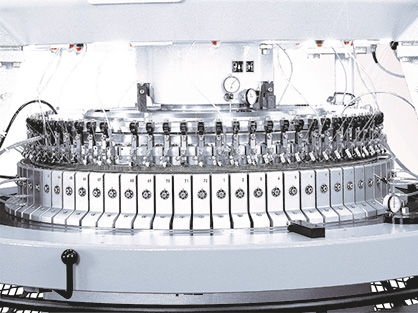
Machine head of the D4 2.2 II, a very popular interlock machine by Mayer & Cie. © 2020 Mayer & Cie


The MBF 3.2 is another top seller in Turkey. A three-thread fleece machine, it knits fabrics for sports- and leisurewear such as hoodies and is very much in keeping with the trend in home office year 2020. “Comfortable clothing is circular knitted,” says Ahmet M. Ög?retmen, “and we benefit from that of course.”

The world’s most state-of-the-art machine parks are in Turkey

Another advantage is the modernity of the Turkish machine park, which is doubly attractive in view of Turkey’s weak currency. Says Mayer Mümessillik general manager Ög?retmen: “In the past 10 to 20 years there has been very heavy investment in high-quality machines. As a consequence we have the world’s youngest and most up-to-date production facilities.” Combined with geographical proximity to the main export markets in Europe that should prove a growth driver in the years ahead – and keep demand for Mayer & Cie. machines brisk and high.
More News from Mayer & Cie. GmbH & Co.

#ITM 2026

Mayer & Cie. Global is getting ready for ITM 2026

ITM 2026 marks the beginning of a new chapter for Mayer & Cie. Global. For the first time, the company will present itself to the international textile machinery industry in its new setup: combining proven circular knitting technology engineered in Germany with a clear commitment to its Albstadt headquarters and an internationally shaped, agile management approach.

#Knitting & Hosiery

Closing completed – Mayer & Cie. Global starts business operations

The future of the Mayer & Cie. brand has been secured: Following the successful completion of the purchase agreement for assets in the circular knitting machinery segment of the German traditional company Mayer & Cie., which was signed in February this year, the brand will continue to exist. The transfer of these assets to the new owner, Xu Hongjie, was formally completed yesterday afternoon. This clears the way for the resumption of business operations at the Albstadt site.

#Knitting & Hosiery

Huixing acquires insolvent Mayer & Cie.

Insolvency proceedings for the circular knitting and braiding machine manufacturer Mayer & Cie. were opened on December 1, 2025. Immediately following the opening of proceedings, the complete cessation of business operations was initiated. Most employees were subsequently given notice effective the end of February 2026. The production of the remaining orders in the circular knitting segment is expected to be completed by the end of the month. As early as December 2025, Mayer & Cie.’s braiding machine division was sold to an Italian investor.

#Knitting & Hosiery

Mayer & Cie. to shut down after failed search for investor – 270 jobs affected

Mayer & Cie., the long-established German manufacturer of circular knitting and braiding machines, will cease operations after its international search for an investor ended without success. The company, based in Albstadt-Tailfingen, had been undergoing insolvency proceedings in self-administration since its filing on 23 September 2025. As Schwarzwälder Bote reports, the insolvency court has now formally opened the proceedings, triggering the decision to wind down the business in an orderly process.

More News on Knitting & Hosiery

#ITM 2026

KARL MAYER presents a textile TEXTRONIC® innovation at ITM 2026

With highly efficient machines and continuous textile innovations, KARL MAYER underscores its role as a reliable partner for discerning top-tier customers. Just in time for ITM 2026 in Istanbul, the industry leader is introducing a true innovation: an eyelash lace with its characteristic fringed look – combined with a previously unattainable 4-way stretch. While the established fabric could until now only be produced as rigid version or with one-dimensional stretch, the new elasticity in both dimensions expands the possibilities for cross-band panel fabrics.

#Knitting & Hosiery

TM WEFT, 270" – More width, more design freedom for the fashion world

KARL MAYER is expanding its successful TM WEFT series with an innovative model that opens up new possibilities, particularly in the fashion & apparel sectors. With a working width of 270", this new machine with weft-insertion not only offers significantly higher output than its narrower counterparts but is also specifically tailored to the demands of dynamic clothing market – particularly in China and Türkiye. A well-thought-out upgrade also ensures even greater design versatility.

#Knitting & Hosiery

“We need to move away from the price trap and return to a value-driven mindset.”

With its new Textile Innovation Center, KARL MAYER is sending a strong signal for innovation, collaboration, and the future of textile applications. In this interview, Karl Josef Mayer discusses new opportunities in warp knitting, the processing of staple fibres, recycling, the changing role of machinery manufacturers, and why the textile industry must once again focus more strongly on the value of textiles. by Oliver Schmidt

Latest News

#Research & Development

Carbon-ceramic hybrid fibre proves its worth – NRW Minister for Science Mona Neubaur congratulates ITA start-up TERNAfil

MAXCarbon technology, a novel carbon-ceramic hybrid fibre developed by ITA spin-off TERNAfil, secured third place at the HIGH-TECH.NRW Demo Day on the TÜV NORD campus in Essen. The technology combines the strength of carbon fibres with the temperature and corrosion resistance of ceramic materials. Mona Neubaur, Minister for Science in North Rhine-Westphalia, congratulated the team on their success and on winning prize money of 4,000 euros.

#

DTF vs DTG Printing - The technologies shaping today’s custom merchandise market

From sportswear to branded tote bags, custom merchandise continues to grow in popularity across sectors, driving print shops to cater to short runs, personalisation, and rapid turnaround. As print providers look to this market, two printing technologies often stand out: Direct‑to‑Film (DTF) and Direct‑to‑Garment (DTG). Each offers its own benefits, and understanding these differences helps determine the most suitable production method for print service providers.

#Associations

Towards pragmatic and harmonised labelling in the EU

EDANA, alongside 14 European associations, urges the European Commission and Member States to adopt a pragmatic approach for the future harmonised packaging labels, in line with the EU’s agenda for the EU Single Market, simplification and competitiveness. The system should rely on text-free pictograms, available in achromatic or monochromatic versions matching the packaging palette, with the possibility of using digital labelling as a core element. Our associations represent manufacturers of consumer goods across Europe.

#Spinning

"We will become a recycling powerhouse"

The textile industry is now in its fourth consecutive year of crisis, while automation, artificial intelligence and recycling are reshaping the rules of the game. In this interview, Rieter CEO Thomas Oetterli discusses the first signs of a market recovery, reflects on his first three years at the helm of the company, explains the integration of Barmag, outlines Rieter’s vision of the fully automated spinning mill and highlights the strategic importance of recycling. In doing so, he explains why the new Rieter Group aims to play a leading role in transforming the textile value chain into a circular economy.

TOP