[pageLogInLogOut]

#Industry 4.0 / Digitalization

Beyond Big Data and tailored for textiles
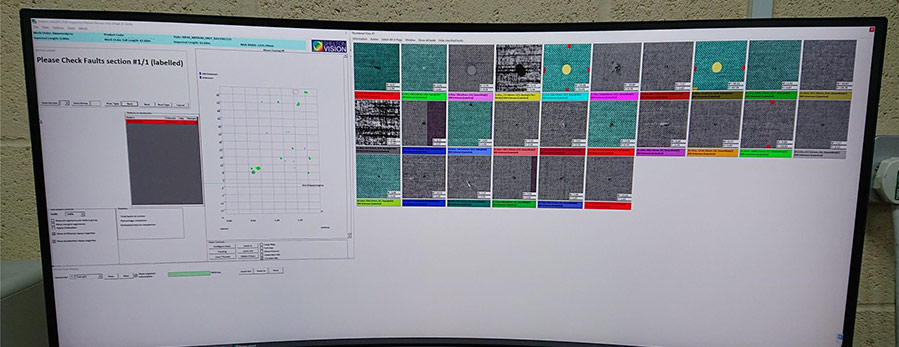
Typically there may be be over 100 fabric defect types that need to be accurately detected, classified and graded in real time. © 2023 Shelton Vision
Over the past three years, a dedicated AI development team at BTMA member Shelton Vision has been developing tailored machine learning solutions for the textiles industry.

The aim has been to elevate the detection process and the accuracy of naming and grading subtle defects in textiles, in real time within production environments.

“Big Data ‘off-the-shelf’ systems such as those behind technolgies like facial recognition and Google Maps involve reading many thousands of single images each second and simply take too long to accumulate sufficient data for what’s required in this specific case,” says Shelton Vision CEO and Managing Director Mark Shelton. “A feature of the textile industry is that in many sectors, the product range changes several times within a year and it is not uncommon to have to inspect hundreds, if not thousands of different styles in a year based on precise settings.”

In terms of defect types, he adds, there may typically be over 100 that need to be accurately detected, classified (named) and graded in real time.

“Added to this is the need to ‘filter out’ the random occurrence of ‘non defects’, such as loose threads, lint and dust on the surface – the number of which can be higher than actual defects – and it is clear that a bespoke system is required.”

The development team has consequently established metadata for identifying defect properties, enabling the successful identification of faults from a much smaller number of images.

“The system employs a unique combination of machine learning for automated style training and novel algorithms for defect detection, to provide high quality images for the AI real time defect classification and grading software,” Shelton explains. “Due to the inherent variation in fabric features – raw materials, construction, texture, colour and finishes, as well as the differing product quality standards in value chains and the regional variations in what defects are called – our AI engine uses models built for each individual company or group of companies, or product value chain.”

The AI models are constructed so that the user operatives can populate them with their own data produced by the vision system or by obtaining defect images from another imaging source (eg a mobile phone camera).

The occurrence of defects is sporadic and many defect types occur infrequently, although when they do, they can have severe consequences. These scenarios re-enforce the need for the AI engine to be quickly set up and able to operate accurately with limited data sets of typically between 30 and 50 good quality images per defect type.

A further feature is a tool enabling the user to periodically ‘clean up’ the AI data during the set up phase. This is used to resolve conflicting data and to correct mis-named images.

Generally, the highest cost component of fabric production is the raw material and in addition to finished product inspection, a cost effective use for vision systems is in process operation.


“There is a need for the real time detection of defects that are being created in separate processes, such as printing or coating and for real time automated systems that can accurately determine the defects and their severity and provide a reliable signal for an operative to rectify the issue, This can result in considerable savings.

Prior to Shelton introducing powerful customised machine vision and real time defect classification, the only systems available were those that required manual sifting through vast numbers of images, which included both real defects and ‘non defect’ images. The task was very often overwhelming and did not provide much benefit beyond manual fabric inspection.
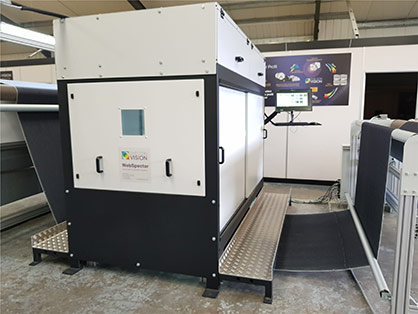
© 2023 Shelton Vision


The Shelton Vision AI development has been completely self-funded and there are many systems already operating in the field in demanding textile applications, as business critical systems that require robust design to provide the needed up time.

“Studies show that the intelligent fabric inspection systems of Shelton Vision’s WebSpector with tailored AI solutions out-perform human inspection in terms of speed, accuracy and consistency,” says Jason Kent, CEO of the British Textile Machinery Association (BTMA). “In addition, there is a global drift of people away from the type of activity that fabric inspection requires, making the company’s technology increasingly valuable to forward-looking mills.”

Founded in 1940, the British Textile Machinery Association actively promotes British textile machinery manufacturers and their products to the world. The non-profit organisation acts as a bridge between its members and the increasingly diverse industries within the textile manufacturing sector.




More News from TEXDATA International

#Recycling / Circular Economy

textile.4U publishes special edition “Top 100 Textile Recycling Companies 2025”

With a comprehensive 176-page special edition, textile.4U is dedicating its latest issue entirely to one of the most dynamic and influential topics in today’s textile industry: textile recycling. The new issue, published exclusively in high-quality print, presents the Top 100 textile recycling companies researched and selected by TexData – organizations that already play a key role in the transition to circular textiles or are expected to have a significant impact in the near future.

#Recycling / Circular Economy

Responsible Textile Recovery Act of 2024 signed by Governor

Senator Josh Newman (D-Fullerton) is proud to announce that Senate Bill 707 (SB 707), the Responsible Textile Recovery Act of 2024, has been signed into law by the Governor of California, Gavin Newsom. This groundbreaking legislation establishes the country’s first Extended Producer Responsibility (EPR) textile recycling program, marking a significant step forward in the state’s efforts to combat waste and promote sustainability.

#Textiles & Apparel / Garment

Modtissimo promotes sustainability with 28 coordinates in the Green Circle

Modtissimo is proving more and more to be a textile and clothing show that delivers the latest innovations in the area of sustainability, with the iTechStyle Green Circle being the main showcase for companies' creations. In this 60+4 edition, taking place on 12 and 13 September, 28 coordinates will be exhibited in a section organised by CITEVE and curated by Paulo Gomes.

#Europe

The EU and Egypt team up to mobilise private sector investments at Investment Conference and sign a Memorandum of Understanding underpinning €1 billion in macro-financial assistance for Egypt

At the EU-Egypt Investment Conference, co-organised by the EU and the Government of Egypt on 29-30 June, the EU and Egypt are teaming up to intensify private sector investments in Egypt. They are also signing a Memorandum of Understanding (MoU) for the disbursement to Egypt of up to €1 billion in Macro-Financial Assistance.

More News on Industry 4.0 / Digitalization

#Industry 4.0 / Digitalization

Lenze receives IEC 62443-4-1 certification: TÜV Rheinland confirms cyber-secure development process

Lenze SE has been certified according to IEC 62443-4-1 since November 2025. TÜV Rheinland thus confirms that Lenze meets the requirements of this internationally recognized standard for a secure development process for industrial automation and drive products. The certification is an important milestone on the way to implementing the EU Cyber Resilience Act (CRA), which will become mandatory for machine manufacturers and their suppliers from December 2027.

#Industry 4.0 / Digitalization

Mango joins TextileGenesis pioneering traceability solution, a Lectra company, for a transparent value chain

Mango, one of the leading international fashion groups, has joined TextileGenesis, the pioneering traceability solution for the fashion and textile industries, to trace their natural and animal fibers, synthetics, man-made cellulosic fibers and leather. TextileGenesis, a Lectra company, offers a complete and secure cutting-edge technology with its six-dimensional (6D) offering and unique “fiber forwards” approach. Mango, has long been committed to maintaining a fully transparent supply chain, and TextileGenesis will reinforce this commitment.

#Sustainability

Cascale’s Higg FEM 2025 update unlocks new data-driven insights

Refreshed Higg FEM 2025 delivers data-driven insights, sharper emission metrics, and enhanced verification to accelerate industry-wide progress.

#Associations

Winners of the ITMF Start-up Award 2025

The winners of the ITMF Start-up Awards 2025 will present their business models at the upcoming ITMF & IAF Conference 2025 which will be held from 24 - 25 October in Yogyakarta, Indonesia and will be co-hosted by the Indonesia Textile Industry Association (API).

Latest News

#Spinning

First PA66 spinning plant with EvoQuench successfully commissioned

With the successful commissioning of a multi-digit PA66 spinning line for microfiber yarns, Chinese textile company Shandong Nanshan Fashion Technology Co., Ltd. has added yarn production to its textile value chain.

#Knitting & Hosiery

SHIMA SEIKI returns to ShanghaiTex

Leading flat knitting solutions provider SHIMA SEIKI MFG., LTD. of Wakayama, Japan, together with its Hong Kong and Chinese market subsidiary SHIMA SEIKI (HONG KONG) LTD., will exhibit at the ShanghaiTex 2025 exhibition (Booth No.: Hall N3, Booth A20) held in Shanghai, China this month. This marks the return of SHIMA SEIKI to ShanghaiTex after a 14-year hiatus, its last exhibit at the show having been in 2011.

#Research & Development

Fraunhofer CCPE presents the “Monomaterial Design Set” – Innovative solutions for circular product design

Composite materials made from different types of plastic often extend the lifetime of products but make recycling more difficult in the circular economy. That is why Fraunhofer CCPE has developed the “Monomaterial Design Set”. This new approach helps to reduce the variety of plastics used in durable products and offers circular solutions for designers and product developers.

#Man-Made Fibers

arena introduces renewable LYCRA® EcoMade fiber in its latest swimwear collection

Italian swimwear specialist arena has unveiled a new collection that brings sustainability and performance even closer together. Launched on December 4, the line features swimsuits made from recycled nylon and renewable LYCRA® EcoMade fiber — the first time the bio-based spandex has been used commercially in swimwear.

TOP