[pageLogInLogOut]
TRÜTZSCHLER SPINNING - FROM WASTE TO VALUE

#Industry 4.0 / Digitalization

Springboard for artificial intelligence: Evonik becomes a member of the MIT-IBM Watson AI Lab to accelerate innovation with AI

© 2021 Evonik
Evonik expands cooperation with IBM in the field of digitization. The two companies extend their strategic partnership ahead of schedule until 2025.
  • Evonik, IBM Research, and US university MIT explore potential industrial applications
  • Admission to the research program's advisory board
  • Early extension of strategic partnership with IBM


Evonik expands cooperation with IBM in the field of digitization. The two companies extend their strategic partnership ahead of schedule until 2025. Taking this decision early creates more opportunities for longer-term projects.

Furthermore, Evonik will be involved in the research and development of artificial intelligence at the Massachusetts Institute of Technology (MIT): Evonik is the world's first chemical company to participate at the MIT-IBM Watson AI Lab.

In this unique interplaying at the MIT campus in Cambridge, Massachusetts, experts from academia and industry are investigating the potential uses and effects of artificial intelligence. "Bright minds from science and business are working jointly together on digital progress. We are delighted to be part of it," says Henrik Hahn, chief digital officer (CDO) of Evonik.

AI is a useful tool for innovation and improvements in the chemical industry. Evonik looks forward to joining the MIT-IBM Watson AI Lab and its advisory board to contribute its ideas and applications across materials discovery, formulation technology, knowledge management and market analysis to advance overall applications of AI in the chemical industry. "The work on artificial intelligence is also a litmus test of what digital systems can do: For example, we are looking at how decisions can be made better, more systematically and faster with the help of algorithms," says Hahn. "Ultimately, it's about the value AI can add to the company," he says.


Hahn takes a positive view of the strategic partnership with IBM, which has already been active since 2017: "The joint work has helped to drive forward digital transformation in a targeted manner. Evonik sees itself as a pioneer in digitization in the chemical industry. Our partnership with IBM and our new commitment to the MIT-IBM Watson AI Lab further substantiate this claim."

As part of the partnership, Evonik and IBM have already investigated new possibilities to create a collaborative intelligence between humans and machines, in pilot projects. Experts no longer have to search for valuable information like for a needle in a haystack. Instead, decades of knowledge are now easy to search and to analyze intuitively. New connections between data can now be found. Chemist can intuitively explore and compare formulations and their related properties to come up with ideas for new products.

Evonik and IBM have also succeeded in building Artificial Intelligence that will further accelerate the research for new materials. In close collaboration with IBM Research a Deep Neural Network was developed and trained that predicts properties or new formulations for high-performance polymers. These predictions help researchers like a compass pointing them in promising directions for new products and customer solutions.



More News from TEXDATA International

#Texprocess 2026

Texprocess 2026: Automation, digitalisation and AI redefine textile processing

Making investment decisions in textile processing has become significantly more demanding. Increasing energy costs, a shortage of skilled labour and ongoing geopolitical uncertainties are compelling companies to focus on technologies that deliver clear gains in efficiency and process reliability. This applies equally to apparel manufacturing and to the processing of technical textiles and high-performance materials. As a result, modernisation initiatives are assessed more carefully – even as the need to upgrade production systems continues to intensify.

#Techtextil 2026

Techtextil 2026: Between innovation pressure & market reality

From 21 to 24 April 2026, Techtextil in Frankfurt am Main will once again become the central meeting point for the international technical textiles and nonwovens industry. Running in parallel, Texprocess will focus on the industrial implementation of textile processing technologies as the leading platform in this field. Together, the two trade fairs form a closely integrated presentation and working platform along the entire textile value chain – from material development to finished applications.

#Techtextil 2026

Between geopolitical pressure and industrial resilience

In this interview, Dr. Janpeter Horn (VDMA) discusses the current challenges facing textile machinery manufacturers, shaped by geopolitical tensions, regulatory developments and subdued investment. He also outlines why innovation strength, integrated solutions and strategic positioning remain key to global competitiveness.

#Texprocess 2026

Between investment restraint and modernization pressure

Texprocess 2026 takes place in a complex market environment shaped by uncertainty and innovation pressure. In this interview, Elgar Straub (VDMA) explains why the trade fair is particularly relevant this year and which technologies are driving efficiency and competitiveness.

More News on Industry 4.0 / Digitalization

#Research & Development

Textilfabrik 7.0 launched: Mönchengladbach becomes a real-world lab for sustainable textile production

With the official kick-off event of the Textilfabrik 7.0 (T7), a major transformation project for the German textile and apparel industry has been launched in the Monforts Quarter in Mönchengladbach. At the “Textile Roundtable,” an event format organized by the Zukunftsagentur Rheinisches Revier, representatives from industry, research, politics, and the regional economy came together to jointly lay the foundation for CO₂-neutral, circular, and economically viable textile production in Germany.

#Man-Made Fibers

OnceMore® from Södra brings end-to-end traceability for circular Man-made Cellulosic Fibers (MMCF) using TextileGenesis

OnceMore® from Södra, the world’s first large-scale process for recycling blended fabrics into high‐quality dissolving pulp, will begin using TextileGenesis, a Lectra company, to strengthen traceability from raw material to retail across the value chain. OnceMore® produces dissolving pulp made from blended textile waste and wood sourced from responsibly managed Swedish forests. By integrating TextileGenesis, OnceMore® supports the growing need for verified data and secure, transparent tracking throughout increasingly complex supply chain.

#Denim

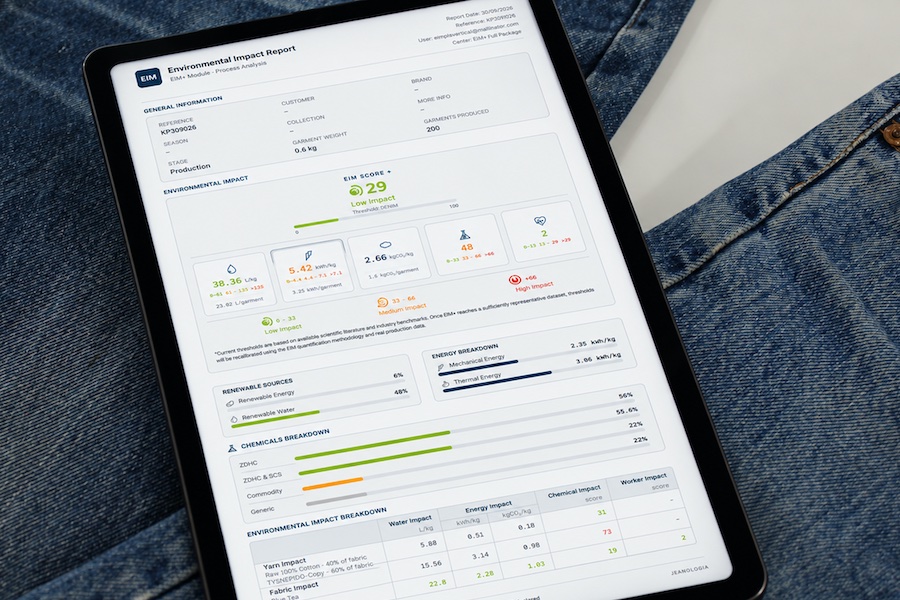
Jeanologia launches Billy

The new AI extracts precise laser designs from a garment image in minutes, transforming how vintage denim is recreated for production. If Jeanologia’s laser changed the way jeans were made at the end of the last century, its AI now takes the next step: moving from reproducing wear to designing it. / archive photo © 2026 Jeanologia

#Dyeing, Drying, Finishing

Monforts unveils interactive digital platform for textile finishers

Monforts has launched a new digital platform designed to give textile manufacturers faster, more intuitive access to the company’s finishing technologies, technical expertise and aftersales support worldwide.

Latest News

#Heimtextil 2027

Heimtextil celebrates Milan Design Week honoring partnerships with Patricia Urquiola and Alcova Milano

Heimtextil is represented at Milan Design Week with its strong design partners Patricia Urquiola and Alcova. At Villa Pestarini, the leading trade fair spotlighted its dynamic collaborations with acclaimed designer Patricia Urquiola and Alcova Milano.

#Texprocess 2026

Kornit Digital expands digital production into footwear and technical textiles with Presto MAX PLUS

Kornit Digital (NASDAQ: KRNT) (“Kornit” or the “Company”), a global pioneer in sustainable, on-demand digital fashion and textile production, today unveiled the Kornit Presto MAX PLUS, a new roll-to-roll system expanding digital manufacturing into footwear, automotive interiors, military camouflage, high-performance sportswear, and high-end furnishings. Debuting at Texprocess 2026 in Frankfurt, Presto MAX PLUS enables entirely new applications for on-demand textile production.

#Textile processing

NATULON® zipper series surpasses 50% of YKK’s global zipper sales

YKK Corporation (Headquarters: Chiyoda-ku, Tokyo; President: Koichi Matsushima; hereafter, YKK) announces that the global sales share of its NATULON® zipper series—zippers that incorporate recycled materials—has exceeded 50%.

#Smart Textiles

Covestro, FILK Freiberg, and OUT e.V. develop flexible, conductive polymer smart textile system

As the smart textiles market continues to grow across healthcare, personal protection, sportswear, and automotive applications, developers are seeking new ways to integrate electronic functionality directly into textiles, without the rigidity and complexity of conventional wiring. To address this challenge, FILK Freiberg Institute, an independent research institution with expertise in polymer coatings for textile applications, collaborated with Optotransmitter-Umweltschutz-Technologie (OUT) e.V. The joint project, funded under the German Industrielle Gemeinschaftsforschung (IGF) program of the Bundesministerium für Wirtschaft und Energie (BMWE), focused on developing flexible, conductive polymer surfaces for next-generation smart textiles.

TOP