[pageLogInLogOut]

#ITMA-Asia + CITME-2014

The HKS 2-M, with an optimised cost:benefit ratio, is premiered
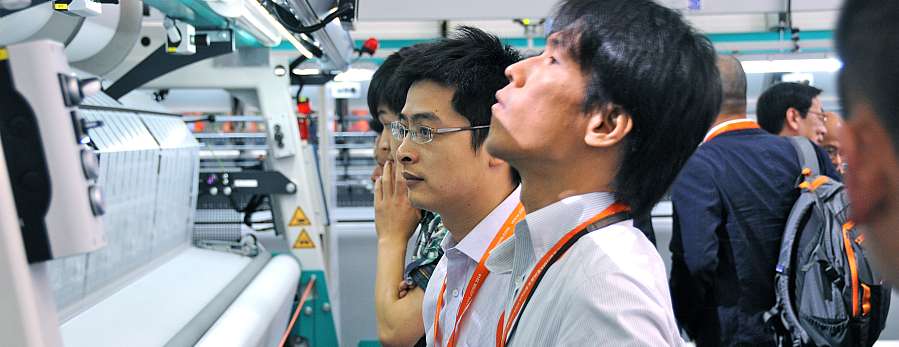
The HKS 2-M on the visitor’s focus at ITMA ASIA + CITME 2014 in Shanghai
Two-bar, high-speed tricot machines can now produce plain warp-knitted textiles even more efficiently. KARL MAYER launched the HKS 2-M onto the market at this year’s ITMA ASIA + CITME fair in June, thus presenting a machine that is roughly 20% faster than its predecessor.
At a working width of 180", the HKS 2-M can reach maximum speeds of 3,200 min-1. The version with a width of 210", which can operate at up to 3,000 min-1, is setting new standards. This increase in speed has been achieved by optimising the knitting motion and making the bars even lighter.

The HKS 2-SE is one of the models equipped with lighter knitting elements and was unveiled at the ShanghaiTex trade fair last year. In addition to increasing the speed, KARL MAYER’s engineers also focused on reducing the cost. Thanks to a number of clever modifications to the construction, the HKS 2-M is being offered at an attractive price. The 210"-wide machine is likely to be particularly well received by the market, thanks to its perfect cost:benefit ratio.

This flexible, medium-stroke machine is especially suitable for producing non-stretch fabrics with a low stitch number, loose yarn running, and gauges of up to E 32. These mainly include technical and semi-technical textiles, for example, mattress covers, velour fabrics for the furniture industry, nets, sports goods, shoe fabrics and printing grounds. But tulle, stylish, open mesh fabrics and plain fabrics for the clothing sector can also be produced on the HKS 2-M.

This all-round machine is also user friendly and operates reliably and accurately. This is due to its well-thought-out construction and its tried-and-tested components, such as the KAMCOS® computer platform, electronic speed control of the main drive, and electronic systems for controlling the fabric take-down and yarn feed.
More News from KARL MAYER Textilmaschinenfabrik GmbH

#Knitting & Hosiery

KARL MAYER's HKS 2-SE Expands Possibilities for Premium Stretch WARP KNITS

Warp knitted fabrics with a woven look are more in demand than ever in the fashion and apparel industries. Stretch WARP KNITS, in particular, impress with their freedom of movement, breathability, and virtually wrinkle-free wear – thereby opening up new style worlds such as smart casual or business casual. When it comes to the highly efficient production of premium-quality stretch WARP KNITS, the HKS 2-SE has long been the machine of choice. KARL MAYER’s best-selling tricot machine produces standard elastic fabrics characterized by high gauges, smooth, delicate surfaces, and a soft hand feel.

#Knitting & Hosiery

Footwear innovation enabled by warp knitting technology– insights from New Balance

The future of the athletic shoe is increasingly being shaped on warp knitting machines. For KARL MAYER, the footwear industry is one of the most important growth markets – and one of the sectors where innovative textiles can realize their full potential. In his keynote address at the opening of KARL MAYER’s TEXTILE INNOVATION CENTER in Obertshausen in April, Vishnu Prakash Muthusamy, Senior Textile and Materials Engineer at New Balance, explained the opportunities that warp knitting technology opens up for performance, sustainability, and faster development processes, and why textile manufacturers are transitioning from suppliers to development partners.

#ITM 2026

Positive market signals for KARL MAYER at ITM 2026

KARL MAYER is pleased with its participation as an exhibitor at ITM 2026. Faced with the challenges of rising domestic costs and fierce competition from low-priced Asian markets, the industry leader had traveled to Istanbul with mixed feelings – yet still draws a really positive conclusion.

#Knitting & Hosiery

STOLL: Agreement signed for the divestiture of selected assets

In early 2025, KARL MAYER announced its strategic decision to focus on its core business areas of WARP KNITTING, WARP PREPARATION, and TECHNICAL TEXTILES. As part of this move, the flat knitting machine business under the STOLL brand was discontinued and the production site in Reutlingen was closed in October 2025.

More News on ITMA-Asia + CITME-2014

Latest News

#Spinning

Ibrahim Fibres and Trützschler: A strong partnership enters its next phase with the TC 30Si

For more than two decades, Ibrahim Fibres and Trützschler have grown side by side, driven by a shared ambition to continuously improve spinning performance, strengthen technology leadership and set new benchmarks in the textile industry. Today, Ibrahim Fibres is a leading yarn and polyester staple fiber manufacturer in Pakistan. The company operates the largest number of Trützschler cards in the country, with more than 200 machines running across its mills in Faisalabad, and plays an important role in one of Asia’s largest textile industries.

#Digital Printing

USColorworks expands digital platform with Kornit Atlas MATRIX and Atlas MAX PLUS solutions

Kornit Digital Ltd. (NASDAQ: KRNT), a global pioneer in sustainable, on-demand digital fashion and textile production, today announced that USColorworks, a North Carolina-based apparel decoration and fulfillment company specializing in custom and on-demand printing for retail and promotional markets, has expanded its Kornit digital production platform with the addition of Atlas MATRIX and Atlas MAX PLUS systems to deliver high-quality, on-demand apparel across cotton, blended fabrics and polyester.

#Functional Fabrics

CovationBio introduces two new bio-based innovations at Functional Fabric Fair New York

Covation Biomaterials LLC (“CovationBio®”) is showcasing its two new bio-based innovations, Xatryx® and Sorona® elasterell-p fiber, at this year’s Functional Fabric Fair in New York City, July 7–9, 2026. Attendees can visit CovationBio at Booth #404 to explore this next generation of bio-based performance materials.

#Research & Development

Geotextiles made from recycled materials: GREEN leads the way into the industry

For the industry, recycled materials are creating new opportunities in geotextile production. In the GREEN project, the Fraunhofer Cluster of Excellence Circular Plastics Economy CCPE demonstrates that recycled polypro-pylene (PP), polyethylene terephthalate (PET), and high-density polyeth-ylene (HDPE) can be processed into nonwovens, fibers, and membranes that meet industrial requirements. This creates opportunities for use in existing production lines and new value chains in the geotextile market.

TOP