[pageLogInLogOut]

#Europe

Statement by President von der Leyen on energy

We are facing an extraordinary situation, not only because Russia is an unreliable supplier, as we have witnessed over the last days, weeks, months, but also because Russia is actively manipulating the gas market.

"I am deeply convinced that with our unity, our determination, our solidarity, we will prevail. And we have, over the last six months, during this war, very much increased our preparedness and we have weakened the grip that Russia had on our economy and our continent. We have done three things, as you recall: The first one was demand reduction. Demand reduction, so save gas in order to save it in the storage. We have created a joint storage, and this is really a success story, because now we are already at 82% with the joint storage in Europe. As you know, our goal was to reach 80% at the end of October. So we overshoot it, and that is good.

The second step that we have taken was: Diversify away from Russian fossil fuels. And you know that we have stopped the import of Russian coal. We are winding down the Russian oil. And we have been working very hard to diversify away from Russia towards other reliable suppliers, like for example the United States or Norway, Azerbaijan, Algeria and others. Actually today, Norway is delivering more gas to the European Union than Russia. And we were able, if you look at the cuts that Russia has done in gas, to completely compensate so far the gas imports through other reliable suppliers.

And of course, the third step is the most important one. This is massive investments in renewables. We have REPowerEU on the table. The renewables are cheap, they are home-grown, they make us independent. We will deploy renewables this year that are an equivalent to round about 8 billion cubic metres. So the renewables are really our energy insurance for the future.

But we also see that the Russian manipulation of the gas market has spillover effects on the electricity market. So there is, on the one hand, the Russian manipulation, but there are also other factors during this summer. We see the effects of climate change. We see the drought. Hydropower has been reduced by 26% in the European Union, and by 46% in Portugal. And we have the fact that we have less nuclear electricity in the European Union at the moment being. And this is the reason why we are now confronted with astronomic electricity prices for households and companies, and with an enormous market volatility. Therefore, we will put forward a set of five different immediate measures.

The first one is smart savings of electricity. What has changed over the summer, because of the elements I was just mentioning, is that we see that there is a global scarcity of energy. So whatever we do, one thing is for sure: We have to save electricity, but we have to save it in a smart way. If you look at the costs of electricity, there are peak demands. And this is what is expensive, because, in these peak demands, the expensive gas comes into the market. So what we have to do is to flatten the curve and avoid the peak demands. We will propose a mandatory target for reducing electricity use at peak hours. And we will work very closely with the Member States to achieve this.

The second measure: We will propose a cap on the revenues of companies that are producing electricity with low costs. The low-carbon energy sources are making in these times – because they have low costs but they have high prices on the market – enormous revenues. Revenues they never calculated with; revenues they never dreamt of; and revenues they cannot reinvest to that extent. These revenues do not reflect their production costs. So, it is now time for the consumers to benefit from the low costs of low-carbon energy sources like, for example, the renewables. We will propose to re-channel these unexpected profits to the Member States so that the Member States can support the vulnerable households and vulnerable companies.

The third measure is that the same goes, of course, for the unexpected profits of fossil fuel companies. Oil and gas companies have also made massive profits. Therefore, we will propose that there is a solidarity contribution for fossil fuel companies. Because all energy sources must help to overcome this crisis. Member States should invest these revenues to, as I said, support vulnerable households and vulnerable companies, but also to invest them in clean home-grown energy sources, as the renewables are, for example.
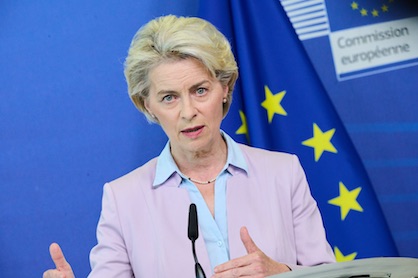


EU President Ursula von der Leyen (c) 2022 European Union


The fourth point is addressing the energy utility companies that must be supported to be able to cope with the volatility of the markets. Here, it is a problem of securing futures markets. And for that, liquidity is needed. These companies are currently being requested to provide unexpected large amounts of funds now, which threatens their capacity not only to trade, but also the stability of the futures markets. It is a liquidity problem. Therefore, we will help to facilitate the liquidity support by Member States for energy companies. We will update our temporary framework and enable thus state guarantees to be delivered rapidly.

The fifth and the last point: We aim at lowering the costs of gas. Therefore, we will propose a price cap on Russian gas. Of course, the objective is here very clear. We all know that our sanctions are deeply grinding into the Russian economy, with a heavy negative impact. But Putin is partially buffering through fossil fuel revenues. So here, the objective is: We must cut Russia's revenues, which Putin uses to finance his atrocious war in Ukraine. And now our work of the last months really pays off. Because, at the beginning of the war, if you looked at the imported gas, 40% of it was Russian gas, since a long time. Today, we are down to 9% only.

So these are the five measures that we will discuss with the Member States at the informal Energy Ministers Council on Friday. These are tough times, and they will not be over soon. But I am deeply convinced that, if we show the solidary, the unity and we have the determination for that, we have the economic strength, we have the political will, that then we shall overcome. "



More News from TEXDATA International

#People

Happy Holidays!

Dear reader, the year 2025 is drawing to a close. We are entering what we hope will be a peaceful holiday season, spending time with our families and taking a moment to pause and reflect. We hope we have been able to support you once again this year with relevant news and articles, and we look forward to surprising you with many innovations in the coming year. Enjoy the festive season, stay healthy, and we wish you a happy and joyful holiday season.

#Recycling / Circular Economy

textile.4U publishes special edition “Top 100 Textile Recycling Companies 2025”

With a comprehensive 176-page special edition, textile.4U is dedicating its latest issue entirely to one of the most dynamic and influential topics in today’s textile industry: textile recycling. The new issue, published exclusively in high-quality print, presents the Top 100 textile recycling companies researched and selected by TexData – organizations that already play a key role in the transition to circular textiles or are expected to have a significant impact in the near future.

#Recycling / Circular Economy

Responsible Textile Recovery Act of 2024 signed by Governor

Senator Josh Newman (D-Fullerton) is proud to announce that Senate Bill 707 (SB 707), the Responsible Textile Recovery Act of 2024, has been signed into law by the Governor of California, Gavin Newsom. This groundbreaking legislation establishes the country’s first Extended Producer Responsibility (EPR) textile recycling program, marking a significant step forward in the state’s efforts to combat waste and promote sustainability.

#Textiles & Apparel / Garment

Modtissimo promotes sustainability with 28 coordinates in the Green Circle

Modtissimo is proving more and more to be a textile and clothing show that delivers the latest innovations in the area of sustainability, with the iTechStyle Green Circle being the main showcase for companies' creations. In this 60+4 edition, taking place on 12 and 13 September, 28 coordinates will be exhibited in a section organised by CITEVE and curated by Paulo Gomes.

More News on Europe

#Nonwovens

EDANA wraps up its Sustainability & Policy Forum 2025: Uniting the industry and EU policymakers to navigate the future of nonwovens

Against a backdrop of rapidly evolving environmental legislation, the EDANA Sustainability & Policy Forum 2025 concluded the past week in Brussels, marking a step forward in the dialogue between the nonwovens industry and European policymakers. Held from 9-10 December at the historic Residence Palace, the two-day event successfully brought together business leaders, sustainability experts, and EU officials to address the dual challenges of circularity and industrial competitiveness.

#Europe

Level playing field at stake: Europe’s textile industry demands decisive action

Yesterday, the European Parliament took a welcomed and necessary step by voting a resolution calling for stronger market surveillance, reinforced customs controls and faster enforcement of the Digital Services Act in case of infringements. For Europe’s textile and clothing manufacturers, this is the first political acknowledgement that the system is broken — and that enforcement must finally match the scale of the problem.

#Europe

EU aims to advance global clean transition and implementation of the Paris Agreement at UN's COP30

At the COP30 UN Climate Change Conference in Belém, Brazil, from 10-21 November, the European Union will reaffirm its strong commitment to climate action. The EU is dedicated to paving the way toward a global transition that is clean, fair, and resilient. This transition aims to provide clean and affordable energy, create business opportunities, stimulate growth, enhance industrial competitiveness, and leave no one behind.

#Nonwovens

EDANA calls for clarity and consistency on the EU Deforestation Regulation (EUDR)

EDANA, the international association representing the nonwovens and related industries, considers the European Commission’s recent U-turn on the EU Deforestation Regulation (EUDR) a missed opportunity to deliver a clear and effective framework to help effectively fight global deforestation.

Latest News

#Weaving

Lindauer Dornier announces leadership transition in weaving machine business

After more than ten successful years at Lindauer DORNIER GmbH, Mr Wolfgang Schöffl will leave the family-owned company at the end of the year to enter well-deserved retirement.

#Heimtextil 2026

Texpertise Focus AI: Messe Frankfurt puts Artificial Intelligence centre stage at its international textile and apparel trade fairs

Under the banner 'Texpertise Focus AI, Messe Frankfurt will place a strong emphasis on Artificial Intelligence (AI) across its international textile and apparel trade fairs from 2026 onwards, setting a future-shaping signal for the industry. The initiative highlights the responsible use of AI along the entire textile value chain, from fibre production to the point of sale. The programme will launch at Heimtextil in Frankfurt in January 2026.

#Technical Textiles

Autoneum and Polestar set new benchmarks for passenger experience and sustainability

As the global market leader in sustainable acoustic and thermal management, Autoneum is a key supplier of interior and exterior components for the highly anticipated Polestar 5 model. The successful collaboration between Autoneum and Polestar marks a significant milestone in sustainable automotive engineering: the electric grand tourer sports car features several innovations in lightweight, fully recyclable polyester-based components that ensure a superior driving experience. Polestar 5 was revealed at the IAA Mobility 2025 in Munich and is available in 24 markets.

#Natural Fibers

Cashmere producers stress the importance of The Good Cashmere Standard®

At the invitation of the Aid by Trade Foundation (AbTF), over 70 experts from the cashmere production and supply chain, as well as other specialists, met at the GCS Unit Meeting in Shanghai, China to discuss the progress and new objectives of The Good Cashmere Standard (GCS). The meeting focused on implementation and verification of the standard, important aspects of animal welfare and the importance of the standard in the global textile market.

TOP