[pageLogInLogOut]

#Dyeing, Drying, Finishing

Inditex and Jeanologia develop Air Fiber Washer, the first industrial air system designed to reduce microfiber shedding in textiles
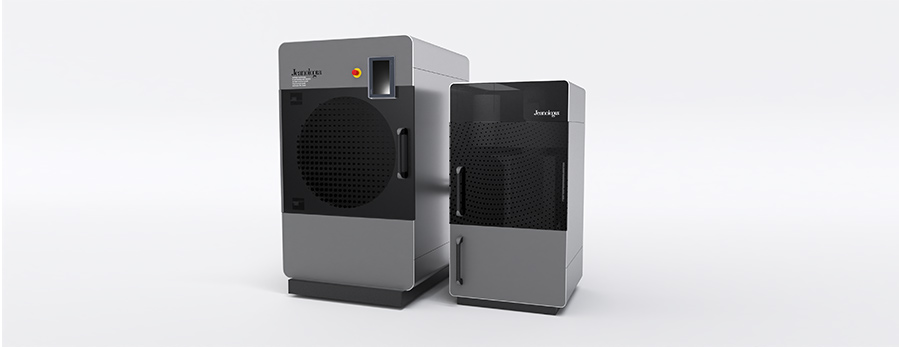
Air Fiber Washer © 2023 Jeanologia
Inditex and Jeanologia have jointly developed Air Fiber Washer, the first industrial air system designed to extract microfibers during garment fabrication and thus reduce subsequent shedding in domestic laundering.

• Air Fiber Washer extracts up to 60% of microfibers during garment manufacturing by using dynamic airflow in combination with microfiltration to capture microfibers.

• Each industrial Air Fiber Washer machine will allow for the collection of up to 325 kg of microfibers per year for potential repurposing.

• This technology will be shared throughout the industry without any as part of both companies' commitment to mitigate the release of microfibers.


Microfibers are small particles with a length of less than 15 millimeters that are shed from textiles, especially during initial domestic washes. This is one of the great challenges for the textile industry due to existing limitations in current industrial capacities for water treatment.

Air Fiber Washer - which will be presented 8-14 June at the ITMA international textile technology fair in Milan - was created with the aim of reducing the release of microfibers in initial washes thanks to a new industrial pretreatment that effectively removes these particles.

With innovative technology, this new development makes it possible to reduce microfiber shedding by up to 60% through the use of air, without employing water or thermal energy and without compromising aspects such as fabric quality. Its dynamic air flow extracts the microfibers from the garments and collects them in a containment bag for potential recycling, moving us closer towards a circular industry with zero waste. Each Air Fiber Washer will collect up to 325 kg of microfibers per year, depending on the type of fabric, and machine conditions such as loading and movement.


A technology placed at the entire textile industry’s disposal

This technology will be shared with the industry with no strings attached, as part of the effort of both companies to mitigate microfiber shedding.

Enrique Silla, President of Jeanologia, emphasized that the goal of Jeanologia, a leading company in the development of eco-efficient technologies, is to offer cost-neutral technological solutions to manufacturers, brands and retailers so that they can act immediately.

"Working with Inditex is a great experience and a source of pride. This initiative is just the first step in the mission we have set for ourselves to minimize the impact of microfiber shedding in textile manufacturing and in the product life cycle," Silla said.

Javier Losada, General Director of Sustainability at Inditex, emphasized that "we must promote innovative solutions that allow us to respond to the challenges of our industry, such as microfiber shedding. This project with Jeanologia is an example of how we can collaborate with other industries to limit our impact on resources such as water right from the manufacturing stage.”

INDITEX

Inditex is a global fashion retail group, comprising seven brands (Zara, Pull&Bear, Massimo Dutti, Bershka, Stradivarius, Oysho and Zara Home) with a presence in over 200 markets. Its business model is focused on satisfying customer demand in a sustainable way. Inditex is committed to achieving climate neutrality by 2040.

Jeanologia: working for the world for over 25 years

Since 1994 their mission has been to create an ethical, sustainable and eco-efficient industry, marking a new era through sustainability, digitalization and automation.

Its MissionZero program transforms the way jeans are made to eliminate 100% of the discharge generated in the manufacture and finishing of Blue Jeans, from the fabric to the final garment.


The company is leading the transformation of the industry with its disruptive technologies: laser, G2 ozone, e-Flow, SmartBoxes, Colorbox and H2 Zero, capable of increasing productivity, reducing costs, water and energy consumption, and eliminating harmful emissions and discharges, guaranteeing zero pollution.
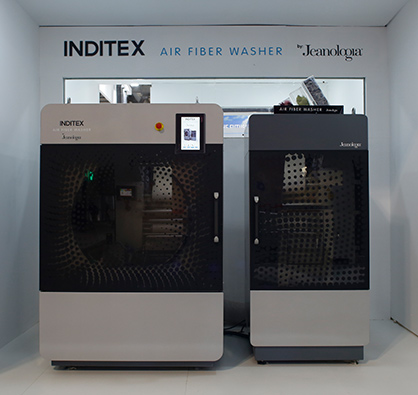

Air Fiber Washer © 2023 Jeanologia


More News from TEXDATA International

#ITM 2026

ITM 2026: The new geography of textile production

New production hubs are emerging across North Africa and Central Asia, while Türkiye is accelerating its transformation toward higher-value, technology-driven and more sustainable textile manufacturing.

#Research & Development

“Production is a product”

From technical textiles and AI-driven robotics to the limitations of textile circularity: Professor Dr Thomas Gries looks back on more than two decades of development at ITA Aachen. In the interview, he explains why production technology remains a decisive success factor, discusses international collaborations and innovation ecosystems, and shares his views on the transformation of production landscapes and the challenges facing an increasingly regulated industry.

#Knitting & Hosiery

“We need to move away from the price trap and return to a value-driven mindset.”

With its new Textile Innovation Center, KARL MAYER is sending a strong signal for innovation, collaboration, and the future of textile applications. In this interview, Karl Josef Mayer discusses new opportunities in warp knitting, the processing of staple fibres, recycling, the changing role of machinery manufacturers, and why the textile industry must once again focus more strongly on the value of textiles. by Oliver Schmidt

#Associations

“Innovation, resilience and international experience remain the great strengths of the Swiss textile machinery industry”

Geopolitical uncertainty, growing competitive pressure from China, new free trade agreements and the shift towards a circular economy are currently reshaping the global textile industry. In this interview, Cornelia Buchwalder discusses the current mood within the Swiss textile machinery sector, the industry’s distinctive innovative strength, new market opportunities in India and Asia, and the technological trends that could shape the upcoming trade fair cycle leading up to ITMA 2027.

More News on Dyeing, Drying, Finishing

#Dyeing, Drying, Finishing

Ferraro S.p.A. acquires the “Finishing” business unit of Cibitex S.r.l.

Ferraro S.p.A. and Cibitex S.r.l. are pleased to announce the completion of the agreement pursuant to which Ferraro S.p.A. has acquired the “Finishing” business unit of Cibitex S.r.l., specialized in the development and manufacturing of technological solutions for textile finishing.

#ITM 2026

New Monforts systems deliver round-the-clock production for Kipaş

As a valued Monforts customer for many years, Türkiye’s Kipaş Textile has just installed a new Thermex dyeing range and a Monfortex sanforizer at its new dyeing and finishing plant in Kahramanmaraş.

#ITM 2026

SETEX turns dyeing and finishing data into daily production control

At ITM 2026, SETEX will show how textile mills can use machine, recipe, quality and energy data for more reliable daily production decisions — not as another reporting layer, but as part of the running dyeing and finishing process. With OrgaTEX X3 MES, E390x/C390x controllers, CamCOUNT and FabricInspector Portable, SETEX connects planning, machine execution and fabric-related quality insight within existing mill structures.

#Dyeing, Drying, Finishing

Tradition and Innovation – Phoenox Textiles Ltd. relies on state-of-the-art carpet back-coating line from Brückner

For more than 70 years, Phoenox Textiles Ltd. has been synonymous with quality, reliability, and inno-vation in the textile industry. Founded in 1954 in Huddersfield (Yorkshire, UK), a region with a long tradition in textiles, this family-owned business has continued to evolve without losing sight of its roots. Today, in its fourth generation under the leadership of the Mosley family, Phoenox successfully combines decades of experience with a clear, forward-looking corporate strategy.

Latest News

#Spinning

Rieter sees Barmag integration on track as orders and sales rise

The first half of 2026 was shaped by the successful completion of the largest acquisition in Rieter’s history. The Man-Made Fiber Division enables entry into the growth segment of man-made fibers and sustainably strengthens Rieter’s market position in the Asia region. The expanded Group is now the world’s leading system supplier for the processing of natural and man-made fibers. In the first half of the year, initial cost savings in material costs and operating expenses have already been realized. The targeted synergies are expected to amount to at least CHF 20 million by the end of the 2028 financial year. Due to the completion of the acquisition on February 2, 2026, the first half of the year for the Man-Made Fiber Division only amounts to five months.

#Knitting & Hosiery

Groz-Beckert at Igatex 2026

From October 15 to 18, 2026, Groz-Beckert will present its latest innovations and solutions across the product areas of Knitting, Weaving, Sewing and Spinning at Igatex in Pakistan (Hall 1, Booth A-1-08).

#Natural Fibers

Better Cotton Initiative multistakeholder event in US unpacks regenerative agriculture potential

The Better Cotton Initiative (BCI), in collaboration with Texas-based partner, Quarterway Cotton Growers, will expand upon its annual US field event to relay the vast potential of regenerative agriculture through an immersive experience of tours and demonstrations.

#Sustainability

bluesign appoints Hanane Taidi as CEO to lead next phase of global impact

bluesign, which partners with the textile industry to reduce adverse impact across the value chain, appoints Hanane Taidi as Chief Executive Officer, marking a pivotal moment as the company builds on its leadership amid rapid industry change.

TOP