[pageLogInLogOut]
techtextil 21.-24.4.2026 FRANKFURT/MAIN Peter Chance. The most important guest at the fair - besides you.

#Techtextil 2026

Gebr. Otto highlights versatility at Techtextil with regional supply chains, yarn innovations and new hygiene segment
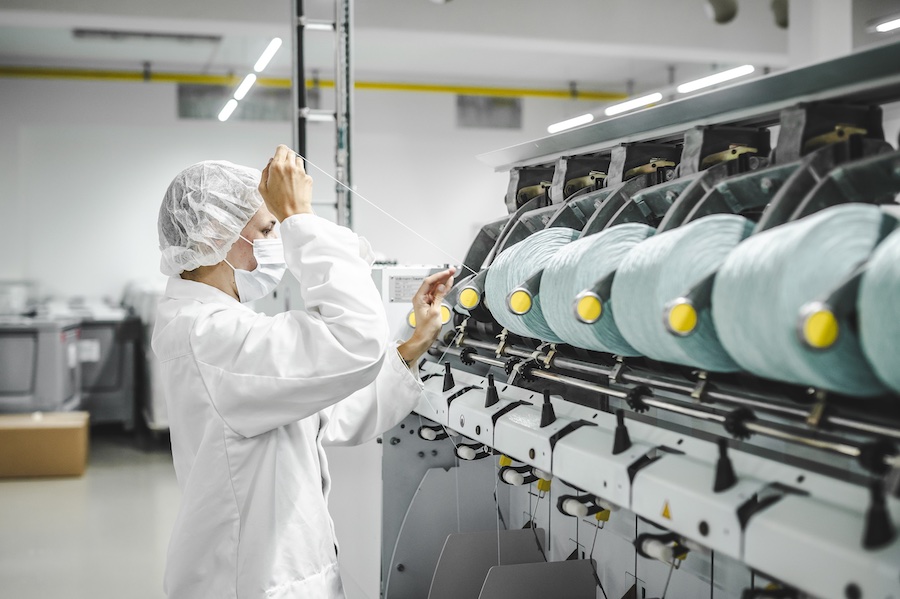
Under strictly controlled conditions, yarns for hygiene products are produced in Gebr. Otto’s hygiene area. © 2026 Gebr. Otto
At this year’s Techtextil, Gebr. Otto places its versatility at the center of its presentation. In addition to spinning, twisting and dyeing – traditionally focused on fine cotton – textile processors will also find a competent development partner for technical specialty solutions. The Dietenheim-based spinning mill has now built up a decade of experience in the production of technical yarns, particularly from aramids. A new hygiene segment has also been established, where yarns for medical and hygiene products are currently being produced. In the future, this department could also develop textile products for the food sector. Gebr. Otto will once again be present at the BW-i joint stand, booth D81, hall 12.1. What is wound onto the spool is determined by the customer: Gebr. Otto develops according to specific customer requirements and transforms its own ideas into yarn innovations.

A future rooted in tradition

“The name Gebr. Otto has stood for fine cotton products since 1901,” says Andreas Merkel, Managing Director of Gebr. Otto. The company will celebrate its 125th anniversary in July this year.

Alongside cotton yarns and threads, the company has continuously expanded its product portfolio. Today, a key focus lies on technical yarns, particularly those made from aramids and other flame-retardant fibers.

Processing these fibers is highly demanding. Their extremely high tensile strength combined with low elasticity requires very precise spinning processes, as even minor irregularities in the drafting system can lead to fiber breakage. In addition, aramid fibers are stiff and exhibit lower fiber-to-fiber friction, making specific process adjustments necessary to achieve the desired yarn strength.

“We operate within a very narrow process window when working with aramids,” explains Oliver Kächler, long-standing plant manager and authorized signatory at Gebr. Otto. These yarns are used, for example, in flame-retardant underwear for firefighters.

Room to spin ideas into innovation

Gebr. Otto has been operating its technical spinning mill in Balzheim for almost ten years. Its development illustrates the company’s ability to adapt and evolve: in the mid-1990s, Spinning Mill I (built in 1958) was shut down, and cotton yarn production was relocated to the newly built, modern Spinning Mill II.

The freed-up space continued to serve as a place for innovation: products such as absorbent kapok pads, tampons with kapok cores and cotton swabs were developed there, although without lasting market success. Nevertheless, the experience gained proved valuable. In 2004, Gebr. Otto became the first spinning mill to successfully process kapok fibers in combination with cotton into a yarn.

Another forward-looking development is recot2, a cotton yarn consisting of 25% recycled process waste and 75% virgin cotton. The company developed its own spinning process for this yarn, which was launched in 2008. “We were perhaps a bit ahead of our time,” says Andreas Merkel with a smile. “Circular economy has only become truly relevant in recent years.”

Initial trials with aramid fibers began in the 2000s. The company’s broad material expertise enabled the “Otto Engineering Team” to achieve strong results early on – and gave Spinning Mill I its current purpose.

“We are never satisfied with the status quo, but continuously search for new products, more sustainable solutions and new market segments,” Merkel adds.
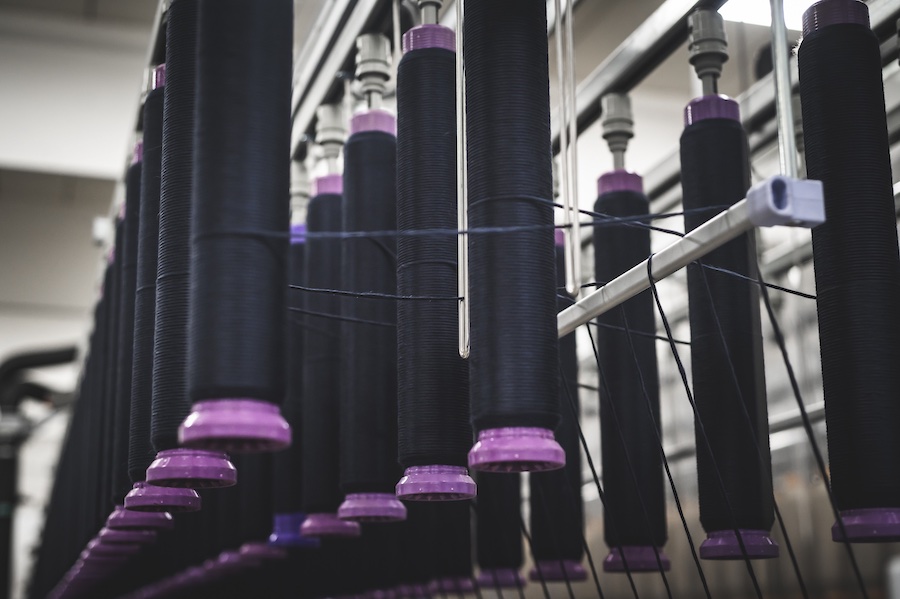
Aramid fibers place high demands on the spinning process: the combination of extremely high tensile strength and low elasticity requires maximum precision in processing. © 2026 Gebr. Otto


Hygiene segment: potential for medical and food applications

In line with its corporate philosophy, Gebr. Otto has operated its own hygiene area since early 2025. Under strictly controlled conditions, yarns for medical and hygiene applications are produced here. This includes dedicated pest monitoring, protective equipment for personnel and changing facilities with black/white separation. Access to the hygiene area is only possible via airlock systems.

“We are confident that this setup will allow us to address additional customers from the food and medical sectors in the future,” says Merkel.

Ongoing developments

One recently completed project is “Eco Yarn”, a collaboration with the Recycling Atelier Augsburg of the Institute of Textile Technology Augsburg (ITA), Augsburg University of Applied Sciences, and industry partners Schwob and Weseta.

The project team succeeded in breaking down used rental textiles into fibers, reprocessing them and spinning them into a new yarn blended with 70% virgin cotton.

Currently under development is the “Innocell” project in cooperation with the German Institutes of Textile and Fiber Research (DITF).
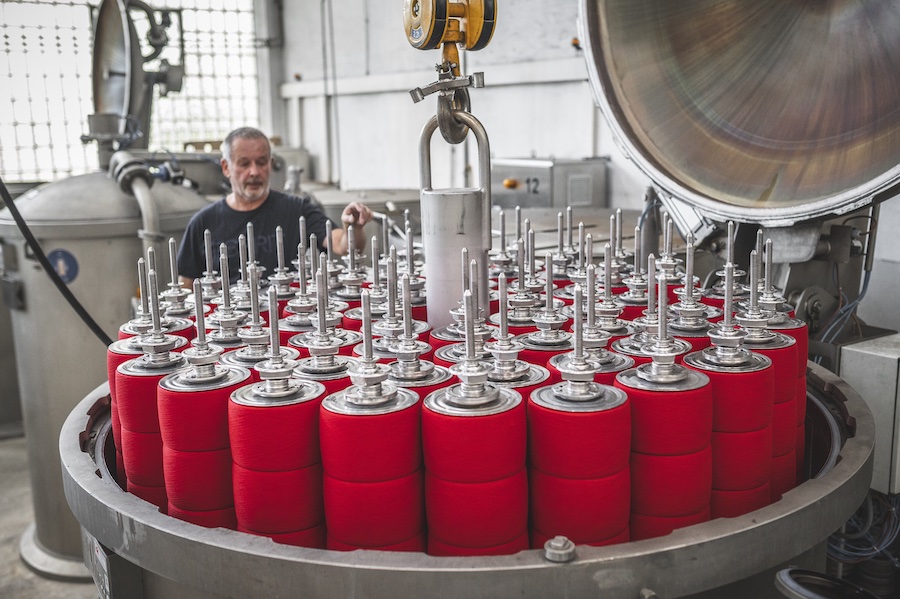
At its state-of-the-art dyeing facility, Gebr. Otto brings color to yarn – and to life. © 2026 Gebr. Otto


Cotton remains the core

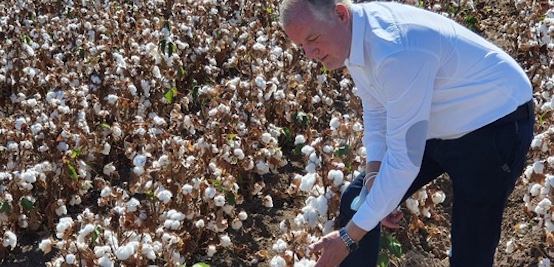
Alongside technical innovations, cotton remains central to Gebr. Otto’s business. Since spring 2025, the company has offered cotton yarns certified with the EUCOTTON label. The fibers originate from Greece and Spain and stand for short, transparent supply chains within Europe.

Another example of regional value creation is the “Lokalstoffmacher” project. “It is often assumed that regional products are automatically more expensive,” says Merkel. “However, when considering transport, duties, taxes and improved planning reliability, the price difference is often significantly reduced.” Project partners Edelweiss Jersey, Textilveredlung Keller and Gebr. Otto are considering expanding their cooperation beyond cotton yarns.

The company is also working on a yarn made from organic cotton and native hemp grown in Germany. The regionally cultivated winter hemp is processed by a project partner and then spun together with cotton or TENCEL. Hemp requires significantly less water than cotton and is therefore considered particularly resource-efficient. A special processing method enables the fibers to be prepared for spinning with cotton.

“We are looking forward to this year’s Techtextil – and to demonstrating our versatility to visitors,” concludes Merkel.
More News from Gebr. Otto Baumwollfeinzwirnerei GmbH + Co. KG

More News on Techtextil 2026

#Techtextil 2026

Precision, performance and progress: British textile machinery at Techtextil and Texprocess 2026

As global demand accelerates for lighter, stronger and more sustainable technical textiles, the machinery and testing technologies behind their manufacture are evolving at pace. At the Techtextil and Texprocess exhibitions in Frankfurt this April, eight members of the British Textile Machinery Association (BTMA) will demonstrate how advanced engineering continues to shape the performance, precision and resource efficiency of advanced fibre and fabric production.

#Techtextil 2026

STFI presents concepts for the textile circular economy and solutions for a healthy and safe life at Techtextil

Sächsisches Textilforschungsinstitut e.V. (STFI) has been supporting companies in developing marketable innovations for over 30 years. With a clear focus on sustainability, the environment, health and protection, the STFI offers future-oriented research, textile testing for tailor-made solutions and certification of per- sonal protective equipment. At Techtextil 2026, the institute will present ideas for the textile circular econ- omy and showcase solutions for healthy and safe living.

#Techtextil 2026

Cetex: Textile innovations “Made in Saxony” at Techtextil

This year, the Cetex Institut gGmbH is once again not only exhibiting but also organising a joint booth at Techtextil. Together with co-operation partners, textile innovations “Made in Saxony” will be presented on almost 85 m². The spectrum covers everything from textile machine construction and the manufacture of technical textiles to measuring and testing technology, with research and development also having its place.

Latest News

#Europe

Commission presents proposal for EU Inc. - unlocking the full potential of the Single Market for Europe's entrepreneurs

Today, the European Commission presented its proposal for EU Inc., a new single set of corporate rules, building the cornerstone and starting point for the EU's 28th regime. EU Inc. is an optional, digital-by-default European corporate framework. It will make it easier for businesses to start, operate and grow across the EU – incentivising them to stay in Europe, and encourage those who once looked elsewhere to return.

#Man-Made Fibers

OnceMore® from Södra brings end-to-end traceability for circular Man-made Cellulosic Fibers (MMCF) using TextileGenesis

OnceMore® from Södra, the world’s first large-scale process for recycling blended fabrics into high‐quality dissolving pulp, will begin using TextileGenesis, a Lectra company, to strengthen traceability from raw material to retail across the value chain. OnceMore® produces dissolving pulp made from blended textile waste and wood sourced from responsibly managed Swedish forests. By integrating TextileGenesis, OnceMore® supports the growing need for verified data and secure, transparent tracking throughout increasingly complex supply chain.

#Sustainability

Experts publish APAC policy priorities

Cascale today announced the publication of its APAC Policy Priorities Paper, developed by the Asia-Pacific (APAC) Policy Member Expert Team (MET) to identify key regional sustainability challenges and provide practical, aligned recommendations for policymakers and industry stakeholders across Asia-Pacific.

#Spinning

Temco launches a new DTY all-in-one solution

Temco introduces the DTY All-in-One Solution – a fully harmonized set of components engineered to give customers a highly stable, low maintenance and reproducible process environment. The solution reduces interruptions, extends component lifetimes and supports consistent yarn quality across all machine positions. All-in-One Solution – a fully harmonized set of components engineered to provide maintenance and reproducible process environment.

TOP