[pageLogInLogOut]

#Dyeing, Drying, Finishing

Wülfing gets much MORE from Monforts
© 2021 Monforts
For leading European textile manufacturers, adapting quickly to changing and highly uncertain market conditions has long been a necessity. The need for flexibility has only been intensified since the onset of the Covid-19 pandemic.

Family-owned German home textiles leader boosts production with a complete finishing line upgrade.

Monforts has been able to assist its customers all along the way through this difficult period, not least with its MORE – Monforts Original Replacement Equipment – programme.

The Monforts commitment to customer service is based on four principles – helpful, accurate, fast and reliable. The company has established a reputation for quickly and efficiently dispatching spares and components where they’re needed worldwide.

© 2021 Monforts
© 2021 Monforts


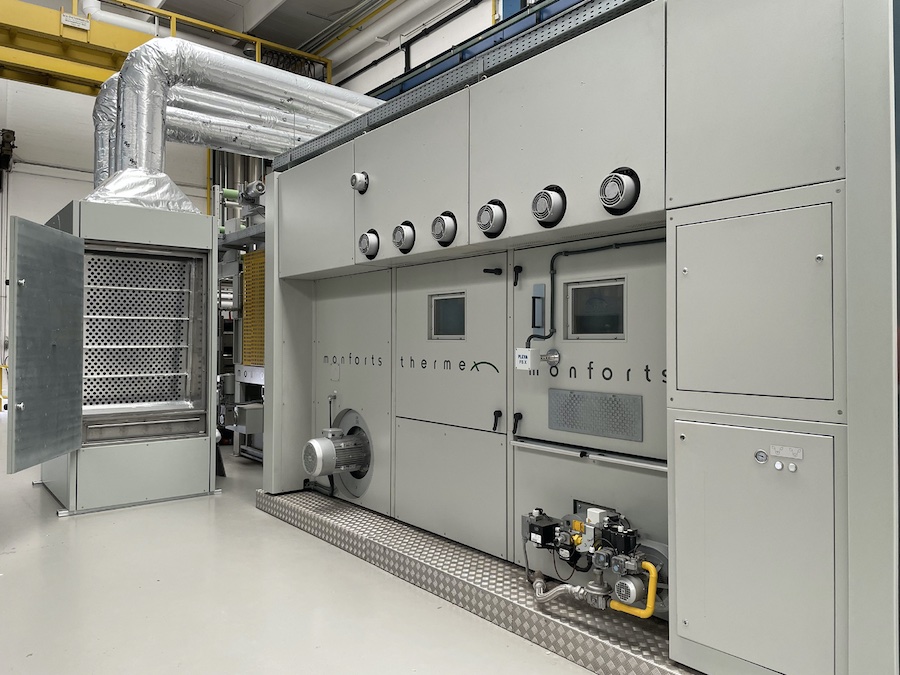
Monforts machines are known for their robustness and long service life, but major advances in digital technology mean that there are now significant gains to be made in the retrofitting of the latest automatic drives and control systems to machines, going far beyond the basic replacement of spare parts.

Home textiles leader

Wülfing GmbH, founded in 1885, is one of the oldest but also the most modern home textiles companies in Germany, with its main weaving and finishing operations located in Borken, North Rhine-Westphalia, and a further jacquard weaving mill in Steinfurt, as well as with a making up and packaging plant in the Czech Republic.

The family-owned company’s extensive home textiles portfolio – spearheaded by the well-known Dormisette brand of bed linen – is supplied both to a wide range of retailers, discounters and catalogues, as well as to airlines hotels, retirement homes and other public institutions.

In addition, Wülfing is also a specialist in African damask fabric weaving at the production site in Steinfurt.

All told, the company has over 500 employees and with 160 weaving machines in continuous operation has an annual capacity of 60 million square metres of cotton fabrics – roughly the area of 8,400 football pitches. In addition 200,000kg of high quality 95% cotton yarns are always in stock, with 15,000kg processed into fabrics on a daily basis.

“Our particular strength is in wide-width weaving and the development of customer-specific ranges,” says Gerd Schulte-Mesum, Wülfing’s Borken plant manager. “We have fully-integrated production in Germany on the most modern machines and flexibility is fundamental to our continued success. The fast-moving market demands ever-increasing innovation, service and the rapid implementation of new ideas.”


Fabric stability

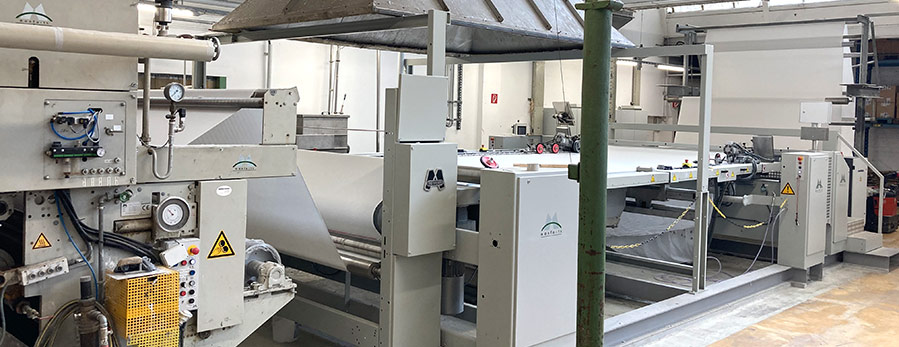
At its Borken plant, Wülfing has employed a Monforts sanforizing line since 2009 to guarantee the required dimensional stability and shrink-fastness of its high quality bed linen. With a working width of over three metres, the sanforizing process is a central pillar in the production of typical wide-width cotton fabrics for home textiles.

In 2017, the company was able to acquire a second Monforts sanforizing line from another company which, although built in 2005, had been virtually unused. It was overhauled and installed behind a Monforts equalizing frame of a similar age.

“Unfortunately, the two machines had to be operated separately via individual controls and did not represent an integrated unit,” says Schulte-Mesum. “This resulted in deficits in the desired productivity and in the control technology.”

Wülfing consulted with Monforts on a number of upgrade options and opted for a completely new joint control system to merge the two machines, as well as a new connecting inlet, a tensioning and damping field and a steaming unit.

“Monforts provided a fast and precise erection and commissioning of the technology in spite of the difficult pandemic circumstances,” says Schulte-Mesum. “The result has been an increase in production speeds by 20% and enhanced uniformity in fabric width through a much improved guidance system.

“We are also achieving energy savings as a result of the new control and drive technology and operation has been simplified and improved as a result of the unified control. We benefit from simplified access for maintenance work such as the grinding of the rubber blanket, but most of all we have greatly improved our flexibility and now have two almost identical Monforts sanforizing lines.”

“It’s been a pleasure to work with the team at Wülfing on this project, which demonstrates what is possible in the modification and upgrading of Monforts machines already in operation,” adds Thomas Päffgen, Monforts Area Sales Manager.




More News from TEXDATA International

#ITM 2026

ITM 2026: The new geography of textile production

New production hubs are emerging across North Africa and Central Asia, while Türkiye is accelerating its transformation toward higher-value, technology-driven and more sustainable textile manufacturing.

#Research & Development

“Production is a product”

From technical textiles and AI-driven robotics to the limitations of textile circularity: Professor Dr Thomas Gries looks back on more than two decades of development at ITA Aachen. In the interview, he explains why production technology remains a decisive success factor, discusses international collaborations and innovation ecosystems, and shares his views on the transformation of production landscapes and the challenges facing an increasingly regulated industry.

#Knitting & Hosiery

“We need to move away from the price trap and return to a value-driven mindset.”

With its new Textile Innovation Center, KARL MAYER is sending a strong signal for innovation, collaboration, and the future of textile applications. In this interview, Karl Josef Mayer discusses new opportunities in warp knitting, the processing of staple fibres, recycling, the changing role of machinery manufacturers, and why the textile industry must once again focus more strongly on the value of textiles. by Oliver Schmidt

#Associations

“Innovation, resilience and international experience remain the great strengths of the Swiss textile machinery industry”

Geopolitical uncertainty, growing competitive pressure from China, new free trade agreements and the shift towards a circular economy are currently reshaping the global textile industry. In this interview, Cornelia Buchwalder discusses the current mood within the Swiss textile machinery sector, the industry’s distinctive innovative strength, new market opportunities in India and Asia, and the technological trends that could shape the upcoming trade fair cycle leading up to ITMA 2027.

More News on Dyeing, Drying, Finishing

Latest News

#Nonwoven machines

A Penteadora starts up ANDRITZ textile recycling and needlepunch nonwoven lines in Portugal

A Penteadora SA has successfully started up a complete mechanical textile recycling line and a needlepunch nonwoven line supplied by ANDRITZ at its production site in Unhais da Serra, Portugal. This investment enables A Penteadora to expand its industrial capabilities and develop a new generation of solutions based on pre- and post-consumer recycled textiles. The input materials originate from its own production waste and other textile waste streams. Both lines are fully operational, and the first products are expected to reach the market in July.

#Recycling / Circular Economy

ReHubs elects new Board of Directors to lead the next phase of ReHubs’ strategy to recycle 2.7 million tonnes of textile waste annually by 2035

ReHubs has elected its new Board of Directors, marking an important milestone as the industry alliance continues to accelerate the industrial scale-up of textile-to-textile recycling across Europe. The election took place during the ReHubs Annual Event in Brussels on June 23rd, held alongside the Textile Recycling Expo and Future Fabrics Expo. The newly elected Board combines expertise from across the textile value chain, reflecting ReHubs' collaborative approach to solving the industry’s textile waste crises.

#Recycling / Circular Economy

Reju opens its first R&D Center in the U.S. in Conshohocken, Pennsylvania

Reju, the company specializing in textile regeneration, today announced the opening of a Research and Development (R&D) Center in Conshohocken, Pennsylvania, the company's first proprietary research center in North America. Located within Technip Energies' existing Advanced Materials and Catalysts research center, the lab will allow Reju to accelerate the rollout of its recycling technologies and develop its next-generation circular solutions.

#Weaving

Itema reaffirms its commitment to the Syrian textile industry at NasTex 2026

From July 18th to 21st, Itema will exhibit at NasTex at the Damascus Fairground (Hall 11 – Stand C02), marking its return to one of the Middle East’s historically significant textile markets. Itema will showcase advanced weaving technology designed to support the competitiveness and technological evolution of Syrian manufacturers and announces a new partnership with Growfast Agency as the sole agent of Itema in Syria.

TOP