[pageLogInLogOut]

#Digital Printing

IDC Industrial Printer Tracker finds mixed results in the second quarter of 2021

New data from the International Data Corporation (IDC) Worldwide Quarterly Industrial Printer Tracker shows that worldwide shipments slowed slightly year over year in the second quarter of 2021 (2Q21).

"Overall large format and industrial printer shipments declined slightly – less than 3% – in the second quarter, largely due to the presence of the COVID-19 delta variant and ongoing supply chain issues," said Tim Greene, research director, Hardcopy Solutions at IDC. "While these factors slowed the recovery that we had seen for three consecutive quarters, some segments still showed excellent growth in Q2 2021."

Worldwide Industrial Segment Highlights for Q2 2021

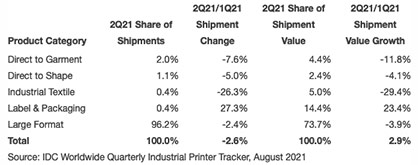
• Large format printer shipments were down 2.4% in 2Q21 compared to the first quarter but were still well above 90,000 units for the quarter on a worldwide basis.

• Direct-to-garment and direct-to-shape printer shipments declined by 7.6% and 5.0% respectively after a very strong first quarter.

• Label & Packaging printer shipments grew by more than 27% in the quarter.

• Industrial Textile printer shipments declined 26.3% in 2Q21 compared to 1Q21.

Regional Analysis

• Total shipments in North America grew 11.6% in 2Q21 compared to the previous quarter.

• Printer shipments in Europe, the Middle East, and Africa (EMEA) declined 8.5% compared to the first quarter. Within the region, slower shipments in Western Europe offset gains in the Central & Eastern European regions.

• Total shipments in Japan were down nearly 25% compared to 1Q21 as the country continues to deal with the coronavirus.

• Shipments in China showed modest sequential growth of 3% in 2Q21.


Worldwide Industrial Printer Shipments and Shipment Value Share and Sequential Growth, Q2 2021

Outlook for 2021

• Investments in new technology that can replace the production capacity of several older devices with greater levels of automation is one of the trends IDC is watching for the second half of 2021 and beyond.

• Despite clear indicators of demand for more digital print solutions, the lingering impact of the pandemic creates a lack of real visibility at either the regional or segment level. Nevertheless, IDC continues to expect the combination of greater demand for new technology, more automated solutions, and more sustainable operations to fuel investments through the end of 2021.




More News from TEXDATA International

#ITM 2026

ITM 2026: The new geography of textile production

New production hubs are emerging across North Africa and Central Asia, while Türkiye is accelerating its transformation toward higher-value, technology-driven and more sustainable textile manufacturing.

#Research & Development

“Production is a product”

From technical textiles and AI-driven robotics to the limitations of textile circularity: Professor Dr Thomas Gries looks back on more than two decades of development at ITA Aachen. In the interview, he explains why production technology remains a decisive success factor, discusses international collaborations and innovation ecosystems, and shares his views on the transformation of production landscapes and the challenges facing an increasingly regulated industry.

#Knitting & Hosiery

“We need to move away from the price trap and return to a value-driven mindset.”

With its new Textile Innovation Center, KARL MAYER is sending a strong signal for innovation, collaboration, and the future of textile applications. In this interview, Karl Josef Mayer discusses new opportunities in warp knitting, the processing of staple fibres, recycling, the changing role of machinery manufacturers, and why the textile industry must once again focus more strongly on the value of textiles. by Oliver Schmidt

#Associations

“Innovation, resilience and international experience remain the great strengths of the Swiss textile machinery industry”

Geopolitical uncertainty, growing competitive pressure from China, new free trade agreements and the shift towards a circular economy are currently reshaping the global textile industry. In this interview, Cornelia Buchwalder discusses the current mood within the Swiss textile machinery sector, the industry’s distinctive innovative strength, new market opportunities in India and Asia, and the technological trends that could shape the upcoming trade fair cycle leading up to ITMA 2027.

More News on Digital Printing

#Digital Printing

Where every detail counts: Experiential applications of DTF and UV-DTF printing

Personalisation has moved far beyond the traditional logo on a t-shirt. Today, brands want to create complete experiences, where every detail – from clothing and accessories to décor and packaging – feels distinctive and reflective of their identity.

#Dyeing, Drying, Finishing

EFI Reggiani and Danitech Group announce strategic multi-year agreement for Mezzera textile finishing machinery

Electronics For Imaging, Inc. (EFI), through its subsidiary EFI Reggiani (Reggiani Macchine S.p.A.), together with Danitech Engineering and Solutions Srl (Italy) and Suzhou Danitech Intelligent Technology Co. Ltd (China), announces a multi-year license and manufacturing agreement covering the Mezzera and Jaeggli textile finishing machinery portfolio.

#Digital Printing

USColorworks expands digital platform with Kornit Atlas MATRIX and Atlas MAX PLUS solutions

Kornit Digital Ltd. (NASDAQ: KRNT), a global pioneer in sustainable, on-demand digital fashion and textile production, today announced that USColorworks, a North Carolina-based apparel decoration and fulfillment company specializing in custom and on-demand printing for retail and promotional markets, has expanded its Kornit digital production platform with the addition of Atlas MATRIX and Atlas MAX PLUS systems to deliver high-quality, on-demand apparel across cotton, blended fabrics and polyester.

#Digital Printing

DTF vs DTG Printing - The technologies shaping today’s custom merchandise market

From sportswear to branded tote bags, custom merchandise continues to grow in popularity across sectors, driving print shops to cater to short runs, personalisation, and rapid turnaround. As print providers look to this market, two printing technologies often stand out: Direct‑to‑Film (DTF) and Direct‑to‑Garment (DTG). Each offers its own benefits, and understanding these differences helps determine the most suitable production method for print service providers.

Latest News

#Functional Fabrics

PERFORMANCE DAYS announces new focus topic & forums for October 2026

With its upcoming October 13–14, 2026 edition, PERFORMANCE DAYS is placing the spotlight on one of the textile industry’s most important transformations: “Bio-Based Materials – From Fiber to Fabric”, a two-part Focus Topic exploring the future of bio-based innovation across the textile value chain. Part 1, presented in October 2026, will focus on fibers and next-generation material developments, while Part 2 at the March 2027 edition will shift the perspective toward dyeing, finishing, additives, and processing technologies.

#Nonwoven machines

MENANG rapidly resumes production with new ANDRITZ airlay line after major fire

MENANG, a Malaysian manufacturer of nonwoven automotive components, has resumed production after a major fire severely damaged its airlay line in mid-March 2026. A new airlay line supplied by ANDRITZ enabled production to restart within only four months.

#Exhibitions & Events

Febratex 2026 to be the largest edition of the leading textile trade fair in the Americas with 10 exhibition halls

Febratex 2026 will be the largest edition in the history of the leading textile trade fair in the Americas. Dedicated to the textile and apparel manufacturing industries, the event will take place from August 18–21, 2026, in Blumenau, Santa Catarina, Brazil, with a strong focus on technology, sustainability, and business generation.

#Raw Materials

Cotton Brazil Dialogues field trip brings international stakeholders closer to Brazil’s cotton production chain

How do you build trust across the global textile value chain? By opening the farm gates. This is the principle behind the Cotton Brazil Dialogues. At the end of July, the programme welcomed its first group of international participants for a five-day immersion into Brazilian cotton production, combining field visits with technical workshops to showcase the quality, sustainability, innovation and traceability behind one of the world’s leading cotton origins.

TOP