[pageLogInLogOut]

#Associations

A unique product created with Swedish innovation
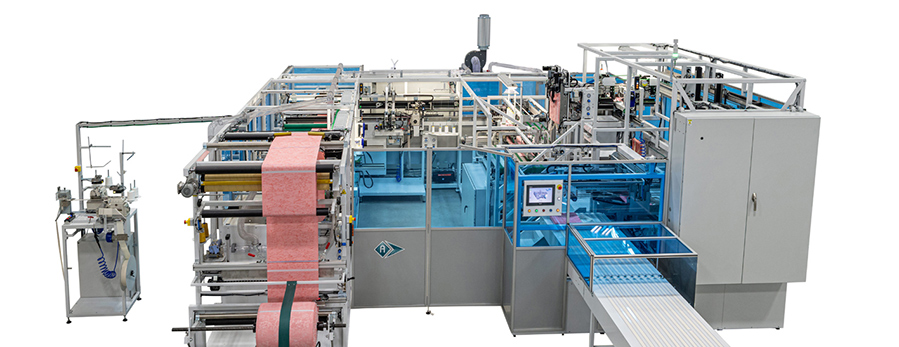
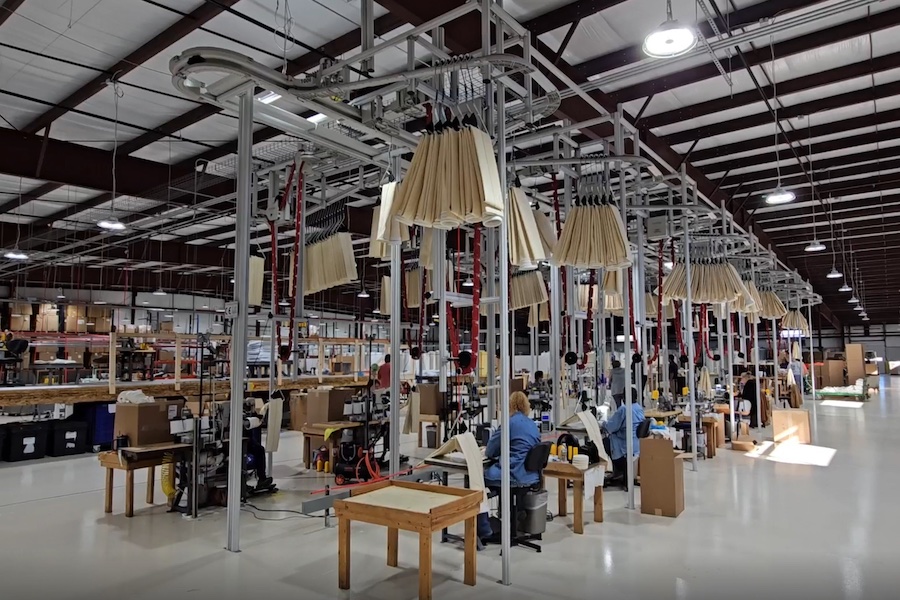
The Automatex automatic tote/consumer bag machine. © 2023 TMAS
Digitalisation and highly automated new technologies are enabling companies in high wage countries to competitively thrive in textile markets that for many years have been closed to them.

Just as significantly, these technologies are providing the tools to differentiate in highly competitive fields, as is demonstrated by a recent project initiated by TMAS – the Swedish Textile Machinery Association – for the highly automated production and decoration of a unique tote bag.
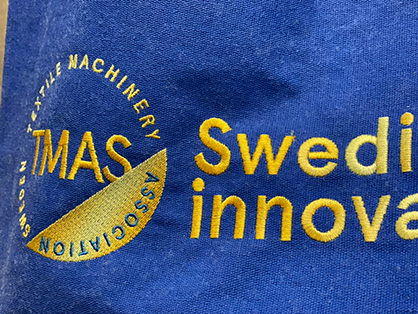
Coloreel technology makes it possible to produce gradients in embroidery designs. © 2023 TMAS


Plastic reduction

Back in 2015, the European Parliament reinforced legislation to encourage an 80% reduction in the use of conventional single-use plastic carrier bags by 2025.

The initiative immediately had broad public support, effectively encouraging a basic and widespread change in consumer behaviour. As a result, the consumption of disposable plastic bags has fallen significantly, along with a corresponding reduction in the waste they create.

There has also been a swing towards durable woven shopping bags which in the past have been labour-intensive to produce cheaply, as a result of the cutting and sewing involved.

Thanks to Swedish innovation, this is no longer the case.

Fully automatic

TMAS member Automatex has developed a fully automatic tote/consumer bag sewing unit which can produce fully finished bags in heights of between 35-80cm and widths of 30-80cm. The machine is configured to carry out all the necessary automated operations including hemming, handle insertion, cutting, labelling, bag forming and gusset forming, which previously had to be carried out manually. 
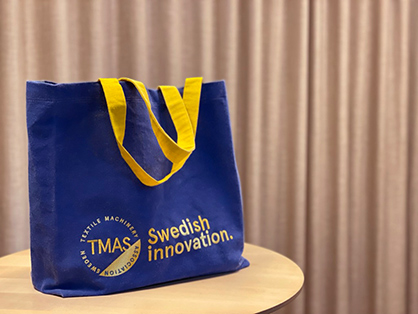
The Automatex unit carries out all operations including hemming, handle insertion, cutting, labelling, bag forming and gusset forming automatically. © 2023 TMAS


Its output is some 540 units an hour, introducing a completely new cost paradigm.

The resulting bags, however, are still plain and uniform at this point, and with products that are intended to be used for as long as possible, personalisation is the key. Unique designs work to ensure purchasers are likely to become more attached to their products – and are happy to pay a little more for them in the first place.

Instant colouration

In order to add decorative appeal, another TMAS member company, Coloreel, became involved in the project.

Coloreel continues to secure multiple orders for its instant thread dyeing technology for high-speed decoration and embroidery – notably with the fast-rising new generation of online merchandisers and brands for whom mass customisation and produce-on-demand sales are the key. The addition of a distinctive embroidered design to the tote bag using Coloreel’s technology took the product to a new level of attractiveness, as a further showcase for Swedish innovation.
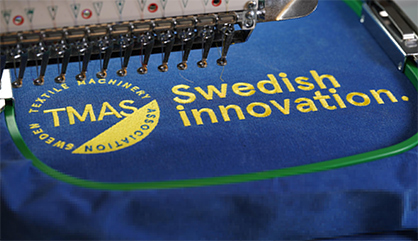
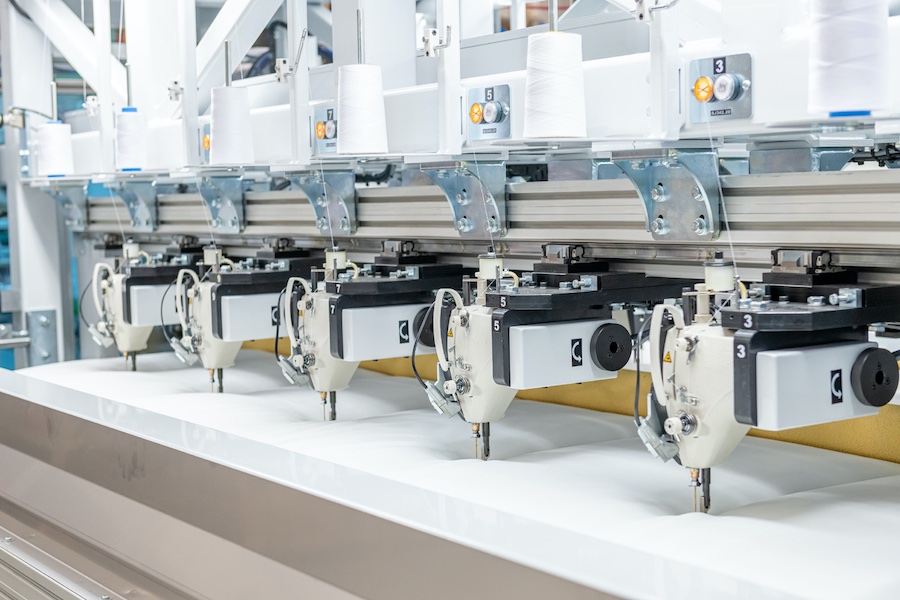
Coloreel’s rapid colour formulation software and high-speed drive technology allow a single needle to carry out what it previously required many multiples of them to do. © 2023 TMAS


The technology enables the high-quality and instant dyeing of a textile thread while it is actually being used in embroidery production. It can be used with any existing embroidery machine without modifications. Additionally, this technology makes it possible to produce gradients in an embroidery design, as demonstrated by the TMAS logo and the text in the image.

Advanced rapid colour formulation software and high-speed drive technology allow a single needle to carry out what it previously required many multiples of them to do – and with much more consistent stitch quality.

By instantly dyeing a recycled white thread during production, the system enables complete freedom to create unique decorations and embroideries without any limitations. Colour changes along the thread can either be made rapidly from one solid colour to another, or gradually, to make smooth transitions or any colouring effect desired.

This provides big benefits when it comes to both sustainability and design creativity.

Potential of Swedish innovation

“Coloreel’s designs on the batch of bags produced on the Automatex machine are truly outstanding and have been turning heads wherever they appear,” says TMAS secretary general Therese Premler-Andersson. “The collaboration really emphasizes the positive potential of the latest Swedish digital textile technologies which are enabling companies to generate new revenue streams wherever they happen to be located.”
More News from Textile Machinery Association of Sweden

More News on Associations

#Associations

Joint Statement: Urgent clarification needed on scope of Textiles EPR for PPE and Medical Devices

EDANA, the voice of nonwovens, alongside fellow industry associations CIRFS (European Man-Made Fibres Association), EURATEX (The European Apparel and Textile Confederation), ESF (European Safety Federation), and EuroCommerce (Retail & Wholesale), has issued a joint statement raising critical concerns regarding the transposition of Directive (EU) 2025/1892, the targeted revision of the Waste Framework Directive.

#Associations

Young researchers recognised for cutting-edge work in recycling, fibre technology and textile mechanics

At the Aachen-Dresden-Denkendorf International Textile Conference held in Aachen at the end of November, Peter D. Dornier, Chairman of the Walter Reiners Foundation of the VDMA, honoured five successful young engineers. Promotion and sustainability prizes were awarded in the categories bachelor/project theses and diploma/master theses. Academic theses that develop solutions for resource-saving products and technologies, for example, are eligible for the sustainability awards.

#Europe

Level playing field at stake: Europe’s textile industry demands decisive action

Yesterday, the European Parliament took a welcomed and necessary step by voting a resolution calling for stronger market surveillance, reinforced customs controls and faster enforcement of the Digital Services Act in case of infringements. For Europe’s textile and clothing manufacturers, this is the first political acknowledgement that the system is broken — and that enforcement must finally match the scale of the problem.

#Natural Fibers

Better Cotton Initiative partners with Uzbek government agency to offset certification costs

The Better Cotton Initiative (BCI) has today announced a strategic agreement with Uzbekistan’s Light Industry Agency to increase financial support for cotton farming clusters adopting sustainable agricultural practices.

Latest News

#Spinning

First PA66 spinning plant with EvoQuench successfully commissioned

With the successful commissioning of a multi-digit PA66 spinning line for microfiber yarns, Chinese textile company Shandong Nanshan Fashion Technology Co., Ltd. has added yarn production to its textile value chain.

#Knitting & Hosiery

SHIMA SEIKI returns to ShanghaiTex

Leading flat knitting solutions provider SHIMA SEIKI MFG., LTD. of Wakayama, Japan, together with its Hong Kong and Chinese market subsidiary SHIMA SEIKI (HONG KONG) LTD., will exhibit at the ShanghaiTex 2025 exhibition (Booth No.: Hall N3, Booth A20) held in Shanghai, China this month. This marks the return of SHIMA SEIKI to ShanghaiTex after a 14-year hiatus, its last exhibit at the show having been in 2011.

#Research & Development

Fraunhofer CCPE presents the “Monomaterial Design Set” – Innovative solutions for circular product design

Composite materials made from different types of plastic often extend the lifetime of products but make recycling more difficult in the circular economy. That is why Fraunhofer CCPE has developed the “Monomaterial Design Set”. This new approach helps to reduce the variety of plastics used in durable products and offers circular solutions for designers and product developers.

#Man-Made Fibers

arena introduces renewable LYCRA® EcoMade fiber in its latest swimwear collection

Italian swimwear specialist arena has unveiled a new collection that brings sustainability and performance even closer together. Launched on December 4, the line features swimsuits made from recycled nylon and renewable LYCRA® EcoMade fiber — the first time the bio-based spandex has been used commercially in swimwear.

TOP